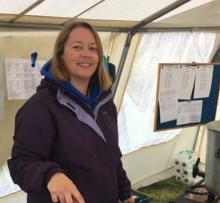
00.32 - Were you raised in Davidson Mains?
I was not, no.
00.38 - Where were you born?
I was born in Inverness, and I grew up in a village called Lochinvar on the west coast near the top, a very small community; it’s a fishing village; it has lots of mountains round about. My primary school had 64 people in the whole school, 3 teachers in the whole school, but it was really special. Our school was built on an old promontory in the middle of a loch, surrounded by water, hills, lots of nature. Saw lots of amazing things when I was a kid, quite different to Davidson Mains.
01.17 - Can you describe the community where you grew up?
Yeah, it was a really small village, about 300 people, something like that and we didn’t have Scouts when my brother was little - there were Cubs. There was a primary school, 64 people in my whole school, 11 in my year. So quite different to Davidson’s Mains huge primary school.
01.48 - Were there any important moments from your primary school life?
I used to be a Brownie and a Guide because at that point, there was only Cubs in the village I grew up in, and I really enjoyed that, but I was quite a reserved child, and I didn’t do a lot of outdoor stuff. I really regret that, though I certainly do appreciate growing up in the north highlands. Lots of wildlife, lots of places you could go that were really special, and I appreciate that more now that I live in cities.
02.38 - Can you tell me about your family, your parents, your siblings?
Yeah, I have a brother, he’s 3 years younger than me and like all little brothers, and I know I shouldn’t say this, but little brothers are very annoying. Yeah, I grew up with my Mum and Dad and my sibling and dogs, lots of dogs.
03.02 - Were any of your family members involved with the Guides?
My Mum was a Guider in Lochinvar, but there were only three Guides when she was a Guider, and I was a Brownie and a Guide for a little while, and my brother was a Cub, but they never developed the Cubs through into Scouts; they were just Cubs because there weren’t enough people to run it. So, a little bit, but not as much as here, it’s a big, vibrant group here.
03.35 - How did you first become involved with this group?
When my eldest son, Alexander, was 5, I knew that I wanted him to be doing more outdoorsy things. He’d always loved going to visit his Granny and Grandad up north, and I knew that I wanted him to be involved in Scouting because even though I only was a Brownie for a short while, I really enjoyed it, and I think it’s really important to be part of a community. So, I put his name down for the Beavers, and he got a place when he was 6 and when his brother came along two years later, they were short of leaders, and it was unlikely that he was going to get a place because they were going to have to shut. So, I started as a parent volunteer and within a month, I was an Assistant Leader and a month after that, I was the Section Leader, and then I was there for 10 years.
04.33 - What were your first impressions of the Scouts here?
I saw how much my son loved it and how much he was getting experiences that most people living in cities don’t get. I think it’s really important to get out of the city sometimes, but also to see your community and to be part of helping to do things and to make really close friends that aren’t always just the same people that you go to school with, so yeah, I could see that it was really good right from the start.
05.08 - Did the Scout group when you were growing up have any traditions, like camp or anything like that?
When I was a Brownie, we didn’t do proper camps under canvas; Guides did, but Brownies didn’t, so we went to outdoor centres, and I really enjoyed that. We would sleep on camp beds and in sleeping bags in big halls and we had to get involved in all the food prep, we had a cleaning routine that we had to do, apart from that, we played games, we were outside a lot, we did camp fires and singsongs, a lot of the things that Scouts do, and in our sleeping bags we’d do things like caterpillar racing where you had to run in your sleeping bag, things like that. I have really good memories of that. When we were Guides, there weren’t enough of us really to go on a camp, but I do remember when my Mum was a Guider, and I was a Brownie, and my brother was very small, she did a guide camp under canvas with the guides and another guide group and I went along on that as just a child of a leader. That was quite fun too and that was the first time I had ever seen a campsite without a toilet, so we had to dig a big hole to do the toilet in and that was not so fun.
06.48 - Have the Brownies changed since you were a child?
I think so, they’re not as formal as they used to, we had to wear horrible little brown dresses that we had to wear and they never fitted nicely and they were very uncomfortable and they had to wear hats and I know that the Brownies now just wear sweatshirts, a lot like the Cubs and I think that’s much more practical and sensible, so yeah, lots of changes.
7.16 - Can you recall any Scout movement campaigns?
Well, I certainly know that I’ve been involved in the recruitment for Davidsons Mains Scouts but yeah, I love trying to actively show the things we can do and try to get people involved. Lots of recruitment campaigns, but in terms of sort of general campaigns, I know that a big thing is that it’s for everybody, and that’s been quite a big push. When I was involved in it as a Scout Leader, was that it was fun for everybody.
8.14 - How do you feel about the media portrayal?
I think that we are unfairly judged sometimes. I think there’s a lot of pressure on Scouts to be very, very, highly held against society generally. I think that Teachers sometimes get a slightly easier media portrayal even really than Scout Leaders as we’re volunteers, and that’s really unfair, but on the other hand we have a very responsible job for a volunteer role. Looking after you guys is really important and making sure that you have everything you need and that you’re safe and happy, that’s what we all want, and that’s why we do it. Sometimes the media portrayal is fair. In every walk of life there are bad apples but we are very lucky here, we have lots of really active decent people who want you guys to have a great time. Yeah, we’re very lucky.
9.20 What did you do after the Scouts, did you go to university, did you get a job?
I went to university, I studied Archaeology, so again very outdoors. I am really interested in education, so I studied Archaeology with Education with the intention of being involved in museums and education and trying to make them more accessible to people, because when I was growing up, museums were very much cases of things that you didn’t touch and that you weren’t really involved with, they had labels on that you had to read if you wanted to know about it, and I thought it could be a lot more interesting than that. So, I’ve always been interested in trying to make things interesting and accessible for people. I never did work in that.
When I came out of university I worked in P.R. I ran P.R. for quite a few big companies, I lived in Ireland for a while, then I had my children, had some time out for them, I ran a cake business, I was the lollipop lady along the Main Street and now I’m a Childminder because I enjoy working with young people and trying to help them, support them, and see them grow.
10.44 - What do you think the impact of the Davidson Mains Scouts is in this area?
Oh, it’s huge, it’s really huge. I think there’s an immediate impact on all of you, all of the young people, so you have somewhere you can go, a group of people that aren’t exactly the same as in your class at school, interesting things to do that you might not get a chance to do otherwise, really good supports through the Duke of Edinburgh Award and things like that, but then there’s a wider impact. You’re able to see what you can do in your community, from being able to do little bits of gardening outside, or fixing things on the Main Street, or helping support the gala, or any of those things.
The community really appreciates that because then they feel more bonded because they have active groups happening in their village, and I think it makes for better relationships for you all at school because you’re not just stuck in your class. I think that you have people of different age groups that you get on with and even if you don’t actively know those people, you know of them because they’re in your Scout group. So, if something happened, you might not feel too worried about that person because you know them from Scouts, so maybe you’d go and say to them, ‘Hey, could you help this? I need a hand with something.’ I think we do make a difference, we do a lot of fundraising, we do a lot of exciting things, we support lots of different people, and we are a big part of the community. It’s also very good for the leaders too. I really enjoyed being a leader.
12.35 - Can you sum up what you think the most important thing is about the Scouts?
I think that it gives you access to things you wouldn’t otherwise and it introduces you to people you might not have otherwise met and in a world where people are becoming more and more defensive against each other and horrible to each other there’s such a lack of kindness that having a great relationship with each other is really important and I think Scouts gives us that.
13.13 - Do you ever attend any camps in the Brownies?
Not so much when I was in the Brownies, but as a Leader, I ran about 19 camps. 14 of those were monthly camps run back-to-back, so 14 months straight through winter, summer, spring and autumn, because a thing called the Zodiac Award, which is a Scottish scouting award where you have to camp in the lowest level once a season, highest level once a month.
We did it once a month and people could come or not come. We did everything from sleeping at the secret bunker, which was amazing and playing wide games at St Andrews, where all the Leaders were dressed up in fancy dress. Fraser was dressed as a hippie, and I can’t even remember what I was wearing, but I can remember what other people were wearing. There was a Smurf, a builder, people thought we were crazy, but it was a great fun game. I can remember camps where it was very cold and wet, we were all huddling inside trying to keep warm, doing wood whittling and things like that, trying to teach people knife skills. I can remember sitting up at an alley on a spring evening on one of our very first camps and all the kids had gone to bed and we were just sitting watching stars over Edinburgh, listening to the noise of the bypass down below us, it was just amazing. There are so many special memories really over those 19 or so camps, I can’t even tell you how many people had a chance to enjoy experiences like that, that they’ve never done before and it is as big an experience for the Leaders as it is for the kids, we had a great time.
15.16 - Was there any one camp that was particularly special to you?
Yeah. I did a lot of stuff with Fraser Dunmore, who I’m sure you know, because he’s involved in everything, but my thing was Christmas camps, so his thing was coming up with ideas for all the other camps and I would help them happen, but I was quite often involved in the catering for those camps and making sure that practically they kept going, first aid and things like that, but the Christmas camps are really my thing and we started having them at Canty Bay and it started off quite small but by quite small, I cooked, the Canty Bay kitchen is quite small, and I cooked on my own, a roast chicken Christmas dinner with all the trimmings and dessert for 45 people and that was very memorable, and we had crackers and we had crafts and we had games outside, you had to carry the presents and run along the beach, like a relay, passing them backwards and forwards, you had to turn people into human Christmas trees and we had bonfires on the beach. Lots and lots of really good memories.
16.34 - That’s all my questions. Is there anything else you’d like to add
No, I think that was really good, it was really interesting.
16.43 - Thank you very much for sharing your memories.