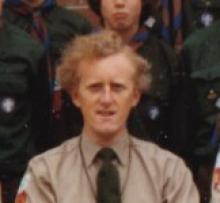
0.00 - The Interviewer welcomes the Respondent to the project and begins by asking about where he was born and raised, to which he said he was born and grew up in Edinburgh, but worked in Scotland, England and abroad. He was then asked how he was involved with the 30th Craigalmond Scout Group and the years that this took place.
“I started in 1975; I started as an Assistant Scout Leader, became a Scout Leader and then in 1981 I had to go abroad and left the Scouts then.”
1.04 - The Respondent was asked if he could recall what it was like on a typical Scout night and the types of things that the Troop did.
“Yes. I should say, my contact with this Scouts was, I went to a cheese and wine evening and then Ken Thomson and Peter Harndon, who were the Scout Leader and Assistant Scout Leader, I had been in the Scouts with Peter twenty-five years previously, and they said why don’t you come along sometime and see a modern Scout Troop, so I said ‘yeah well ok’, and about a month later I went along to my first night and I put in my diary, ‘they were an unruly mob’, So that’s how I got started.
Interviewer: And at the time, was there just one Scout night running?
Respondent: Yes – the Fridays.”
1.56 - He was asked how these nights were typically run.
“Yes, we always started with flag break and Inspection, which was quite rigorous in those days, then we had some games, we had badge work – that filled in the evening, and then flag down in the evening and a prayer. And there was a tuck shop after the meeting, which was kept in one of the patrol boxes that used to line the hall, and then the older boys, the patrol leaders usually, could stay on and play football with the leaders. It was the highlight of the night for the leaders.”
2.41 - The conversation moves on to discuss ceremonies and traditions that took place within the Scout Troop.
“There was the usual flag break and flag down at the end of the evening. We had coming-up ceremonies when the Cubs joined us and investiture ceremonies, and we had church parades and the Gala Day and things like that.”
3.09 - The conversation goes on to talk a little more about what takes place at a ‘coming- up’ ceremony.
“Well, the Cubs they came up from our Cub pack. They were introduced to the Troop by name, and they made the Scout promise again when they came up the Cubs said ‘hello’ to the Scouts, and the Scouts said ‘hello’ to the new Cubs, and then they were allocated to the patrols and joined those on that occasion.”
3.41 - The Respondent was asked about the investiture ceremony, to which he explained that it was along the same lines as the coming-up ceremony. The Interviewer then asks what he recalls about the Scout uniform.
“The 30th were very particular about their uniforms. They were one of the last troops to be wearing uniform Scout trousers, because by then a lot of troops had gone over to wearing, well, just dark trousers or anything but we were pretty insistent on keeping them. In fact, we had a bank that people could come along and see if there was a pair of trousers that fitted them when they came along.
Interviewer: Can I ask what was different about Scout trousers?
Respondent: Well, they were the uniform… I don't know what colour you call it… browny colour. When we met with other groups, they were a motley bunch as far as we were concerned. We were properly dressed, as were the leaders, and the leaders all wore ties, whereas in lots of groups the leaders wore the same neckerchief as the boys.
Interviewer: So, these were official Scout ties?
Respondent: Yes, a dark green tie.
Interviewer: And specific to the 30th?
Respondent: No, no, it was the Scout Association leader’s tie. Sounds a bit boring, but that’s what we all had.”
5.12 - The Interviewer asked whether members wore hats at the time.
He replied that they did not, although he believed that shortly before he joined, some Scouts had worn berets, and a few still wore the traditional wide-brimmed Scout hat, similar to the one he himself had worn as a Scout.
When asked about equipment expected alongside the uniform, he explained that each Scout was required to carry a notebook, a pencil, and their membership card.
Occasionally, during inspections, which were quite competitive, as they counted toward the monthly patrol competition, Scouts could be randomly checked to ensure they were carrying these items. He was then asked to talk more about the inspections.
“There were points for inspection, and for some games, some competitive games, also for badge work, yes. Interviewer: And how would the groups be divided at this time? Respondent: Patrols.”
6.18 - The Respondent goes on to explain that the patrols were all named after birds, although he couldn’t remember all the different names. He was then asked what he remembered about his fellow leaders.
“When I got my first warrant, I was 19/20 maybe, I was an assistant Scoutmaster, but when I got my work with the 30th, I was an assistant Scout Leader, so the system had changed. Do I remember anything? Well, there was just Ken Thompson and Peter Harnden and five young lads, well, they were young to me, they were 20 years younger than me, who had just come up from the Scouts and were now helping out. David was one of them, who's here today.
Interviewer: Do you think as a Scout the leaders had changed since your time? Was it more relaxed, or was it just as formal? Or do you think there was much change to the way that leaders were treated by the Scouts?
Respondent: Well, it's funny that because not long after I joined, my wife and I were out walking in Davidson's Mains, and a boy came up and said ‘Hello, Jim’, and my wife says, ‘Who is that?’ I said that's one of the Scouts. ‘He's not calling you Jim, is he?’ Because she'd been a Cub leader, and she was like I was, you know, I was much more formal then but no, the boys knew us by our Christian names.”
8.14 - The conversation then moved on to badges. He explained that Scouts often worked toward them during meetings, though he could not recall any specific ones at this time. He was then asked how the evening programmes were planned and whether the Scouts themselves had any involvement in the process.
“At the beginning of the session or before the beginning of the session, the leaders had a meeting and laid out a plan for the year as to what we were going to do and which badges we were going to do and if we had any particular themes for the year, and that was done before the meetings started in September or late August.”
9.27 - The conversation moved on to talk about community events that the Scouts took part in, and in particular, the Gala parade.
“We were in the Gala, we always took part in the Gala procession through the town and then had a stall or a presence at the Gala, in fact, I brought some photos of a monkey bridge that we built. The public paid to go over it, and I think, according to my diary, 200 people. I would dread to think what Health and Safety would say about it nowadays.
Interviewer: Was the Gala at this point in the park?
Respondent: In the park, yes.
Interviewer: You’d talked about Church parades. Was the group linked to a particular Church within the Community?
Respondent: Not really, no, but we used, no, that’s not the right term, we went to Davidson’s Mains Parish Church just up the road. In fact, sometimes I think we borrowed tables from them and things like that. So yes, that’s where we went, usually on Armistice Day, we had a formal service with flags, as people used to do.
Interviewer: And did that take place within the Church?
Respondent: Yes.”
10.31 - The Interviewer asked if he remembered when the Scouts began attending the Memorial Service in Davidson’s Mains.
He explained that this tradition did not take place during his time but was introduced much later. The conversation then turned to memorable trips away and outdoor activities that took place while he was a leader.
“Well, we had some good camps which were enjoyed by everyone – I was just saying to David, when we came in today, that I’d found a list of a weekend camp at Fordell Firs, and I think about 40 turned out for that, which was quite a lot of boys in those days. And then we had our week camps at various venues, probably the best one, or the one the boys will remember, was Lochearnhead, where we camped at the end of the loch, and there was a couple of guys in a speedboat practising for parascending in the south of France. They were training for that, and they came ashore, and we offered them some lunch, and we chatted, and they said, ‘Would the boys like a run?’
So they all got a turn on the speedboat out on the loch, and then at the end, the leaders got a high-speed run in them. As far as I recall, there were no lifejackets, no thought of safety or whatever, we just got on with it. What it would be like now – goodness knows!”
12.33 - The Interview asks a little more about Scout camps and enquires what his favourite camp out of those he attended.
“Well, I think that’s a memorable one for the boys. Yes, the camps all went pretty well, I think people enjoyed themselves. We had a few injuries, nothing serious – sunburn was the worst of them – in Scotland, yes [laughs].
Yes, we tended to go for building big pioneering projects and at one time all the pioneering poles, which were longer than… well, they were 20ft or so, were stored on the roof of the hall here, so every time we were going to camp, they had to be brought down and transported somehow. One year we went by a corporation bus, single decker and the poles were up the middle of the aisle, and you’ve no idea how difficult it is to get a long 20ft pole through the doorway of a single decker bus, but anyway the boys were all sitting with their rucksacks on their knees and so yes we had some interesting times.”
13.54 - The conversation turned to the transport used to get to camp. He explained that buses were not always available; at times, they used borrowed school buses or even furniture vans, and he eventually sat the test to be able to drive a minibus himself. Sometimes people travelled by car, but more often the leaders went along with the Scouts, usually around 20 to 30 boys, and they always travelled together.
He was then asked if he remembered any of the ceremonies or traditions that took place at camp.
“We tended to have as many campfires as we could fit in, sing songs. People were awarded woodcraft names, not but I think it was three summer camps, and you got a woodcraft name – some people liked them, some didn’t. Ken was Eagle and…well, the boys will tell you what they were.
And we did individual patrol cooking, which was kind of foreign to me because in my troop, each patrol took a turn of cooking for the week or for a day. But the 30th had a tradition of individual, so all the food had to be arranged and handed out to each patrol, and every patrol survived on their own cooking.
Interviewer: And they did that independently?
Respondent: Yes.
Interviewer: Cooked and did the meals?
Respondent: They did, yes. So they’d been given a menu at the beginning and were told what they were going to cook and that they had to get on with it, so I think it was quite a good experience for them as most of them were used to their mum just putting it down on a plate – so if you didn’t cook properly – you starved, that was it.”
16.10 - The Respondent was asked about camp activities.
“The camp was busy, there was always things going on, apart from just after lunch – there was a period when they had a break, and they had to stay in their tents – lying down and no running around, so that was official that you stayed there. But there were all sorts of games, and there was a competition that you ran for the whole week, and the winners got a carving or something at the end. Games, hikes – older boys went away on their hike overnight, or two nights, yes, we set up games, tennikoits or bumble ball, all sorts of things.
Interviewer: And did you do wide games?
Respondent: Oh yes, we had wide games! At Lochearnhead, we were having a wide game, flag raiding, and it didn’t seem to be going too well, and I had a wander round, quite a long way away and found a group of boys chatting over the fence with a group of girls, who happened to be walking past, so that kind of put paid to the wide game! Yes, yes, we did all these sorts of things. Pioneering was a big thing; we were quite keen on building big things and we had, what do you call it, with a pulley going down… what’s its proper name… I think they are practically banned now, and you’re not allowed to have them as they are a danger to health, but we had one every year!”
17.55 - The Respondent is asked about campfires, whether they were popular and what kind of things they did around them.
He mentions that they did lots of singing and would have cups of cocoa, which were made by the leaders.
The conversation then returns to the Gala, and he is asked what was involved for the Scouts in taking part in the Gala Day parade.
“We met in the same place that they meet now, marched, walked through the village, round Vivian Terrace, past the school, along Main Street and Quality Street and up to the park. At that time, there used to be a travelling fair came to the park as well.
Interviewer: At the same time?
Respondent: Oh yes, yes, well, I think it was an opportunity for them to make some money from it. It was Davidson’s Mains and Cramond - so there used to be a football match between Davidson’s Mains and Cramond Schools. So yeah, that was about it. It was mainly Davidson’s Mains; there were no Cramond Scouts involved.”
19.48 - He was asked whether the Troop had much contact with other Scout Groups in the District.
He explained that this was mostly limited to District competitions such as rugby matches and swimming galas, which were usually held annually. He recalled that by 1980 the Troop had split into two, with him leading the Friday night Scouts and Peter Harden running the Monday night Scouts.
That year, the Friday Troop won both the District Flag and the Area Flag—the first time in 15 years, which was cause for great celebration. They did not progress beyond the National competition but were proud to place 6th out of 14. He was then asked whether there was much competition between the Monday and Friday night Scout Troops, to which he said they deliberately tried not to create competition between the two.
The conversation moved on to whether the Respondent could recall any community activities the Scouts would have been involved in, such as litter picks or Bob-a-Job.
“Bob-a-Job, I'm not sure if it was still going when… I don't know when Bob-a-Job finished, I remember Bob-a-Job, but I can't remember our Scouts when I was there doing anything about it. I gave somebody a leaflet, or maybe I’ve got it…No, I think I gave it to somebody about tuning a Radio.
Interviewer: Yes, in the 70s.
Respondent: Yes.
Interviewer: The frequency was changed. Could you tell me a little bit about that project?
Respondent: Yes, well, there was an advert in the paper asking for assistance in helping, particularly old people, to rearrange their channels on their radios. So, I wrote in, and we were sent packs. We advertised that we were available to help. I think very few took it up, to be honest, but we took part in it anyway. People knew that the Scouts were there to help if necessary.
Interviewer: And they could go into someone's home and help them.
Respondent: Yes, that’s right, with their radios. I shudder to think what some of the Scouts would have been like doing it, but that's not the matter [laughs]”
22.36 - The Interviewer then asked about other community outings, such as the Gang Show. He recalled that while one or two boys had taken part, participation was limited during his time. He admitted he was never a great fan of the Gang Show, as it meant Scouts occasionally missed Troop nights.
He was next asked about Scout Jamborees or international camps, but he could not remember attending any during his time as a leader, although he did take part in such events later in his Scouting career.
The conversation then turned to awards, and he was asked whether any Scouts had achieved their Chief Scout Awards while he was there. He remembered that a few had earned their Queen’s Scout Award, including Kenny Deans and Ken Thomson.
He was then asked if there were any moments when he felt a real sense of accomplishment during his time with the 30th.
“Quite difficult to see because it's a sort of continuing process, it's not a eureka! this has been terrific today, it's a general thing. Yes, I felt I was doing some good, if you like to put it that way, and it was a worthwhile… even though I look back at my diary, because I've been keeping one since I was 21, and that's why I've got the dates of every Scout meeting and committee meeting and area meeting, I've got that. When I look back in my diary, I wonder how, at the age of 38, with three daughters and married, obviously, and trying to get our practice established in Edinburgh, how I ever had time to do the Scouts as well. But anyway, it was really good, and I enjoyed it. I enjoyed my time with the 30th.”
24.53 - He was then asked if he thought Scouting had a positive impact on those who attended.
“Oh yes, Oh yes, definitely. It’s amazing how many people you meet, not necessarily from the 30th, but who say they were in the Scouts and remember it. Well, they think it did them some good. It was, yeah, a well worthwhile organisation to be in.”
25.18 - The Interviewer asked whether he was still in touch with any members of the Group. He replied that he wasn’t really. He explained that he retired from Scouting at 65 and, since then, had little involvement apart from serving on a committee with Ken and Alison Thomson that selected senior leaders in the Region.
He added that he had been surprised to learn that the Group now included Squirrels. He was then asked for his thoughts on the current Scouting movement and whether his daughters had ever been involved.
He explained that they had been Guides but had wanted to be Scouts. He admitted feeling awkward returning from camp and telling them about all the activities he had been part of, knowing they did not have the same opportunities in Guiding.
He recalled one occasion when he took his youngest daughter, then about eight or nine years old, with him in his caravanette to the first and last weekends of a summer camp. That, he said, was the closest any of his children came to experiencing Scouting.
When asked whether his daughters would have joined if girls had been allowed in Scouts at the time, he believed they would have.
“Well, to be honest, things are so different when I was Assistant Commissioner for Scouts for Edinburgh, that's when the Guides, that's when the girls joined, and I was a bit apprehensive about it at the time, I have to confess, and I still am because boys are different and they get up to different things to girls and they tend to show off a bit of their girls around as well, that's the other thing that happened. And the rules and regulations are much stricter now than they were than we were carrying out things. Some of the things we put up too - it would horrify people now.”
27.58 - He was then asked if he had any final thoughts or memories about his time with the group that he would like to share, to which he said that it was a good time even all though many of the leaders were much younger the leadership worked well together and when he took over the position of Scout Leader from Ken Thomson, it seemed to continue fairly smoothly until he left to work abroad in Egypt.
The Respondent was then thanked for his time and for contributing to the Project.