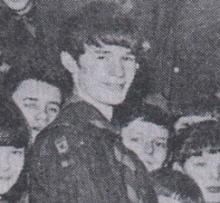
0.00 - The Interviewer welcomed the Respondent to the interview and began by asking where they were born and grew up, to which they stated that they were born and raised in the Silverknowes area of Edinburgh and moved out to Livingston after they were married.
He was then asked about his involvement with the Scout Group and the years he was active.
“Started in the Cubs and worked my way through and then ended up in Venture Scouts and helped a wee bit towards the end as a Venture Scout helping the Scouts.
Interviewer: OK, so you're almost like a young leader.
Respondent: Yeah. I was ‘help’”
1.26 - The Interviewer asked if he recalled any of the leaders when he was a Cub, to which he said there was a Kenneth, but couldn’t remember his surname. He was then asked what he remembered about a typical Scout evening.
“Well, we’d normally meet up, have our Inspection, we’d go and do an activity, be it in Davison’s Mains Park or Corstorphine Woods, and it was good fun – just youngsters get together and enjoying themselves in different parks. I was in the Curlews, I remember that.
Interviewer: You know what year that would be?
Respondent: It must be late '60s, maybe about ’67, round about that.
Interviewer: So ’67, you joined Cubs; you’d be three years at Cubs, then three years of Scouts?
Respondent: Something like that.
Interviewer: So, into the early 70s? Respondent: Yeah. I mean, I was in them when they were at the old Scout Hall, and then this one was built when I was still in the Scouts, so I think Cubs, I’d be in the old one and then when in Scouts we moved in here.”
3.05 - The conversation then continues about the old Scout Hall and what he recalls about it.
“It was up beside the Catholic Church, I don’t know if there’s still a chip shop there – there used to be a chip shop on the corner, and we were right across the road, and I think there was a Fine Fare, or supermarket, was the building next to us. But no, that was the old…quite an old building.
Interviewer: Do you remember much about the building?
Respondent: Yup. I remember it was the Scout Leaders who had an office down the stairs, and then the Pack leaders had a wee room upstairs – that was just a wee room.
Interviewer: Like an attic?
Respondent: It was part of an attic.
Interviewer: And did the Cubs get to use that space?
Respondent: No, they were always downstairs, it was just if you were a pack leader, the leaders met upstairs so they could have their chats.”
4.02 - The Interviewer went on to ask whether, at that time, both Cubs and Scouts were using the hall, to which he confirmed that they were.
He was then asked if he recalled much about the construction of the new Scout Hall. He explained that he didn’t remember the building process itself, but did recall attending as a Scout once it was completed. Compared to the old hall, he remembered it as a brand-new, very modern facility.
He went on to say that the Cubs and Scouts moved into the new building at the same time. During his time there, he believed it was used exclusively by the Troop, as he didn’t think it was hired out to other groups.
The conversation then shifted back to his memories of what the old hall had physically looked like.
“I would describe it as more like an old stone cottage-type building. Yes, we were upstairs, but there wasn’t a proper upstairs, so it was all on a level, and you went in the door, and I remember the, I don’t know if it was a kitchen and an office on the left-hand side and then a hall on the right-hand side as you went in. It was quite an old stone-built building. Interviewer: Was it quite cold? Respondent: Oh, I think it probably would be – when you’re young, you never notice the cold, but no, it was certainly a very old building.”
5.51 - The Respondent was then asked about his recollections of going on outings during his time in the Group.
He explained that they often went to Davidson’s Mains Park or Corstorphine Woods, where they practised craft skills and played games.
When asked if he could recall any specific games, he said he couldn’t remember the names but remembered that they were usually ball games or hide-and-seek-style activities. He also noted that, on occasion, time in the woods was linked to working towards badges.
The conversation then moved on to Scout Camps.
“Then, of course, we had Scout camp, which was always good to go to. I remember going to Lochearnhead at one point – I think that was when I had started secondary school, and by that time I had started canoeing, and I got canoes from the school to take to this. But I mean, you wouldn’t be allowed to do it nowadays – they were all piled in the back of a removal truck with everything else in the truck – tents and everything [laughs] and we were sitting in the back of this removal lorry! Totally unacceptable now.”
7.32 - The Interviewer returns the conversation to Scout evenings and asks about Inspections and what they were like.
“You’d have your uniforms all nicely done, neckerchiefs done – presentable. You were inspected for the way you were dressed, and I don’t know if we got points for it or something, but we were always trying to be well done and turned out. The hats – the old Scout hat – I remember getting the iron and a sort of damp cloth, and you would iron it to make sure the rim was nice and flat.”
8.28 - The Respondent goes on to talk about the point system in the Scouts, and he explains that he was at one point a patrol leader and wanted his patrol to get the most points, so he recalls encouraging the other members of the group to be smart for Inspection to ensure they got the points. He was then asked if he remembered any other traditions or ceremonies.
“I remember each pack had its own flag. I don’t know where we got the poles from, it wasn’t like a broom handle, it was a proper pole – straight piece of wood with the Curlew flag – white flag with the curlew’s head in it. And then when we went to camp, I remember the boxes each patrol – I’m saying group, it was patrol – and we had a box, and I remember painting it, and I decided to paint it fancy, different colours. And we kept all our stuff for the patrol in that box when you went to camp. I remember that. Interviewer: Were the boxes kept here? Respondent: They were kept at the Scout Hall, yes, but no, each patrol had its own box.”
10.00 - The Interviewer asked if he could recall any other patrol names, but he could not. He was then asked about the badges he had worked toward, and he remembered First Aid, Woodcraft, and Map Reading. He added that even today, he is still a good map reader, a skill he attributes to his time as a Scout.
He went on to discuss undertaking night hikes in the Pentland Hills and noted that his interest in walking, which continued into adulthood, began during his time in the Troop.
He also mentioned that his interest in kayaking and mountaineering also started then, and now he is the chairman of a local mountaineering club. The conversation then returned to his experiences with kayaking in Scouts.
“I remember in the beginning the Scouts actually had an old wooden framed kayak with the canvas, I don’t think it was canvas, but a kind of material, rubbery type of material, and I remember going down to Cramond to paddle that, and that was my first ever time in a canoe down at Cramond.”
11.52 - The Interviewer asked if there were many water sports at Scouts, to which he responded that these types of activities would take place at Cramond, unless they were part of Scout camp. He explained that at camp, Scouts were taught kayaking and canoeing by the leaders, who, in his view, probably did not have any official qualifications at that time.
The conversation then returned to night hikes. He recalled that these occurred about two or three times a year, usually in the Pentlands. The hikes involved the entire Group, though not all Scouts attended. He also remembered Sausage Sizzles, which usually took place in Corstorphine Woods.
When asked about Scout leaders, he could not recall any names. He was then asked whether he attended Scout nights with friends or siblings, and he remembered another boy from his street, who was also in his class at school, attending. When asked if many in the group were his classmates, he explained that initially, in Cubs, most were boys from Davidson’s Mains Primary School, and many continued to Scouts and then Venture Scouts.
He was asked if he had any favourite games at Scouts. He said he enjoyed hide-and-seek-type games.
Finally, he was asked whether the evening was divided into set activities, and he explained that most of the night would be some sort of games, which would include a learning-type game.
He was asked if the Scouts would still go outside for activities during the winter months, to which he explained they would still go outside for activities unless the weather was bad.
The conversation moves on to ask if he recalled any community-based activities.
“You know about Bob-a-Job Week – going round people trying to get wee jobs to do – washing cars, weeding their garden or anything like that, we could go and get a wee job to do off of somebody, neighbours, friends. Interviewer: And how did you do it? Did you go door-to-door, or were you on your own? Respondent: Probably in my street. I’d be on my own, I don’t remember doing it with somebody else, but just round neighbours or if I was at my Grampas and it was Bob-a-Job Week, I’d do something there because he was a farmer and you’d get something to do on the farm – probably mucking something out [laughs]”
17.15 - The Interviewer asked if he thought the community enjoyed Bob-a-Job Week. He said that he believed they did and liked seeing the Scouts out and about. He added that, as a Scout, you had the opportunity to engage with people outside the Group, and he thought it was a shame the scheme was no longer run. He felt it should be reinstated, as it would benefit current Scouts.
He then discussed how Health and Safety regulations have changed the nature of young people’s activities. He explained that some of the pupils at his school were involved in the Cairngorm disaster of 1971, in which several students lost their lives.
Following that event, the school greatly restricted the types of activities its pupils could participate in.
While he acknowledged the need for safety, he felt that too many restrictions limited young people’s opportunities for experiences.
Returning to Bob-a-Job, he was asked whether the scheme raised much money for the Group. He believed it did, recalling doing many jobs and having his card filled up. He also noted that there was a competitive element among Scouts regarding completing jobs. When asked if he remembered any other community activities, the conversation continued.
“We did Jumble Sales. I do remember doing Jumble Sales in the Hall.
Interviewer: And did you have to collect the jumble, sort it out, man the stalls.
Respondent: I think we helped sort stuff out and did stuff with the stalls, I don’t remember actually going to physically pick it up. I take it the Scout Leaders would pick it up from people, or people would drop it off.”
20.06 - The Interviewer asked if he recalled being involved in any shows as a Scout. He did not think the Scouts ever participated in any shows, but mentioned that he attended the Gang Show at the King’s Theatre.
The conversation then turned to the annual Gala Parade. His memory of this was not as a Scout, but as a page boy in the ‘Royal Court’ with his Primary School. He recalled that the parade started at the Green and proceeded to the park, where the Gala Day took place. He remembered the fairground rides and described it as quite an occasion, but he had no recollection of participating in it as a Scout.
The conversation then returned to Scout Camp, and he spoke further about his experiences at Lochearnhead.
“I remember going up a big mountain there, I don’t know what it was at the time, it could have been Ben Vorlich, maybe, I don’t know, but Strathfillan I think, was one I may have went to...But no it was good fun, you had your patrol tent, and we cooked on proper fires, not gas stoves or anything that we probably use nowadays – it was back to basics – making bread on a stone from the fire. Scout camps were always a good education.”
22.48 - The Interviewer asked how long camps usually lasted. He thought they were typically a week, with one summer camp held each year that attracted a good number of Scouts.
He explained that Scouts slept in tents with their patrol and were responsible for their own fire and cooking. Patrol members were assigned different roles, with the least popular being washing the dishes. However, he remembered quickly learning that pans could be cleaned effectively with lumps of earth. Each morning, there was an Inspection, during which Scouts had to roll up the sides of their tents and lay out their personal items and equipment neatly.
He remarked that camps were an excellent learning experience, teaching self-sufficiency in the outdoors. He recalled making bread by placing dough on a flat stone that had been heated in the fire. Although he admitted to burning a few meals, he fondly remembered the cocoa made by leaders each evening to enjoy around the communal campfire. These gatherings, which usually took place most nights, included singing songs such as Ging-Gang-Gooli and listening to stories.
Other activities he remembered included orienteering and a Parents’ Day at the weekend, when families could visit Scouts at camp.
When the conversation turned to the weather, he remarked that as a child, it never bothered you—you simply got on with things.
The Interviewer then asked whether he had undertaken any Chief Scout Awards. He was unsure, but did recall completing his Duke of Edinburgh Award through the Scouts, which he spoke about in more detail.
“I remember I ended up going for my voluntary service – I went to the hospital and worked with the porters, so went round with the porters delivering meals, and occasionally we would have to go round and pick up a deceased, not that we did much with it, you would go with the trolley, and it was covered on the trolley, so anyway you worked with the porters and they were very good.
Interviewer: That was at the hospital?
Respondent: Yeah, the Western General.”
27.46 - He goes on to talk more about what he had to do for his Duke of Edinburgh Award and talks about doing an expedition which took place out at Dalkeith, where they walked to Penicuik. He recalled the night they camped, being particularly cold, that frost could be scraped off the inside of the tent.
The Interviewer then asks the Respondent if he can recall a time in Scouts, where he felt a particular sense of achievement, which he recalled one evening, that took place in the Scout Hall. On that evening, they had to make paper aeroplanes and see how far they could fly them, and he won that competition. He achieved this by going last, and when it was his turn, he scrunched the paper into a ball and threw it, and it hit the furthest away wall, and thus he won. He explained that he had made a plane, which he then scrunched into a ball, and so did not break any rules.
He was asked if he recalled any other nights in the hall, to which he couldn’t remember any details, but did recall when he was in the old hall the boys would go up to Davidson’s Mains Primary school when the evening was finished to see the Guides who were there and then go to the chip shop.
He was then asked that when he completed Scouts what made his move up to the Venture Scouts, now known as Explorers.
“I enjoyed it. I just enjoyed doing what we did, you know, it was good fun, and I just wanted to keep going, didn’t want to leave. It’s like school, I didn’t want to leave school, not because I enjoyed school, but because I did canoeing and climbing, and I stayed on till sixth year. I left in sixth year with no more than I had in fifth year, but I had a great time in sixth year. We went on an expedition to France – kayaking, so I enjoyed myself.”
30.23 - The Respondent was then asked about his experience as a Young Leader with the Group. He said that he quite enjoyed passing on skills such as map reading and compass work to the younger Scouts. To this day, he still enjoys sharing these skills with anyone interested, as he remains a keen hill walker and kayaker.
Once again, he reflected that Scouting had given him a grounding in many of the skills he still uses.
He was then asked about his thoughts on the current Scouting Movement and whether his own children had been involved. He explained that they had not, as they were busy with many other activities and did not recall there being a Scout Group in the area where his children grew up, but said that if there had been, he would have encouraged them to join, remarking: “I think it’s well worth going to, you pick up a lot of life skills.”
When asked what he knew about Scouting today, he said he was aware that girls are now able to join. He assumed many of the traditional activities were still part of the programme, alongside more modern ones.
Finally, he was asked if he had any last thoughts or memories he would like to share.
“No, just that I thoroughly enjoyed it, it was a great experience being in the Scouts, and I think it’s a shame if people don’t get that opportunity nowadays. There’s so much you can learn from it, just life skills in general, it’s a shame if they don’t get to do that, it should be encouraged.”
33.57 - The conversation continued briefly about the current Scout Group, and then the Respondent was thanked for sharing his stories and for taking part in the Project.