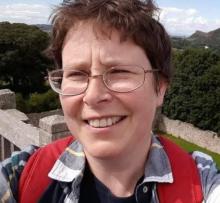
0.00 - The Respondent is introduced and thanked for attending the Interview. She is asked where he was born and where she grew up, to which they respond that they were born in 1969 in Perth and grew up in Dumfries.
0.34 - The Respondent is asked what brought them to Edinburgh and how they came to be involved with the 30th Craigalmond Scout Group.
“Right, okay, so I studied here; unfortunately, I’m a lifelong sufferer of M.E., chronic fatigue syndrome, whatever you want to call it. So, I was back in Dumfries for a long time, ended up back in Edinburgh, and then that was when I met Eddie, my now-deceased husband. And that was through orienteering. I had been orienteering in the early days. And we got married and had the children, and where the story starts, it's actually a really good story.
So, we were at the D’Main's Gala Day, when the kids are really wee, and the Scouts, the 30th, had a climbing wall, I think. And they were saying, ‘Oh, do you want to volunteer, do you want to help?’ And, of course, I just get chatting to people, and the kids were having a go on the climbing wall and stuff like that, and they said, ‘Oh, we're going to be having a new Beaver colony.’
So, I think they already had one; they were going to have another. So, I put the girls' names down because they were always, like, give it a go kind of girls. And my older son, Patrick, I've spoken to him before about Scouts; he was like, ' Nope, nope, nope, nope, nope.’ Yeah [laughs] I don't know why, but he was not interested. And then we just completely forgot about it, and then we actually got a visit from somebody, a really lovely lady, I can't remember her name, who actually came to the door. And she said, ‘You know, you put your name down - the girls put their names down for Beavers a long time ago, and we're starting this new Beaver colony.’ And there was one other girl that was in it, and they wanted to kind of get another girl or girls, I think. So, the girls are just like. ‘Oh, yeah.’ Like I say, they were always up for everything. So, they then started going to Beavers, and the other girl, Millie, was smashing. They got on really well, and I remember the first night; it was so, so funny. They were in for the first night, and they came out, and they were like, ‘Oh, we're going to be doing this, we're gonna be doing this, we're gonna be doing this!’ And one of the things that they said was ‘weaselling’, which I thought was so funny; I thought, weaselling, what's weaselling? Going between rocks or something?
And Patrick was in the car with me to pick them up. And he heard how enthusiastic they were, that he was just ‘Right, like. I'm going to join Scouts.’ And it was so good because he had been so reluctant to do it, you know, so he was then able to go straight into Scouts.
And at that time, there were quite low numbers, so he went, and I remember I was quite anxious because we were at Ferry Hill Primary School, so we weren't the D’Mains crowd, so we didn’t know people. And I remember he went in the first night, and he didn't know anybody, and yet he was fine. And it was, like, the best thing he's ever, ever done.”
03.47 - The Interviewer then asked what year this took place, to which the Respondent believed it was around 2014 when her daughters joined Beavers and her son joined Scouts. The conversation then turns to her daughter’s first Beaver sleepover.
“So, I remember that the girls had their, it was a Beaver sleepover, and it was the hall here.
Interviewer: Was it just one beaver pack at this time?
Respondent: There was two… I think there was two because I think this was them starting up a second one. And the girls, like, had a separate tent in the hall, it was all about, you know. So, the boys were all around the girls; they’ll tell you more about it when you see them, hopefully. And Millie, who was the other one, they just hit it off, they got an absolutely great. And I remember my brother was over from Sweden at the time, and he and I were helping, and we were threading spaghetti into sausages, and it was Fraser Dunmore who had sort of planned that.”
0.42 - The Respondent goes on to talk a little more about Fraser.
“So that was kind of at the start of him, he must have been… I don't know what he was - a senior Pink Panther at the time, or something. Around the same time as Patrick started.
Interviewer: Into Scouts?
Respondent: Yes, yes. I remember we got this letter that came home. And it was like, we're going to be doing this new thing called the Zodiac Award, we're going to be camping every month, and if you want to join up, put in a fiver, it was so cheap a fiver! And Patrick was keen to do everything, and that was Fraser, and Fraser and Fiona Priestley.
So, it was kind of like Fraser was so motivated. I just feel we have been so, so fortunate to be in the Fraser era. I am so grateful to that guy. I could get emotional about it, I really could, like the way he's done, the way he's pushed things and made things happen. I mean, it's just amazing. The guy's amazing.”
05.40 - The Respondent is then asked if she has any Scouting experience.
“Yeah. My mum was a Queen’s Guide, and actually, interestingly enough, her whole family were in Scouting. Her dad, my grandpa, he's from Newcastle, and they were all in Scouting, he was born in 1899, and I've got his Wood Badge at home. And his brother ended up being really quite high up in Scouts, and they just, their family ethos was so much, I don’t know, like, kind of self-reliance. And, you know, when you think back about the philosophy about it, yeah, just really fascinating. It's actually fascinating in terms of kind of empire ethos, and - you know, when you think about, kind of, public school values, except for the working class, and they all went into shipbuilding, they were all in Newcastle, all went into shipbuilding and stuff like that.
He was a ship's draftsman and ended up in Dundee, working on submarines during World War II. Yeah, that's a whole other story [laughs]
Interviewer: So, you yourself then were a Guide?
Respondent: Well, I was, yeah, but it was really rubbish, I'm sorry to say. It was absolutely rubbish. And my brother's experience of Scouting and my experience of Guiding was really, really poor. Robert got bullied in Scouts; it's just so bad, and Guides, they just never did anything. We never did any camping, we never did anything, it was all… it was just really rotten, I'm sorry to say… I'm really sorry, it was absolutely awful, so when I had the kids, I was like, well, I'm not going anywhere near those.
Interviewer: Until you went to the Gala
Respondent: You know, yes, well, I have always said, like, it found us. Yeah, and another thing was that I mean, I'm quite a tomboy-type person, and I'm an outdoorsy person, so is Eddie. We knew each other through orienteering and stuff like that, so we're very much outdoor people, but I never forced the girls to follow in my tracks or anything like that.
I know there's another friend I've got who was really quite militant about trying to get her daughter into Black Hall Scouts when they had a zero-girls policy, even against, you know, against the rules for a bit. So, it was never a mission of mine to get the girls in on an equality basis at all. It's just what happened.”
08.27 - The Interviewer then asked at what point the Respondent became involved with the group.
“Well, I helped at the Beavers.
Interviewer: As an assistant leader.
Respondent: No, no, no, I was just a parent helper. I'm just trying to think. I think I… I got on the Fundraising Committee. I remember having really, not having much success [laughs], I'm sorry to say.
So recently, oh, I mean, this is wonderful news, somebody got money off the Edinburgh Airport Fund for the lighting, and I was just so happy because the number of times I've applied to that bloody airport funding! [laughs] Because, yeah, I applied for… so when the Scouts were going to the Irish Jamboree, the Jamboree in Ireland, but then that's not the kind of funding they gave, anyway, I was trying, I really did try.
Interviewer: You'd come in because someone had stepped away?
Respondent: No, well, I think it was just they were always looking for people, and I… Oh, I know, I came to a night … it was like they were looking for volunteers, and I came to a night. But I wasn't… the family were just too wee, and it was just all… and Eddie was ill, so he got dementia, sadly. And that was really difficult for us. It's just been really difficult, difficult story for our family; it's been quite, yeah, tricky.
I couldn't be a leader because I just couldn't commit. But I started on the fundraising, yeah.”
10.05 - The Respondent was asked about her role as a Fundraiser.
“Yeah, it's actually hard to remember. There was, like, a group of us, and we did meet occasionally.
And, yeah, and then you've got different things to do to work on, but I have to say, I never felt I was particularly effective. But at least it was in, I was helping, I was, you know, trying to help [laughs].”
10.31 - The Interviewer asked what the biggest challenges in fundraising were.
“Well, one of the things that I felt was tricky for this particular Scout group is that it's in a fairly affluent area, and at the time, I was working, I volunteered, and then I worked, for not very much money, as a sort of play leader/ storyteller in the North Edinburgh Arts Centre. I was aware that we, the North Edinburgh Arts Centre, were applying for funding and things like that, and that's an area of multiple deprivation.
You know, it's just a stone’s throw from here, it's so interesting, you know, it's such an interesting area. It is so mixed, because you've got, like, millionaires in Black Hall, just across there, and then you've got, you know, where I live. You're, like, 100 meters from a SIMD20 area. So, I did kind of feel like, well, we're always quite… it was always quite a wealthy group. So, I suppose that was something that I felt, I felt a wee bit torn about that, I suppose.”
11.46 - The conversation moves on to the difficulties faced by the family throughout the time of her husband’s dementia. Because of their financial stress, they did not think they would be able to continue with Scouting.
“I remember saying, actually, to Fiona Priestley, I don't think they're all going to be able to continue the Scouting because I just couldn't afford it for three kids, basically. And she was so amazing. She got us a grant from the Round Table, and I was able to buy, like, sleeping bags and things like that. I don't know if she ever knows how much I appreciated it.
And she then got us half price. Repeat half the cost of camps and half the cost of subs and everything.
Interviewer: So, do you feel the group was made accessible?
Respondent: Oh my god, absolutely. And I also… feel that it's a big thing that it's confidential, it was completely confidential. And I am incredibly grateful for that. And I don't think anybody else knows that we… that we did that.
And then there was other things I remember, Patrick was a really keen bag packer. Yeah, he absolutely loved it [laughs], it's crazy. I remember when we were fundraising, he was fundraising to go to the Jamboree in Ireland. And Fraser let him bag pack just for him, so he was on a till, like, the entire day. And all that money that he got in his box was going to go towards his trip.
No, I mean, that was really good. And then when Patrick was on that trip, which was so… so wonderful, so wonderful. And we actually sort of liaised with the leaders so that he could get a phone call to Eddie halfway through that trip. Because, you know, Eddie was really not that great, and we've got this lovely photo of Eddie standing with Patrick in the back garden. Patrick's in his kilt and everything, all ready to go, and there's Eddie and Patrick. And it's actually, so we've realised that it's 5 years since he died, so he died in the Covid pandemic, he was in a care home, you know? I mean, he was in a really bad way at that point.
So, I mean, I think Scouts has been with us through this whole thing. I mean, Eddie used to cycle to Scouts with Patrick, and even when we'd moved out, he'd help me out occasionally at night and things like that. He was a geography teacher, so it was all his kind of thing.”
14.37 - The Interviewer asked if she felt that having her children in Scouting helped them throughout that difficult time in their lives.
“Oh, absolutely, absolutely. I'm actually just remembering now; I mean, Dylan was a really… he was great. He was a great, I mean, he's a great guy. He knew Eddie, and we used to come to the [points to the hall]. Even when Eddie was quite, you know, obviously struggling, we came to the coffee mornings and things like that, and people would chat, you know, he was still included in everything.
Because even though we split up, you know, I was still trying to look after him and support him and everything like that. It was very difficult because our relationship had broken down. Dementia is just like a horrible thing. I could just go on and talk about that.
With my kids, what they've done in Scouting is, you know, when you just see them getting packed to go away. They can pack themselves now. I mean, obviously, they're grown-up, they're grown-ups, you know, but… they can pack, they can plan, they can get themselves somewhere, whether it's boggy, it's pouring with rain, no matter what it is, they can get themselves set up. And they're enjoying it, you know? They're enjoying it. They're not like, ugh, you know?
And they can do that anywhere, anytime. And I’m in the position you're probably in, the same position that your kids are applying for jobs now, and they're applying for uni.
And Rona had an interview in Aberdeen last week, and we were talking about, you know, what are your experiences of being in a team? What are your experiences when you've been challenged? What are your experiences of teamwork under pressure? My God. They have that. They have that. They could talk a blue streak about that. Things they've been through in Scouts! Multiple occasions! Like, because Rona ended up with the Jamboree, the one that was in Korea, so she and I were talking about this as something that she could talk about in terms of leadership and teamwork under pressure. When so many of the others were ill because of heat stroke and insect bites and things like that, and you know, and she and the others worked together to get water to the kids who weren’t well, to look after them, to get food… yeah, and under terrible, really tricky circumstances.”
17.04 - The conversation moves on to discuss how the Respondent returned to the 30th to become a Cub Leader during the COVID-19 pandemic.
“Yeah, during the pandemic, I started doing Cubs because I thought, right, this is the time that is right for me to, and they would look for somebody. So, my first experience of being a Cub leader was actually on Zoom calls, and I remember the nights of making a loaf of bread and stuff like that on Zoom. I mean, how did we ever do that?
Interviewer: A challenge. Could you talk a little bit about how that worked?
Respondent: Well, I suppose I was kind of; I was just coming in, so I didn't know things that well. I just remember that because I didn't know about Zoom, I didn't know anything, and the kids had to help me log in and everything. I just remember all the faces.
And I remember one of the things I think is one of the absolute best things about Scouts, I’ve probably said about many, many things, some of the best things, is the Young Leader Program. I just think that it's just the most amazing thing. So, my experience in Cubs was that there were these fantastic young leaders.
Who absolutely blossomed in that role, and you'd see them, you know, when we go back to face-to-face, just had such fun, you know. And they loved Scouts, and they enjoyed it, and they loved sharing it with the younger ones, and the younger ones loved loved having the older ones. And the older ones have been mucking about, you know, in the adults are sort of standing around being a bit embarrassed. The older ones are just, you know, playing with it.
And they were so good at running games and things, and Niamh she was one of the leaders, and I remember that she ran a night on Zoom, which was like problem-solving, or a treasure hunt or something, and it was so good! And you've got these kids who took on that technology, you know, understood the technology, and obviously, the pandemic was difficult for people, but they just coped with it. And I remember her doing something online, and she was demonstrating it with a pile of COVID test boxes or something. I was like [laughs] Oh, it's just not; I mean, you think back now, and you think, what was our life like?”
20.01 - The conversation then proceeds to discuss how the Respondent felt about being a Cub leader during that difficult time.
“I felt, I felt good about it; I mean, I felt good about myself, yeah. I did feel really proud of myself for doing it. That I was doing something, and I remember, oh, God, I just remember I was so anxious about doing it. I was so anxious about coming along on the evenings, and I would be like, ‘Why am I doing this?’
When then I came out of it, I just felt so good.
I think it was just so important to be kind of, like, seeing other people, and I just feel like my life was not in a great place in some respects, and, um, personally, how I felt about myself personally was not good. And, you know, for, like, a couple of hours or an hour or something like that, you're thinking about other things, you're thinking about other people, you're interacting with other people.
You feel valid, I guess, yeah. I'm a bit emotional saying it.”
21.00 - The conversation then proceeds to discuss the challenges of disciplining as a Cub Leader and the various styles employed by other leaders. Then, the Respondent discusses the training she undertook as a leader.
“Just the way the training is. The sort of philosophy of it, of the Scouting. So, again, I said about the experiential learning. So, when you look online, and you look at an activity that you're going to do. You've got the activity, it can be quite a simple activity, as knots or building a den or something like that, and then they've always got this boot at the end, reflection. And it's where you just take a minute or two to just chat to them about what do you think went well, what do you think went, but, you know, and you know, and I just think that's absolute gold! Gold! To have the kids doing things, and then this… just thinking about it.
And I felt like, as a Cub leader, I felt like the wee conversations that I had, we're sort of, like, when we were walking out the park or whatever, because we were in the park most of the time because of the COVID thing. And I felt like, just the wee conversations, like, that you'd have, like. I'm into birds and stuff, and so there's such and such bird, and you just felt like you were just dropping in tiny things. You never know when you're dropping in something that might be valuable. And we saw that, you know, there were bats, and we heard an owl, and, you know, it just felt like wee moments of reflection. You know, I see things like, oh, you know, last week we were here, and there weren’t any nettles, now look at the nettles, and you're just kind of getting them to just reflect a wee bit. I just think it's great, and I felt like I was contributing something.”
24.08 - The Respondent goes on to talk about her life at this point and the need to find work to support her family. She talks about participating in a Women’s Returner Program, a government scheme that helped build her confidence and develop the practical skills necessary for returning to the workplace.
As she searched for various jobs, a volunteer opportunity arose to work on the Scouts' Communication Team, to which she applied and was subsequently offered the position.
“And she started to train me to use Canva, and you know, I did a lot of stuff on you know, Microsoft 365 and stuff like that, doing things and creating social media content. And I'm particularly proud of this, a post I did for Facebook, which was Scout values, you know, we know what the Scout Promise and things like and the Law. The Values are really, really, really good, when you look at them, they're really good. A lot of us don't really know them, but they underpin everything that we do. Like, there's Integrity, Respect, and Belief is one.
So what I did was I got quotes from some of the Pink Panthers and some other people that Kirsty had been liaising with another explorer unit in the region. I had these quotes. And we've basically said to them, what does this mean to you? You know, in terms of Scouting. And what does this mean to you in terms of your life? So, leadership, or something like that. Okay, somebody said, like, our teamwork. One of them said, like, oh, being part of a football team. And then, in terms of Scouting, you know, working together and putting up a tent or something like that. And I made these social media posts just saying, you know, so under RESPECT for Aretha Franklin, you know - R.E.S.P.EC.T., you know, we've all heard Aretha Franklin sing this. But what does it mean to Scouts? And then it had the quote from whoever it was, and then the picture. And I'm really proud of that! I mean, it was just a tiny drop in the ocean, but they were so good, and I just felt like… I really felt passionate about telling people because I felt like, in today's world, you know, as a parent of teenagers, you so want them to be doing things that are not just on their phones, or gaming, or whatever. You want them to be doing community stuff or thinking about these topics, and this again comes back to the thing in Scouting where there’s that reflection kind of moment. And I believed really strongly, and I just felt like, you know, we really, people need to know. And I felt like, when I was coming to Cubs, and when my kids were going to Pink Panthers, I felt like amazing things are happening, like, every night! In Scouts, you know? And you know, I was just really keen to do that.
Anyway, basically, that stuff that I did and again, I feel like that I didn’t contribute that much in the end. I don’t know.
I helped Chrissy to run this army. She did this army. She worked with the army to do, like, a day of Scouting with the army, it was really good, Tara went along to it, and I was, like, doing, tweeting, and, and I was so I was doing the social media for one of the days, and I was, like, taking photos and posting straight away. It was so exciting. Cause that was where I kind of thought I might get a job, was in that social media kind of thing.”
30.04 - The Respondent goes on to talk about applying for jobs and getting a job with the Scottish Book Trust and feeling grateful to all the organisations, including Scouts, who supported her in achieving this and growing her confidence.
She was then asked if she thinks her life would have been different had she not signed her children up for Scouting.
“Oh, yeah, I mean, my story is interesting and everything, but I feel more it's what my kids do and are still doing that I find just… I'm so proud of them. I'm so proud of them for, you know, Patrick's now a leader. He's a Pink Panther leader.
He's got his night’s away permit; he ran a camp earlier this year. You know, he went with them to Switzerland. Tara went on the trip last year across Europe to Switzerland, and, you know, and there was a time when I thought that she might not want to camp, you know? Because of the kind of discomfort and some sort of sensory issues or something like that. And, you know, and now they're doing their D.o.E Gold and the opportunities through that.
So that's the region, so I think that this, I suppose, what I'm doing, the moment is getting the kids, they're planning their expeditions and liaising with the people in the region, the Southeast Explorer expeditions, you know. Those people have, just love and respect those people so much, the people that are putting so much in, you know if you did a D of E Explorer Expedition Leader, that's so complicated, all the things you have to do. And yet, all I can say to those people is that the opportunities you're giving these kids are absolute gold. They're just amazing, and they are really life-changing. You know, I mean, Patrick – he did his gold D.o.E canoeing. Yeah, away for 4 days canoeing, you know, camping wild, and he saw, like, beavers and whatever, you know? And it's just crazy, you know?”
33.33 - The conversation moves on, and the Respondent talks about how her M.E. meant she had to focus on her job, and she couldn’t continue as a Cub Leader, but she still has lots of involvement with the Group.
The Interviewer asks what she would say to people who have considered volunteering in Scouts but don’t think they have the right skills.
“Yeah, so what I would say is, I would say what's needed is, so I'm going to have a recommendation here, I would say, what's tricky is that it's all volunteers. And what you really need, I feel, is you need support for people that are just starting to volunteer. And I'm aware that there were one or two people that were volunteering at the same time as me who didn't feel as included. So they joined up.
I remember one guy in particular said, oh, I thought it'd be, you know, really good socially, I'd get to know people and everything, but it hasn't really happened. So I think that, and I also felt that the fact that I found it so stressful, and I was so worried. You know, the people who were the leaders above me they were, like a full-time teacher who also had three kids, and the most they could do was turn up in the evening and run the night. And they couldn't really support the people below; they just needed bodies, you know what I mean? So, I think that's tricky. Because I think that people who come along, you know, Dylan’s always saying, oh, you know, we need leaders, we need leaders. Yeah, it's definitely not an easy thing to do, so I don't know that I couldn't, in all honesty, say, you know, you don't need to know anything, just come along, because I think that is tricky. I think it's tricky. I think that it's very difficult for you to then have people who could support other people. And if they're spread so thin.”
36.33 - The Respondent is asked what her favourite memories of volunteering are with the 30th.
“Loads, loads, I mean, the coffee mornings are absolutely fantastic.
You know, when the especially when on a sunny one, when there's, you know, they've got all the bunting out, and just the sense is huge in the community. So much fun, it's so lovely, you just feel so involved, and you feel part of it, and the kids are kind of they're kind of with you, but then they're with their friends, but then they're with the team.”
37.27 - The Interviewer asks if she feels the Scout group has a good community visibility.
“Yeah, yeah, I do, I do.
Again, I feel like it's odd for us because we're slightly tangential to it, it's a D’Main's community, which we kind of moonlight in the D’Main’s community, but then we also moonlight in the Blackhall community because of where we go to the doctors is, and Pink Panthers is at like, Blackhall, you know. So I mean, things that I did as a Cub leader, I mean, when I'm out walking my dog and stuff like that, like, Lauriston Castle and I just think, oh, I remember when we did that with Cubs, and you know, I remember we were in a team day where all of the groups where it Lauriston Castle, helping To cut down some ivy, something like that.
And I just remember, you know, all of the units being there, you know, like, everybody, Beavers, Cubs, Scouts, and I was there with Cubs, and I remember me and some of the kids had the ivy that we'd cut down, and we made them into headbands [laughs] these headbands! So there was, like, the… there was, like, an hour of doing the job, and then there was, like, a wide game.
I mean, those wide games are just fantastic. Kids love them so much, and everybody - boys, girls, everybody should be running around like that, mad, doing those kinds of games, and that is core Scouting from right from Baden-Powell, right back to the beginning, right to what probably my grandpa did. Being at ease in the countryside.”
39.15 - The Respondent is then asked, as a parent of Scouts, if she recommends Scouting for all children.
“Oh, yeah, oh man, so much, so much. I think I am aware, however, that it does occur primarily in more affluent areas. But that's because it relies so much on parental involvement, and it's run by volunteers. Yeah, so you kind of feel like the people that need it most; that sounds a bit patronising. But that, I suppose I mean, the sort of vision of the movement is everybody. But, I mean, that's where, hopefully, my kids are going to talk to you about, like, jamborees and things they've been on. For, like, Rona, that was at the World Jamboree; I mean, one of her best memories of that was playing football with guys from round the world. You know, like, just from different countries where there was vast inequality, you know, you know, where we are such a… we're so privileged, you know?”
40.29 - The Interviewer asks if she has any final words she would like to say.
“Tara, she went to Kandersteg with the Pink Panthers last summer. This was a big fantastic trip, fantastic trip. She was doing the social media - she's like a TikTok girl. And, I'm so proud of, I'm so proud of this, because she's the kid that's had so many difficulties, and she was doing the TikToks and the social media, and I was looking at it from home. She did this hike at Kandersteg, which a lot, you know, it's like, it was really hardcore, and she was the only girl that did it. And it was, like, a huge, big walk, and then they got up, and they spent the night in this hut, mountain hut, and then they got up the next morning and walked further up, and she's got this TikTok, and it's of two guys that are playing this game.
It's, oh, it's one of these, I know what boys play, but it's like these, I don't know, some kind of game. I don't know what it is on there [laughs]. And she's got this, it's so great! It's them doing this, and then the mountains, and it's like, you know, she did a lot of other TikToks from the campsite in Kandersteg. It just makes me so proud because those things that she's doing, she's saying Scouting is amazing for us, you know? And where she's come from, and where we've all come from to that, you know, it's just, like. Get your hankies out; it's so good.”
42.19 - The Respondent was then informed that the Interview had ended and thanked for her time and for sharing her memories with the project.