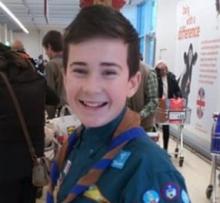
0.00 - The Respondent was introduced and thanked for attending the interview.
The conversation begins with a question about how he first became involved with the 30th Craigalmond Scout Group. He explains that he joined as a Scout around 2014/15 after his younger sisters started attending Beavers. He admitted he was a bit jealous of the fun they seemed to be having and decided he wanted to join too.
After completing Scouts, he moved on to the local Explorer Unit, the Pink Panthers in Blackhall, and eventually became a leader there, which remains his current role.
He was then asked to share what he remembers about coming along to his first night at Scouts.
“I think I remember like being very nervous, and I think my mum came to drop me off, and I don't think I was there for the whole time, and I think I was there with a couple of other people, one of whom I still work with in Pink Panthers. And I remember it was, I mean, looking back, it was so small because I think there were probably.15 scouts and three leaders, and now that, like now that it seems Scouting is so massive, that seems minuscule. But I can remember meeting Dylan, who was the Scout leader at the time. I can remember meeting Steve Barton, of course, and I, yeah, I remember being, I remember being very nervous, but very excited, I think.”
2.33 - The Respondent was asked whether, at the time he joined, only one Scout Troop was running. He confirmed that there was a single Scout Troop meeting on Monday nights from 7:15 pm to 9:00 pm.
When asked to describe the typical structure of a Scout evening, he recalled being part of the Yellow Patrol, with yellow electrical tape on the floor marking where his patrol stood, and his Patrol Leader being Nathan Bailey.
He admitted he couldn’t remember the full structure of a typical night, but he did recall starting with Flag Break, and he didn’t think they carried out inspections. Most evenings took place in the hall and involved practical activities such as making things - he remembered building a sawhorse on one occasion. They also spent time in the local park playing games, went on bike rides, and took part in camps.
He was then asked how much he remembered about working towards Scout badges and what that involved.
“I do later on at the early stage, I don't, I remember, I think the thing that sticks in my mind is the Zodiac Award because Fraser Dunmore then or being a young chipper, he would have been a young leader when I was in Scouts. He wanted to do the Zodiac Award, which is obviously camping. I think it's one night per month in every calendar month of the year, in various different circumstances, by which I mean under canvas, in a hammock, in a dormitory, up a mountain, whatever. And I can remember him and Fiona Priestley, who is the mum of one of my best friends, Alexander, he and Fiona pitched this grand idea of doing the Zodiac Awards to the Scouts, and it seemed very exciting, starting bronze, going up through to gold. I remember, I think the majority of people who did that felt it was absolutely fantastic.
It was probably the golden age of Scouting for certainly for people I know, because it was camping all the time, we did so many activities, and it was really fast-paced and fun.
In terms of badges, every night I can remember making things to do stuff like, oh gosh, it was like an air activities badge. I can remember doing things well, I mean, nights away, obviously, fires, things like that. They were all sort of, you know, Your, I suppose, your average nightly badges. I can remember, I mean, I couldn't name all the challenge badges off the top of my head, but I can remember doing things for them, loosely, because I do remember getting my Gold Award at the end, so I must have done something for that, but I can't remember anything specifically.”
6.39 - He was then asked whether most of the badge work took place in the hall, to which he said much of it did. He was asked if he remembered completing any badges independently at home. He recalled working on the Musician Badge, as he played the cello at school - although he admitted he didn’t always enjoy it, he did complete the badge successfully. He also believed he achieved the Cyclist Badge, as he was very into cycling at the time.
The Interviewer then moved the conversation on, asking what the Respondent remembered about the outdoor activities he took part in as a Scout, to which he went on to talk about one of his favourite outdoor games, Kick the Can, which he was asked to explain.
“There is a can brackets ball in a marked space, a conned marked space, and to begin the game, you choose, say there are 20 people playing, you pick three or four people to be the defenders of said can. To initiate the game, you kick the can slash ball, and with all one’s strength, and then everyone disperses into the forest or the field or whatever, and the name of the game is not to be caught and not to be put in the jail which is adjacent to the can storage area.
The sort of four people who have been selected to chase everyone around and try and find you as you stood buried in whatever mess was in D’Mains Park, hide in a bush or something stupid. And if one of the hunters was to say, “1…2…3 I see Patrick over there”. You would have to run with all your life to try and beat the person who spotted you back to the can area, and if you made it back in time, you wouldn't be put in jail, but if you did, you went in jail.
And to release people from the jail, one anonymous person from the sort of being the being hunted category would have to run back to the ball base and kick the ball out. And then one of the hunters would have to come back whilst everyone was released from jail and dispersed. But it was so much fun.”
10.07 - The Interviewer asked whether this was a game he had learned in Scouts, and he confirmed that it was, adding that it quickly became the most requested game each week. He recalled how excited he had been playing it in the park when he was younger.
He was then asked if he remembered any other activities that took place outdoors or in the community. He fondly recalled a visit to the local fire station and the “chip shop challenge,” which he described as “the best thing ever” for a 9–12-year-old.
The challenge involved each patrol visiting local eateries that sold chips around Davidson’s Mains, sampling these, and scoring them in different categories. The Scouts funded one portion of chips per patrol, and he remembered how popular the night was because they were out in the community and, of course, eating lots of chips.
Another outdoor memory involved a project led by a young leader, Fraser Dunmore, who was working with a conservation group to remove the invasive plant Himalayan Balsam from local woodlands. Fraser arranged for the Troop to spend an evening in Corstorphine Woods pulling up the plant. The Respondent recalled this as surprisingly satisfying work, with the Scouts removing a significant amount of the species together. He explained that this type of conservation night became a regular activity for the Group, and later for the Explorer Unit as well.
He went on to say that this project in particular had stayed with him, he is now a Geography student, and during a recent field trip to Inverness, focused on riverbank ecology, he was able to identify invasive species and think this was from an instinct that he learned in Scouts.
He was then asked whether he had any specific memories of trips or outings during his time in Scouts, and he went on to talk about one that stood out and which was to the W.E.C.
“So the W.E.C stands for Wester Hailes Education Centre, which is just off Sighthill Road to the north between Sighthill Road and the canal, and it's a high school, but for some reason …I mean, probably some eighties vision of the future, is called Wester Hailes Education Centre, and it had a swimming pool, quite an impressive swimming pool.
I mean, it was a bit decrepit when we used to go there, but that was usually where we went swimming with Scouts, I don't really know why, [laughs] cause we're not far from Ainslie Park or Drumbrae. I think it's probably because it was cheaper, because it was in school. You could attend even though you weren't at the school, and it was, I mean, it's, I think it's gone now because it's being remodelled and it's been renamed as a high school rather than an education centre.
And it was just so much fun. I think it was a bit odd because the changing rooms were non-cubicle sorts, so it was very, very pre-millennium or very European, should I say [laughs].
And I remember it had one, I think it had a springy diving board and a big high sort of solid diving board into a diving pool, which was always so much fun. And there used to be a massive competition to jump as high as you could. Did it have a flume? I don’t think it had a flume, I think it might have had a slide of some description, which was very fun, and it had a generic swimming pool as well, all within a brickwork facade clad sort of area, it was very sort of tired, mainly because it was at the school I suppose.
And I can remember swimming up and down that pool for hours. Oh, it felt like forever to try and get the required amount of lengths for a swimming badge. And I can remember always being really cold that particular pool [laughs], but no, I remember the diving pool being so much fun. That was absolutely brilliant.”
16.06 - The conversation moved on to trips and outings. The Respondent believed that the Troop had visited Bonally Scout Centre for various activities, though he couldn’t recall the specific details.
He also remembered visiting the local beach on a few occasions and, during bike rides, cycling through the Dalmeny Estate.
The Interviewer then asked whether he felt connected to the local community through Scouting. He replied that he definitely did. Although he grew up and went to school in neighbouring Drylaw, he felt very much at home in Davidson’s Mains because of Scouts, as it was so integrated into the local area.
He was then asked whether he had any memories of more traditional community events—such as the annual Gala Day or the Remembrance Service—and whether he had attended any of these as part of Scouts.
“The Gala day, I remember, I think we used to take part in the parade, and that was always good. I remember going as a young person, obviously running around that massive field, and I remember my highlight being the sort of little train that used to run on top of the field because I was a weird child, so that was really interesting. And I remember as an Explorer and as a leader, I actually I must have been since COVID! Yeah, I think I remember being in that bloody hot dog marquee stand for ages, making hot dogs and making teas and coffees.
Interviewer: This was the Scout stand?
Respondent: Yes, this was the Scout fundraising stand, which was under a marquee, where I think we served hot dogs and coffee and juice and stuff like that.
Interviewer: Do you ever remember walking in the parade as a Scout?
Respondent: Yeah, I do vaguely remember because of all the bunting, but I have more memories of the Remembrance parades because they used to be every year, I remember.
I still remember meeting outside the Church and walking up to the Green and being part of the ceremony. I must have, I think I really laid the wreath a couple of times as well, and yeah, I always felt that was really important.
And I mean it's a sad day, but it's really, it was always really respectful, really well attended and really important, not just to the young people, but to the older people from the community and the various other organisations because it was just really well represented, which was always really nice, and I always enjoyed participating in it because I thought it was important and it was a good thing to do. So, yeah.
Interviewer: Did it get a fairly decent turnout from the Scouts?
Respondent: Oh, absolutely, absolutely. Yeah. I remember it being packed and packed, and it's only went from strength to strength more recently. So yeah, absolutely.”
19.32 - The Respondent was then asked whether he recalled any other forms of community involvement as a Scout, such as fundraising events. He said he did and remembered his first Scout coffee morning in particular.
“I remember the very first coffee morning, which must have been when I was a Scout; I can remember being extremely chaotic; I must have been 11 or 12 or something like that. And, I remember, yeah, I remember it being in the hall and outside the hall. I can't, I think they'd borrow chairs cause so many people turned up and, and I can remember being an enormously chaotic event, but I remember running around between. I remember the lots of different stalls for lots of different causes, I remember there were people fundraising as Explorers to go to Jamborees. I can remember there being various stalls from other people. I can remember there being prizes, and I can remember, oh yeah, I can remember that being extremely chaotic and people going, ‘What on earth is going on here?’ Oh, it's a coffee morning and then more people turning up, but no, I do, I do remember that, and they were always extremely well attended. So yeah, that's probably the main flux point.
I can remember also being at the Sycamore Church area up there a couple of times, but can't quite remember what for, but there's photos. I think there's a photo that might still be out there, or it was up there out there until very recently, which was like whole Troop photographs from the time we were there. So there was a Scout photo, Cub photo, Beavers photo and then everyone together in that church hall. So yeah, we just used to do quite a few things.”
21.14 - The Interviewer then asked whether he felt the Scout Group was visible within the local community. He felt they definitely were, although he noted that post-COVID people seem less willing to take part in community activities, including Scouting.
Despite this, he believes Scouting has always been a force for good and continues to maintain a strong community presence.
The conversation then returned to his early experiences in the Troop, and he was asked whether he knew anyone when he first joined and, if not, whether he was able to connect quickly with the other Scouts. He explained that he did not know any of the young people or leaders beforehand, but he felt he settled in fairly quickly, although he had been nervous about starting, admitting he was often apprehensive about trying new things, but he ended up absolutely loving it and attended every camp.
He was then asked what he remembered about the first camp he attended as a Scout.
“So, my first camp, I don't know the date, I should have looked at the Facebook page because the Facebook page was… the 30th Scouts Facebook page was most active when I was a Scout, so there’s still some incriminating photo evidence of me as a child.
I remember my first camp, I believe it was in, I'm going to say September of 2015, possibly later, possibly earlier, and it was to a campsite, I can't remember the name off the top of my head, it was outside Forfar in Dundee and I remember it was the Glen's challenge, which I don't know if it still happens and it was a national camp that was a bit like the brass monkey camps that used to happen, so it's sort of challenge based which was run usually at an outdoor centre and this one was yes, so it was quite a while away, I didn't realise it was relatively far away until I look back because I mean we don't go on Scout camps that far away anymore.
And I remember we got a minibus hired and a trailer hired, and we drove to the campsite, I remember.
Interviewer: Was it just Scouts that were attending?
Respondent: It was just scouts that were attending, so there were probably 12 to 15 of us, and I remember we stopped to have chips. I can still picture this chippy [laughs]. I don't know where the chippy is, but I can still picture it in my head. I can picture arriving at the campsite - very small, very flat, not particularly exciting. It was quite busy.
Interviewer: With other Scouts?
Respondent: With other scout troops, yeah, yeah, from all over the place, I can’t really remember where from. I remember being in Stormhavens. I don't remember not getting any sleep, but I'm certain I got no sleep; I could not, least because we were in Stormhavens, but there we are. I can picture photos that are still there that remind me of doing things. I can remember it being quite sunny; there were not very many of us. I think it was Dylan Lynch, Steve Barton and a guy called Peter Morris, who was a Scout leader with me, who I still have fond memories of. Those three were our core Scout leaders.
The thing that I remember most about that camp is an activity that they did called the Lunar Challenge, which was basically a night hike.
I've got a feeling that it went on till a lot later than it really should have been for little kids. I mean, probably past midnight. I remember it was basically a hike that was from place A to place B through, I mean, some pretty generic tracks. I've got a feeling it was on an estate somewhere, a bit like Dalmeny Estate, and there were, I think, you had to choose… there were maybe 3 patrols from our group there and there was one person from each patrol or two people from each patrol that had to go, and I said yes because I didn't know I'd say no. And I remember doing this wee thing. I remember being very nervous, it was pitch black, my torch was not very good, and I can remember walking through a forest for ages, and then just stopping off to do challenges for people I didn't know, running them, and they were slightly odd. And I remember walking, it's just so dark, and I can remember walking through this estate, and there was just this massive, abandoned tractor or something like just lurking in the darkness and going ‘oh, what's that?’ because I just didn't know what it was [laughs].
And I remember yet again, not getting any sleep on night two of two, I know it was a weekend camp, and I remember finishing and being very relieved, but also a bit sort of a bit struck with fear[laughs]. The one thing I do remember about that camp that was very significant, it still takes my mind, is there was a 1980s Leyland National Bus that was being used to ferry people around, and it was nicknamed the Irn Bru Bus because almost certainly had been deliberately painted in sort of Irn Bru blue and orange, which is my overriding memory of that camp.”
27.55 - The Respondent was asked whether this had been his first time away from home on his own. He confirmed that it was and said that although he was nervous at his first camp, he was also very excited.
The Interviewer then asked whether he had ever become a Patrol Leader during his time in Scouts. He explained that he did take on this role in his later years and recalled being made a leader at a joint camp at Wemyss Firs with the 122nd Comely Bank Scout Troop, where he is now a Scout Leader. At that time, he had been an Assistant Patrol Leader but was given the chance to swap roles with his Patrol Leader for the duration of the camp. This was part of a wider exercise happening across all patrols, as the camp was also a competition.
He remembered feeling very nervous because there were many elements to the competition, run by leaders he did not yet know—although he now knows them well in his current role. Despite the pressure, his patrol won the overall camp competition, something he was extremely proud of and which gave him a strong sense of achievement.
When asked whether Scouts generally took these leadership roles seriously, he felt they did. On a personal level, he believes these early leadership experiences have shaped his confidence today, as he now often takes the lead in group settings and
feels comfortable doing so. He attributes this directly to the opportunities he had in Scouting.
The conversation then moved on to discuss his experience working toward the Zodiac Award, which he had mentioned earlier. He went on to talk about this in more detail.
“So, the Zodiac Award was just amazing, I mean, I can't remember all the camps we did, some of them were specifically Zodiac camps because they were one night or two nights long, some of them weren't specific Zodiac camps, but some of the things we did there counted towards the Zodiac Award. But I remember, I mean, it's, it probably had quite a profound effect on me just doing all this stuff all the time because it's just the best thing in the world.
Interviewer: So, it was each month?
Respondent: At its height, it was each month. It often wasn't very many Scouts, it was maybe 10,12,15 and then at large camps, there was more, I don't actually know how many of my cohort got the gold Zodiac award, but I mean everybody was very enthusiastic and again the joint captaining of Fiona and Fraser, I am quite frankly forever indebted to them because I just think it was the best thing ever, it was the best time to be a Scout because we're just going out and doing things and having fun and learning new things all the time and it was brilliant!
Interviewer: And do any of those particularly stick out to be maybe particularly challenging, exciting or just fun?
Respondent: I don't know, I mean, I had my first night in a hammock on a camp like that in on a camp like that and that was very exciting. But no, I remember just camping in different ways - I think we camped in bivvy bags once, so that was incredibly exciting and all these things besides go to different places, doing different things – hiking, doing different skills, going to random campsites that were very small and doing random activities, but because it's so small and it was so frequent we were just having more fun every time [laughs] So no, I, I just love, I loved it so much, loved it so much, and it was so important to me at the time, so important to me but yeah, it was just brilliant.”
33.29 - The Interviewer asked whether there had been any ceremony or celebration for those who achieved their Gold Zodiac Award, but the Respondent could not quite remember; he did recall receiving his Gold Chief Scout’s Award, with his friend, Alexander Priestley - while flying above the Irish Sea on a Ryanair flight returning from a Jamboree in Dublin in 2018. This was just before he left Scouts, and he believes he earned his Gold Zodiac Award around the same time, as one of the requirements was to camp internationally. Although he does not remember any formal celebration, he said his mum would have been very proud, so he likely marked the achievement with his family, and the award still sits on his mantelpiece today.
The Respondent was then asked about the International Jamboree in Dublin and whether it had been his first time travelling outside Scotland with the Scout Troop. He confirmed that it was, although he had previously taken part in an overnight trip to Beamish - the living museum in County Durham, which technically counts as being outside Scotland but not internationally. He spoke briefly about that visit before returning to share more about his experience in Ireland.
“So, Ireland was organised mostly by Fraser Dunmore – I have no idea how he got away with it. I mean, he got away with it because he's brilliant. But yes, we went to the Irish jamboree, which, from memory, happens every five or six years or something, and this was in County - I'm going to pronounce this - it's County Laois or something like that. So, it's slap back on the middle, I can't remember. So, I think it was probably July into August, we left, we flew to Dublin, we had a day in Dublin, and we went to Croke Park, which was very fun, again, I had never and I've still never been back to Ireland, so it's kind of ridiculous.
Then we got the bus campsite. I can remember it was on an estate, not quite a stately home estate, but it was of that ilk- sort of massive area of grass and with loads and loads and loads of tents.
And we were positioned in sub camp Oz cause all the sub camps were named after mystical lands. So, there was Oz, there would have been… I’m now showing my lack of fictional knowledge by forgetting the one that's in The Hunger Games… oh, I've no idea, there's various other ones, and they'll probably come back to me. And we were situated next to some lovely Irish people from Dublin who some of them I still have on Instagram, and we had the most wonderful amount of time. We did loads of activities, don't think any of them are off-site. I can't remember specifically a lot of them, but it was really fun.
Our subcamp was great, we had loads of really lovely people. I can remember being over the moon because I remember this was one of the best parts about that camp, is that I got to explore so much, I mean, it felt massive to me because I was a very small kid, but I can remember one of the best things was we had our neighbours, who we got on very well with, had bikes to navigate the campsite and I used to borrow the bikes and cycle around, they were just brilliant and great for running around.
Interviewer: The Scouts were from all over?
Respondent: Yeah. Oh, absolutely. They were from all over the world, the majority Irish. There were Canadians there who we've gone really well with; they were lovely. I can remember chatting to them, I still have a couple of things on Instagram as well [laughs]. They probably don't know who I am anymore, but yeah, there were people from all over the place.
I remember the opening ceremony with a big, massive stage, and they had everyone from all over the place, and they listed all these countries.
Interviewer: And did you feel connected to something bigger?
Respondent: Oh, absolutely. I was like, my word, this is incredible, I can remember doing lots of different activities that were slotted in, there was pioneering, there was inflatables, various other things I can't really remember. There was, I can remember they did like a talent… on our sub camp, there was a small sort of box trailer stage. So, people were just doing comedy and guitars and all sorts of crazy stuff there before. But again, another thing about doing something like that was the fact that I just got to run around and do what I liked and socialise with people, and it was just brilliant. I'd say that was the first proper time that I felt completely disconnected from the outside world, and whenever I've spoken to people who said I'm going on a Jamboree, I went on a Jamboree. What are Jamborees like? I tell stories to people, Scouts or not Scouts, I say it is a feeling that I'm pretty sure cannot be replicated anywhere else in the world. You feel completely disconnected from the outside world. It's like the world shrinks around you around this camp, and you feel like there's nothing else. It feels like the world is there on camp, everything is there for you and it's just the most fun because you just get to go. Oh, nothing else matters. I can run around like a headless chicken, and it was brilliant.”
40.16 - The Respondent was asked whether he had much opportunity to interact with Scouts from other groups during the Jamboree. He explained that the camp used an app to communicate what was happening across the various themed activity zones.
He remembered a central hub area that included a range of activities, a stage with music, and a camp shop, noting that around 5,000 Scouts were in attendance.
One of his strongest memories came from visiting the science and technology zone, where all the activities were run by enthusiastic and highly skilled volunteers. He recalled being particularly excited by a flyover by the Irish Army that had been organised, which included fighter jets, and by the chance to handle a plane fuselage mounted on a trailer, an exciting experience for a 12-year-old.
Throughout the Jamboree, he collected numerous badges, either given to him or swapped with other Scouts, and he said he thoroughly enjoyed his first experience of international Scouting and meeting so many new people.
Staying on camps, he was asked whether he remembered taking part in any camp traditions, to which he mentioned singing ‘Father Abraham’, recalling a photograph of Scouts around the campfire.
The song was a well-known tradition at the 30th Scout Group camps, typically sung on Saturday night around the fire. He also remembered other popular campfire songs in the Group, including ‘Van Der Beck’ and ‘Get Loose, Get Funky’. He described the campfire sessions as great fun, often lasting around two hours and filled with singing and laughter.
Another memory - possibly unique to the 30th Craigalmond Group - was the tradition of bringing home baking to camp. Each Scout was required to bring something homemade, which would later be served with hot chocolate around the campfire. He recalled that some parents became particularly well-known for their baking, mentioning one Scout whose mum made exceptional tablet.
The conversation then returned to his Gold Chief Scout Award, and he went on to share a little more about receiving it.
“The day I got it, I don't know why. I think because on the Irish Jamboree we had to tick something off about it because it was international in one way or another. So, me and Alexander Priestley, were on our flight back home, on Ryan Air, there's a photo of us getting it actually. So, Fraser Dunmore came up to us and said [grunts], and he managed to get the whole plane to pay attention to us getting our badge.
There's a photo of me and Alexander getting our badge on a Ryanair flight somewhere in the sky and which was very nice. And I do think it was particularly nice because of that, and it was an achievement to be honest, because it was sort of symbolising that I had done well in Scouts.
And yeah, I can remember we did loads of things for it, again, all the challenge badges, but we talked about badges, and my memories are not very good in that area, unfortunately.”
49.35 - The Interviewer asked whether he still stays in contact with Alexander Priestley and others he was in Scouts with, and he said that he does, and went on to mention that he still sees Dylan and Fraser, describing Fraser as both a very good friend and a real inspiration. He also mentioned Ian Dunlop and noted that he often bumps into people from the 30th in everyday life. The Interviewer then asked whether Scouting has had a lasting impact on his life.
“I'm pretty sure it's the best thing I’ve ever done. I'm pretty sure it’s the best thing I’ve ever done. It's changed my life been so, so many different ways, and I don't think I'd be the same person without it. And I think I'd be a bit more miserable without, not because I was miserable without it and it cheered me up [laughs], I think it's just been… so it's shaped my character and the things I do and the things I like and the way I am so much. Yeah, it's just brilliant.
Interviewer: Would you recommend Scouting to young people today?
Respondent: Absolutely. I think it's like any social activity, it's difficult, but I think the thing that I know about Scouting it is whatever you make it; it toughens you up, but not in a harsh way, not in a way that people would say, oh, Scouting, it's always staying in tents in the rain, not in that way, It provides you with… people use the phrase skills for life all the time, but the skills for life are not just you trying to complete a badge that says you could have sewing or something like that. The skills for life come from so many different areas. You're getting up in the morning as part of a patrol and going on an activity, and working as a patrol as a 10 year old, That simple activity repeated over and over again in the hall setting, in an outdoor setting, anything like that, that is invaluable.
And in a world where people's confidence is often lower than it really should be, not because people are not very good, it's because people are struggling with their confidence. That simple realisation that you can work in a team and do things, and be a team player. It's so important, and the world doesn't function without teams, and I think being a team, I'm a bit obsessed with teams at the moment because of being at university, but it's so important, and whatever you make it, I suppose.”
53.07 - The Interviewer then asked the Respondent, from his perspective as a leader, what challenges Scouting is currently facing and what challenges he encounters personally.
He acknowledged that there are many. At an organisational level, Scouting faces issues such as public perception, bureaucracy, and limited resources and noted that at times the organisation is expected to “manage the unmanageable,” which can cause priorities to become unclear.
On a personal leadership level, the challenges are often more everyday matters, such as young people speaking too loudly or out of turn, or struggling with changing attitudes. He believes some of these shifts stem from the long-term effects of the pandemic, which he feels are still being felt across society. He also reflected that Scouting is affected by a broader cultural shift towards being more inward-looking. For example, people may be less willing to car-share, contribute home baking for camps, or take part in campfire singing.
He feels there is also a growing reluctance to join a team: while many leaders are passionate about certain activities, fewer seem committed to the organisation as a whole, yet for Scouting to function well, teamwork and collective effort are essential. Despite these challenges, he hopes the movement will continue to grow from strength to strength.
Moving to the final question, the Interviewer asked what stood out most in his entire Scouting journey. He replied that it was undoubtedly the people he met and described them as incomparable, brilliant individuals for whom he has deep respect and from whom he has learned a great deal. He continued to reflect on this as he concluded his answer.
“If there was one thing that I think is the most important thing that scouting has given me, is probably confidence and sort of self-worth, not self-worth, but self-pride I think and determination because particularly the time I have been a Scout, certainly the early days until I was maybe 15,16,17… my life was not that easy for various reasons and I think the materialistic way of saying it would be and I wouldn't have been there outdoors much if it hadn’t been for Scouting, which I now know is incredibly important to me because of the fact that my dad was ill and he was a very outdoorsy person and I'm now outdoorsy because of being in the Scouts. But also because it was difficult and having a haven in the physical and metaphorical sense, to be with people, do fun things, just to say it probably saved me, to be honest, because it's become so much part of my life and I think it's very, very, very good that it came along at the right time.”