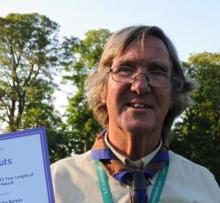
00.34 - Where were you born?
“In Surbiton in Surrey.”
00.40 - Were you raised in Davidson's Mains?
“No”
00.49 - Can you describe to us the community you grew up in?
“It was a London suburb, not very different from Davidson's Mains or Silverknowes”
01.07 - Can you please tell us about your family, parents, siblings?
“My Father was Ted, my mother was called Beryl. They were married a couple of years before I was born. I have a brother two years younger called Tony, and a sister who is seven years younger than me and she’s called Sarah.”
01.26 - How did you become involved with the Davidsons Mains Scout Troop?
“My daughter, Harriet, was offered a place in the Scouts. She hadn’t been in Cubs or Beavers but she was offered a place and then there was a cycle ride and I came along to help and generally sort of get in way and then I came along because they seemed a little short of parents, so I became a parent/helper and then the previous Leader decided to stand down and at the same time, his Assistant decided he was moving to the south coast of England.
This left the Troop with no Leaders and the GSL, who was Liz Leslie. She became the Acting Scout Leader while Mike Pontin started training to be the Leader, and I was training to become the Assistant Leader.”
02.32 - What were your first impressions of the Scout Troop?
“They seemed very pleasant. I knew many of the boys. There were just two girls, my daughter and one other, who was Liz Leslie’s daughter, and the rest were boys. I hadn’t got much experience of boys that age. I knew a lot of friends, and by chance, they had a lot of girls, and I also helped at a riding stable for a short while, and girls are worse than boys.
I quickly had to learn their names, which is not as easy as it sounds and then just fit in where it was needed.”
03.21 - Did you ever attend Scouts or Cubs as a child?
“Yes, I started in Cubs when I was eight, and I stayed in the Cub Pack for three years, and when I was eleven, I moved to the Scouts Group, but I only stayed until I was fourteen, normally, it was fifteen in my day because I had too many other calls on my time.”
03.47 - What were your favourite memories when you were in the Scouts?
“I enjoyed camping most of the time. I’ve still got a few memories, like it was raining a lot and we were singing a song which was ‘Our tent’s got a leak in it so we might drown’, and at that point we realised our tent had got a leak in it. We’d chosen to have the camouflage tent, and there was no reason not to, but it hadn’t been checked out to be waterproof, so we decided we’d better have one of the normal ones, which are a bit like today’s Stonehavens.”
04.27 - Do you have any favourite memories of being at Scout Camp?
“I remember we went canoeing on Coniston Water that was quite good. It was greenfield camping, so we had to dig a pit for both the dry and wet waste and our wet waste pit filled up with water and we were wondering what best to do so we tried to dig a bit deeper and we got one of the older Scouts who’d be a sixteen to eighteen year old, came along with a heavy shovel and he started digging and one good hit and the spade disappeared downwards and all the water suddenly disappeared and a few minutes later it was out in Coniston Water, we’d hit the underground stream. So, our wet pit never filled up.”
05.30 - In relation to Davidson’s Mains, are there any particular favourite activities at camps that you’ve been on?
“Probably the ones I’ve enjoyed are the organised sites where the Scouts get to do things like Jacob’s Ladder, Kayaking, Raft Building and it’s quite interesting to see how well people do and quite importantly it’s not just the ones who make it to the top of Jacob’s Ladder, there’s always some and you can usually guess which ones it will be, but it’s the one who will just be persuaded that he or she can do one more rung of the ladder and sometimes you just see a very nice one, it was somebody who just didn’t want to do Jacob’s Ladder but you may know as well as that you have to get one of the Scouts on the safety rope and he never shirked doing his turn on the safety rope. He didn’t want to climb the ladder, but when it was his turn on the safety rope, he did it, and that is always a nice thing to see. It’s surprising if they don’t like what’s happening, either something in the food they don’t like, they just go without, without complaining, and they are really a pleasure to have at camps. I’ve been to a number; sometimes we’ve been doing most of it ourselves, and sometimes it’s been with the Adult Support Unit. The Leaders have got a very easy task. The one thing I tend to have to do when we’re doing it ourselves is ensure we’ve got enough gas because if a gas bottle is empty it’s got to be refilled and for the last ten years I haven’t gone out to work, I’ve worked from home and I can just take half an hour off and drive over to Sighthill to collect a full one. Again, it’s to watch people, in many cases always helping others, and it’s usually not the ones you’d expect.”
08.02 - What is the difference in badges between now and when you were a kid?
“There were two main badges in the Scouts. The Second Class and the First Class badge, and there was a stage before the Second Class, and you had to do half a dozen or so basic things, one of which was to learn the Scout promise. I can’t remember what the rest were, and you had to do the first few before you were invested. Cameras were expensive in my day, so parents weren’t invited to the investiture, and in fact most Scouts didn’t want their parents there. Then you did the Second Class badge, which was about ten or fifteen things, including the safe use of a hand axe, safe use of a Scout knife, various knots, some first aid, about fifteen things, and when you’ve got all of those ticked off on your record card, you got your Second Class badge. Then you had another lot to get your First Class badge, one of which was known as the Scout Journey, it was a bit like the Duke of Edinburgh bronze, bear in mind most people didn’t leave Scouts until they were fifteen and I think you had a hike, it was just one night under canvas but you walked, followed a map, and if you were lucky you managed to get round and get picked up at the right place at the end. You had proficiency badges. I actually managed to get my First Class badge fairly quickly, I think, but I never got any of the proficiency badges. I was quite busy with schoolwork and stuff like that, and I just never picked them up, but in the Cubs, you got various badges. I got six of the fifteen proficiency badges. My brother did all fifteen, and the local paper had a picture of him. He was determined to do it, he’d seen older boys had done it.”
10.40 - Have the Scouts changed since you were a child, and if so, how?
“Quite a few changes. The most important one is that it was known as The Boy Scouts in my day, and that meant boys; there were no girls in the Scouts at all. Girls went to Guides or Brownies. The Scouts wore short trousers, and the Leaders also wore short trousers, although, for modesty, lady Leaders wore a skirt. There were Scout shorts, Scout belt, the badges were slightly different, and the scouts also wore a beret, like some of the Army berets. There were very few badges, and this was done with a record card because it cost a lot of money to make badges in those days.”
11.50 - Did any of your experiences with the Scouts influence your career path?
“I’m not aware of any, but I suppose you learn to be able to cope with situations you weren’t expecting, and that can sometimes help, but no not really.”
12.14 - What did you do after leaving the Scouts, like university or college?
“I went to university to study chemistry, and then immediately I finished that course, I studied toxicology, which is about looking for unwanted side effects of drugs and other chemicals.”
12.40 - What do you think the impact of the Davidsons Mains Scouts is on the area?
“I couldn’t really begin to say but it certainly has gone from a Troop of approximately twenty Scouts to two troops of about thirty to thirty-five each. So, the Scouts are much more involved with the community. They’ve always been involved at the Remembrance Day Parades, the Gala and more recently, at the Christmas Lights, and they’ve become well known. There’s a lot of Leaders who have put in a lot of time and particularly Dylan, to make sure that the Scouts are involved with things, and a lot of parents too. If it wasn’t for the parents, we would have no Scout Troop.”
13.42 - Can you sum up what you think is the most important thing about the Scouts?
“That’s difficult. I would think it’s bringing on people to learn new skills and go on. When I first meet people, either as a very quiet, shy, or very noisy ten-year-old and gradually you see they become more capable, and I’ve met several of them who’ve went on to be Explorers. I went to an Explorer Camp and saw former Scouts that were far more grown up than they were Scouts, and some have gone on to be Leaders, they’ve gone to university, they’ve studied, and I expect that sooner or later one of my former scouts will turn up and say, ‘Do you remember me?’. I’ll struggle, and they’ll say, ‘This is my little boy, or this is my little girl, ’ starting in Beavers or little Squirrels.”
15.01 - That’s all our questions. Have I missed anything, or would you like to add anything?
“If I was asked to give a message to people, it was, some people have been a Leader for quite a while, and some are fairly new, but we all started out knowing very little other than what we came to it with, either as a parent or having been through Scouts and they in turn will go on to become the new Leaders.”
15.37 - Thank you very much for sharing your memories with us.
“You’re very welcome.”