In 1909, when Robert Baden-Powell devised Scouting for Boys, it was intended for use by existing uniformed organisations such as the Church Lads’ Brigade, the Boys’ Brigade, and the Cadet Corps.
However, the demand grew for these young people to have an organisation of their own, and they followed the guidance Baden-Powell had laid down in Scouting for Boys for non-uniformed groups, where he had written
If your patrol does not belong to any Uniform Corps, it should dress as nearly as possible thus:
- Flat - brimmed hat or wide-awake hat.
- Coloured handkerchief tied loosely around the neck
- Shirt: Flannel
- Colours: a bunch of ribbons of patrol colour on left shoulder
- Belt, Haversack, Shorts: trousers cut short at the knee
- Stockings, with garters made of green braid · Boots or Shoes
- Staff as high as scouts shoulder
At the outset of the Movement, Scoutmasters themselves had no defined uniform. Instead, adult leaders adopted the recommendations given to the Scouts and combined them with other practical items of clothing suited to their role.
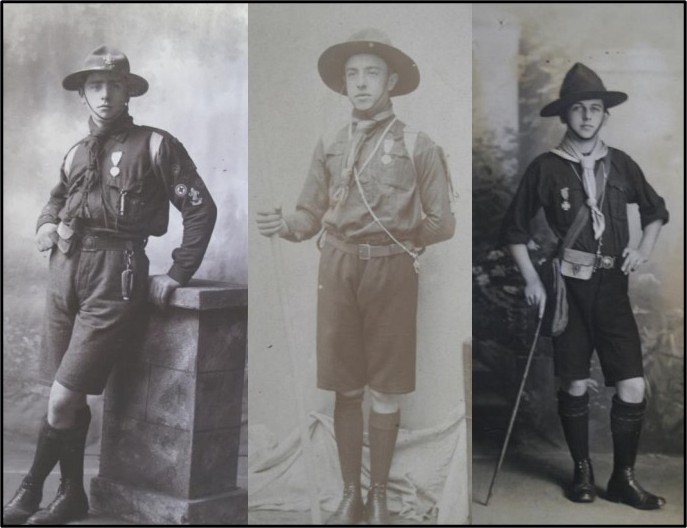
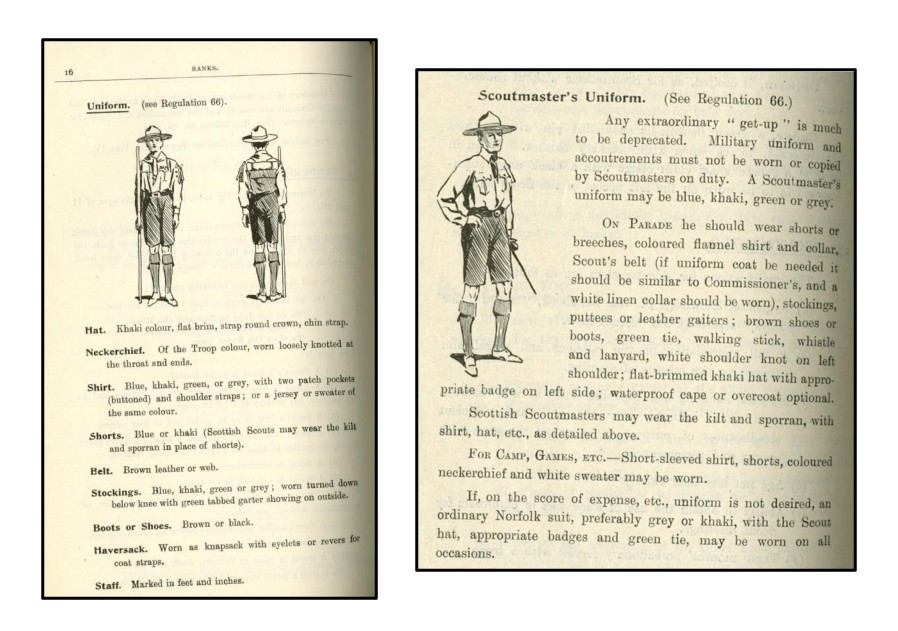
The uniform requirements for both boys and adults were incorporated for the first time into the Boy Scout Regulations in 1911(an early forerunner of what is now known as Policy, Organisation and Rules), with diagrams of these uniforms shown the following year.
In an effort to distance the Movement from accusations of being a military organisation, these regulations consistently prohibited adults from wearing any form of military uniform or military-style accessories while taking part in Scouting.
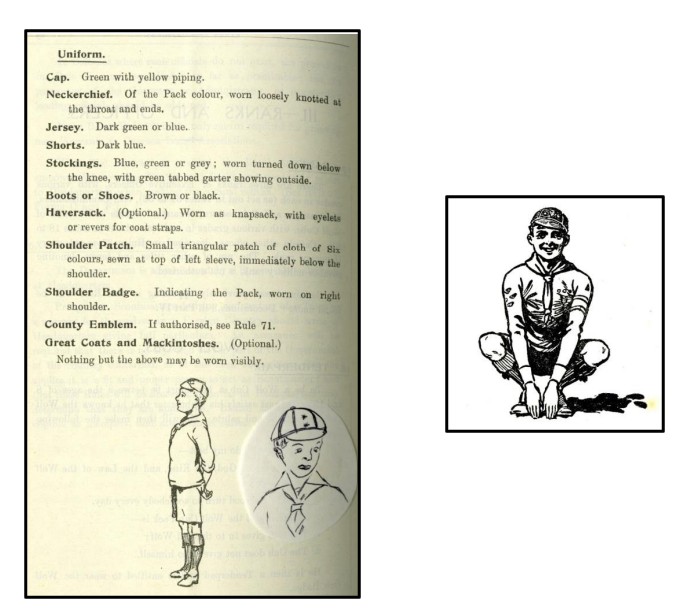
Wolf Cubs formally became part of the Association in 1916, and the uniform was detailed in the Policy, Organisation and Rules (POV) the following year.
The First World War had led to hundreds of women becoming involved in Scouting in support of the war effort, and the Association came to recognise both their value and their contribution; however, details of a uniform for women in Scouting were not published until 1917. Despite this, it was still widely believed that women were best suited to working within the Wolf Cub section.
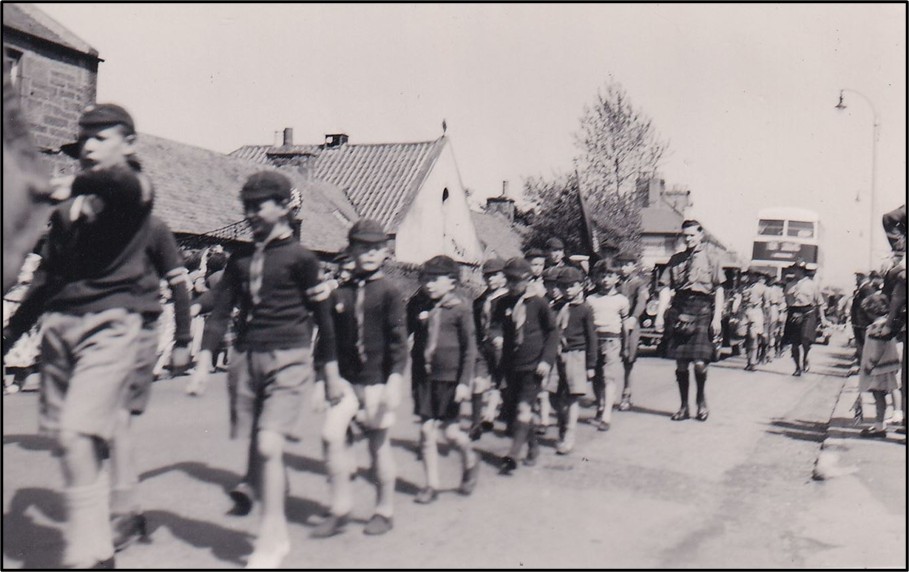
In 1918, the Scout Association introduced Rover Scouts for young men aged roughly 18 to 25. Rovering emphasised service, outdoor adventure, and personal development, providing a more mature and flexible programme than that offered to younger sections. Rover Scouts are first mentioned in Policy, Organisation and Rules in 1919, albeit only in a brief note stating that a pamphlet of provisional rules had been published. The first reference to a Rover Scout uniform in POR appears in 1923, with a fuller and more detailed description not emerging until 1933.
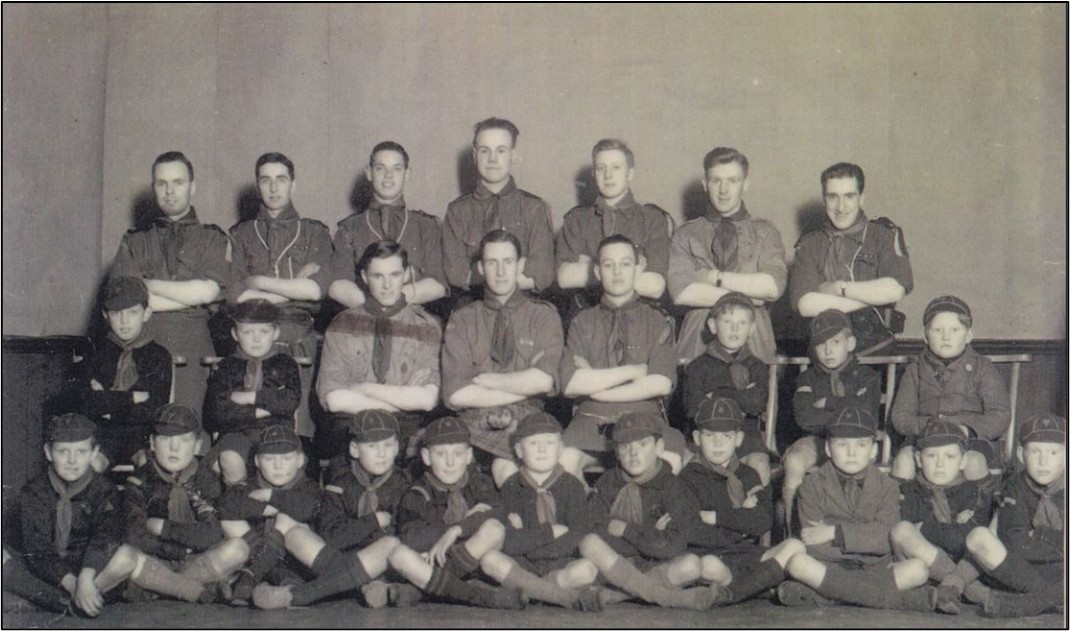
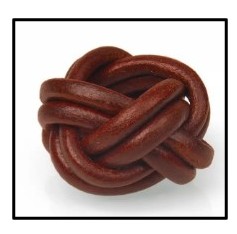
Until 1924, a loose knot was the official way to fasten a neckerchief. That year, a troop ring was suggested, inspired by practices at Gilwell Park and reports of American Scouts using scarf rings known as boon doggles.
“Khaki shorts, khaki shirt and the big Baden Powell hat, which was religiously…the brim… religiously pressed every week.”
Peter Flanagan (Cub & Scout 1950s/1960s)
Bill Shankley developed a leather Turk’s Head knot, naming it a “woggle,” which became the Gilwell pattern for Wood Badge holders. The idea quickly spread, and Scouting for Boys referred to scarf rings from 1928 and used the term woggle in 1929, though POR did not adopt the term until 1945.
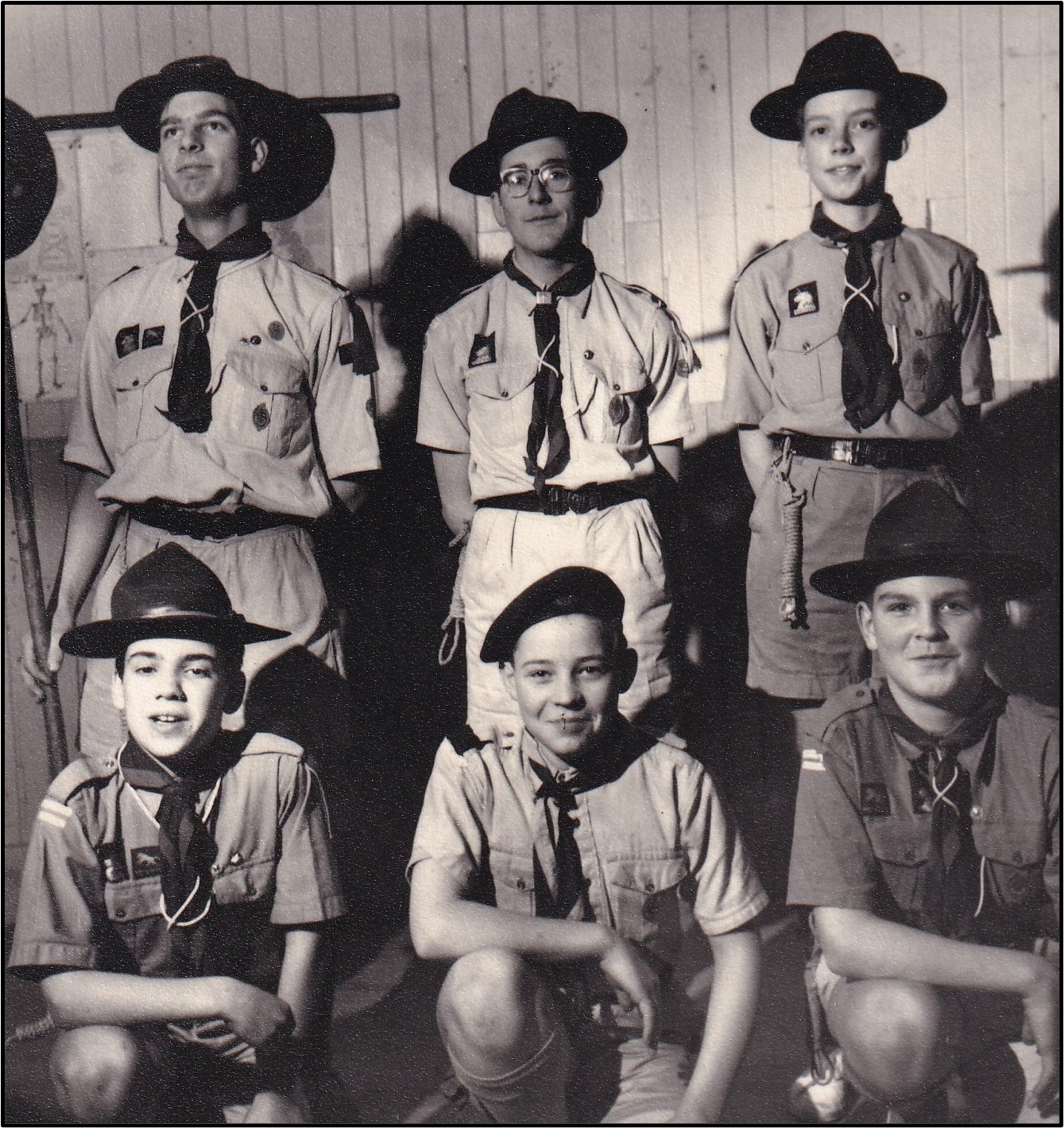
The beret was introduced in 1952 as an alternative to the traditional “lemon-squeezer” hat. It was made available to Senior Scouts (in maroon), Rovers, and both male and female Scouters, while Cubs continued to wear their caps. By 1957, illustrations in Policy, Organisation and Rules showed the beret as the standard headwear for all sections other than Cubs and for leaders. The once-iconic hat had become the alternative, foreshadowing its complete disappearance a decade later.
“You’d have your uniforms all nicely done, neckerchiefs done – presentable. You were inspected for the way you were dressed, and I don’t know if we got points for it or something, but we were always trying to be well done and turned out. The hats – the old Scout hat – I remember getting the iron and a sort of damp cloth, and you would iron it to make sure the rim was nice and flat.”
John Blaikie (Cub, Scout & Venture Scout 1960s/1970s)
In 1963, The Scoutmaster’s Guide A–Z (first published in 1960) noted that Scouts often carried a sheath knife and stated that, if a Scout was truly to fulfil his “Good Samaritan” role, it was an essential tool.
“In those days, we had the big sheath knives with an eight-inch blade in them, which we all used to wear in the back of our belts…we used to walk about the streets with them…nobody bothered in those days, nobody ever thought about using them for any harm. We used to have knife-throwing contests with them, but they were quite lethal weapons; you’d get jailed now if you were carrying one of them.”
Peter Flanagan (Cub & Scout 1950s/1960s)
“You had your neckerchief and your woggle, back in those days, I think you would walk about with a sheath knife on your belt – yeah, you thought nothing of that – having a penknife or something like that in your pocket, now walking about the street with a knife visible – no chance.”
James Allan (Scout 1970s, Venture Scout/Leader 1980s)
In 1964, the Chief Scout’s Advance Party was formed to review all aspects of Scouting, with its report published in 1966 and changes introduced from 1967. The review recommended regular updates to the uniform and set the principle that dress should suit the activity. Full uniform was to be worn for formal occasions, with headgear reserved mainly for ceremonial use. A common membership badge was introduced, with different colours for each section, and the Movement was given a year to adopt the new uniform.
By 1968, the main changes for Scouts were the introduction of mushroom-coloured trousers (only the Cubs section still wore shorts). The traditional lemon-squeezer hat was replaced with a beret, and the shirt changes were from khaki, dark blue, green or grey to a standardised green shirt.
“Well, at that time, there was a transition between the old-style Baden Powell’s Scout uniform and then introducing a new style Scout uniform, so it was a bit of a mix and match. So, when I went to the Scouts they were transitioning and you could order the new uniform through the Troop, so you had a new, instead of the old sort of khaki coloured shirt that you had, they had a green shirt and you had long trousers, which I think were grey instead of the shorts and you had a beret instead of the old style Yogi Bear cap – hat as it were. So, it was a bit of a mix and match going on until everybody transitioned to the new uniforms, which they were introducing.
Ian Davidsons (Cub & Scout 1960s)
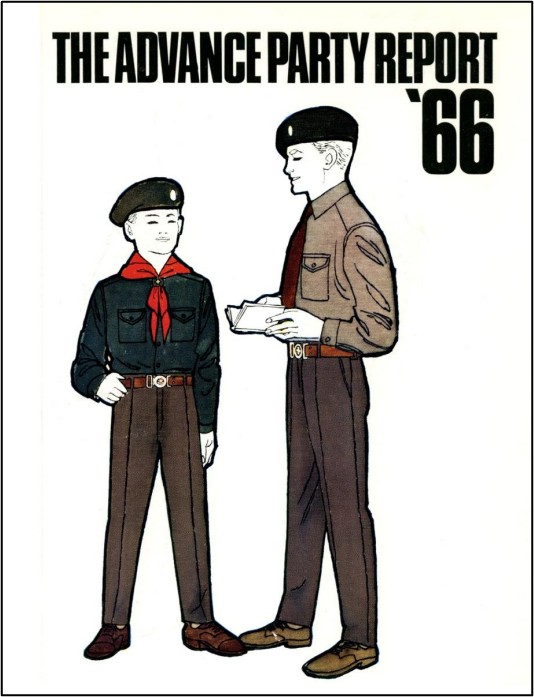
“Scouts it was a green shirt, green shirt, beige trousers, Scout belt, it was a brown belt with a Scout badge on it, I’m trying to think was it - the belt doubled as a bottle opener, the two parts went together, one was a circle with the Scout crest on it which clipped in through and then doubled back on itself on the other which was a rectangle with a round hole on it and that section doubled as a bottle opener.”
Andrew Marshall (Cub, Scout & Venture Scout 1970s/1980s)
The Cub Scout uniform remained largely unchanged after the Advance Party Report, although a T-shirt was introduced to be worn under the jersey, with the most significant changes concerned badges, as previously, the Wolf Cub badge appeared on both the cap and the jersey. The cap badge was replaced with a gold fleur-de-lys, while the jersey badge became a standard membership badge. These changes reflected both the renaming of Wolf Cubs to Cub Scouts and the evolution of the programme, with less emphasis on The Jungle Book.
“In Cubs, it was a sort of dark green pullover, there was neckerchiefs in both because obviously there was a coloured woggle for the Cubs, and then the Scout one was just a leather one with a gold Scout crest on it. The Cubs had the cap as well, the green jumper, the neckerchief, there were shorts, you just wore your school shorts, they were grey shorts and there was sort of the green bits – garter flashes on your socks.”
Andrew Marshall (Cub, Scout & Venture Scout 1970s/1980s)
“We had the cap which was a great source of amusement because we would fling that across to each other across the hall like a big frisbee and try and catch it and throw it back to each other, while trying to set a good example, so you’d have that and your shorts and a green vest or jumper with your badges down the side, and then your necker and woggle.”
Gavin Hunter (Cub Scout 1980s)
After the APR, the titles Scouter, Lady Scouter, Scout/Cubmaster and Scout/Cubmistress were dropped and all adult volunteers became known simply as Leaders, such as Group Scout Leader or Assistant Cub Leader.
Female leaders could wear a green skirt and shirt or a green dress with a cardigan. Trousers were allowed on camps but not at meetings.
Male leaders wore the same uniform as Venture Scouts: a beige shirt and jumper, mushroom trousers and a green beret, with the addition of a green tie to distinguish them as leaders.
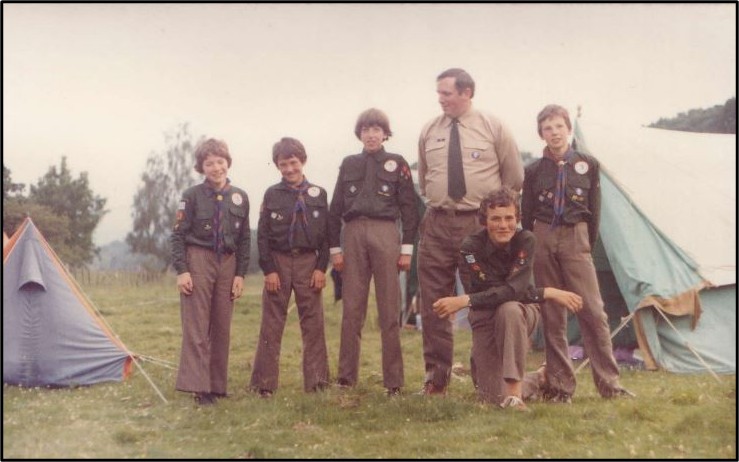
“In Scouts, we had a green shirt, woggle/necker, you know and sort of beige trousers. I do remember that the Scout Association not keeping up with fashion, because we had drainpipe trousers when everyone was wearing flares, and they finally caught up with us, gave us flares, as the rest of us moved to drainpipes, so it was all a bit of out of kilter really.”
Eric (Cub, Scout & Venture Scout 1970s/1980s)
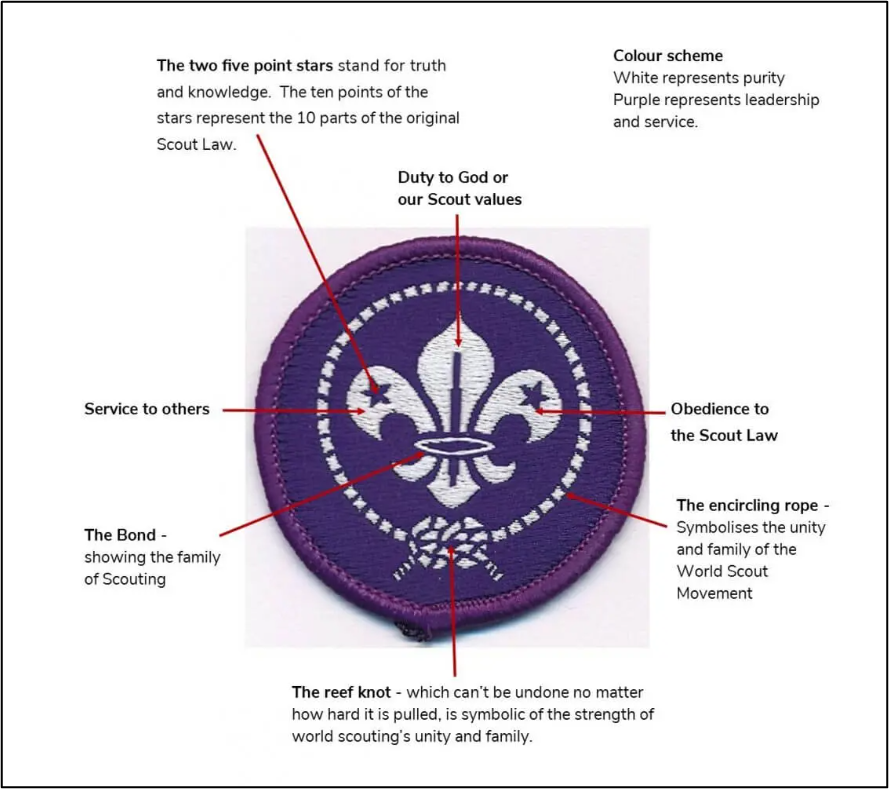
In 1971, the section-specific membership badges introduced in 1967 were replaced by a single, universal purple membership badge. This new badge was formally introduced in the Policy, Organisation and Rules (POR) in 1972.
“You’d have your uniforms all nicely done, neckerchiefs done – presentable. You were inspected for the way you were dressed, and I don’t know if we got points for it or something, but we were always trying to be well done and turned out. The hats – the old Scout hat – I remember getting the iron and a sort of damp cloth, and you would iron it to make sure the rim was nice and flat.”
John Blaikie (Cub, Scout & Venture Scout 1960s/1970s)
In October 1982, the Scout Association introduced Beavers for boys aged six and seven, responding to growing demand for an optional pre-Cub section within Scout Groups.
Similar provisions had existed for years in other countries. Beavers began in Northern Ireland some 15 years earlier, with comparable schemes in the Republic of Ireland, Australia, Canada, New Zealand, and parts of Europe and informal projects also emerged in Scotland and England.
At first, Beavers were not full members of the Movement, but this changed in April 1986, when they became a recognised training section and adopted the title Beaver Scouts.
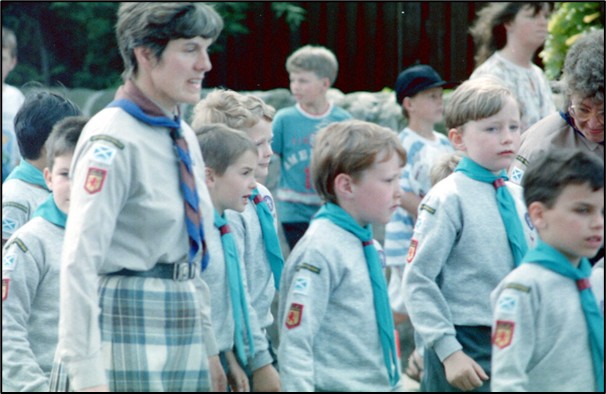
The first uniform was a turquoise scarf with a maroon woggle, and in 1985, Beaver uniform guidance appeared in POR, and from 1986, it specified suitable trousers or shorts.
Girls were permitted to join Venture Scout units from 1976, yet the first reference to a female uniform did not appear in POR until 1985.
The uniform mirrored that of boys, with the addition of a mushroom-coloured skirt; female Venture Scouts were not required to wear a beret, and by 1989 all headwear was dropped from the uniform requirements for Cubs, Scouts, Venture Scouts and leaders.
In 1992, culottes were added to the uniform options for female leaders and Venture Scouts, and following a 1991 resolution, girls were permitted to join all sections of Scouting from 1992. This remained optional, with groups able to opt out.
No changes were made to the youth section uniforms until 1995.
From 2000, a major uniform review was launched, supported by a wide consultation across the Movement, with 46,000 questionnaires completed. Feedback was gathered on several proposed changes, including:
- Navy activity trousers and skirts – trousers were popular; skirts were not.
- Changing Beaver sweatshirts from grey to turquoise – approved by 60%.
- Claret shirts for the new Explorer section – unpopular.
- Grey shirts for leaders – also unpopular.
“The 30th were very particular about their uniforms. They were one of the last troops to be wearing uniform Scout trousers, because by then a lot of troops had gone over to wearing, well, just dark trousers or anything but we were pretty insistent on keeping them. In fact, we had a bank that people could come along and see if there was a pair of trousers that fitted them when they came along.”
James Campbell (Scout Leader 1970s/1980s)
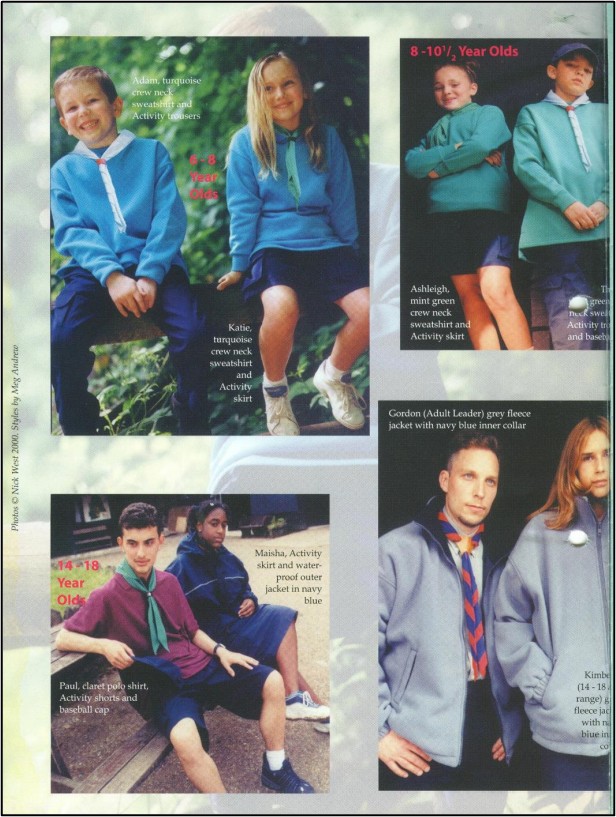
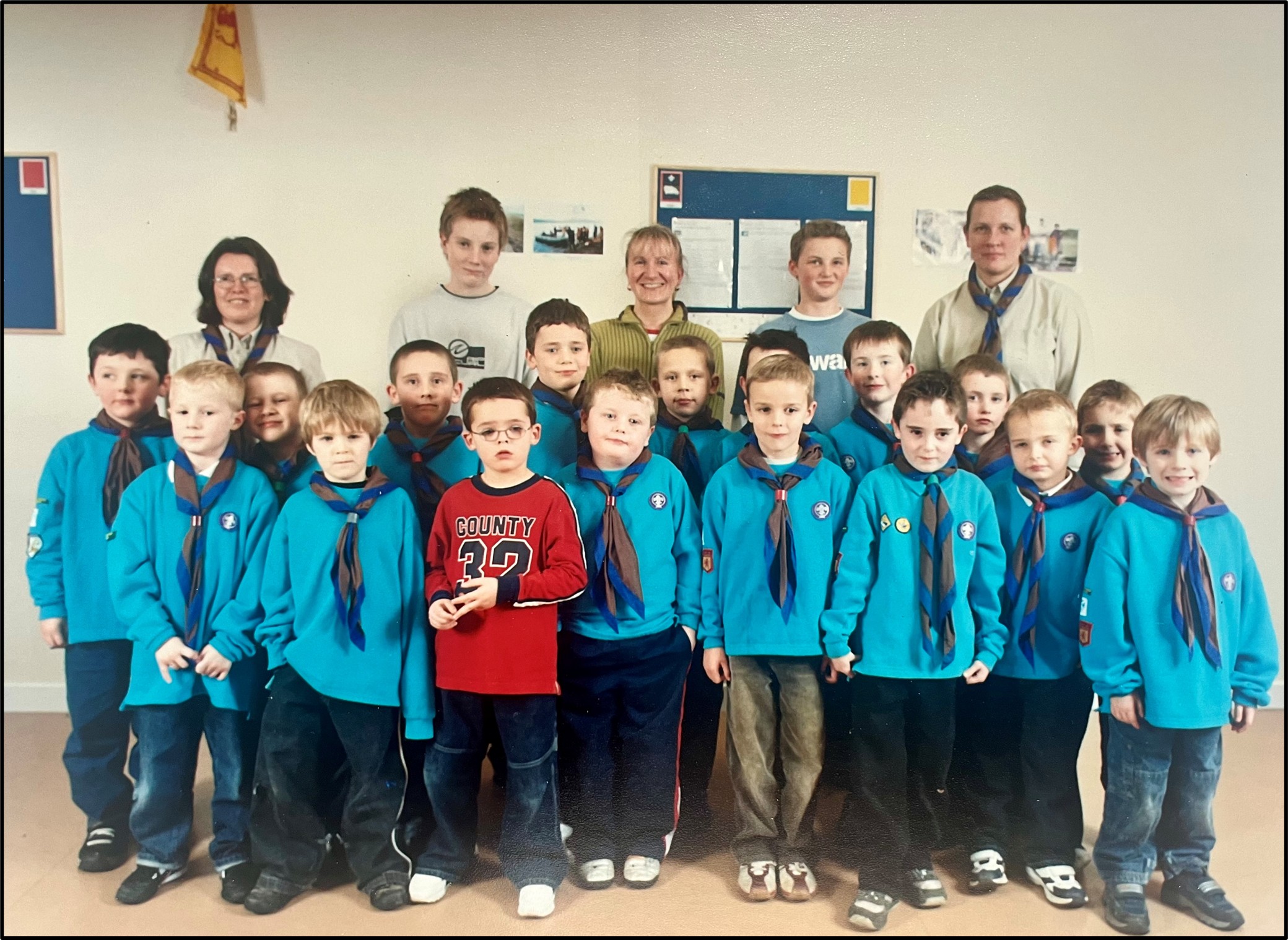
In 2002, the uniform review confirmed that the Beaver Scout uniform would consist of a turquoise crew-neck sweatshirt, a Group scarf (necker) and a maroon woggle or an alternative colour to identify a lodge or team. Groups could also choose to adopt optional items such as navy-blue shorts, a grey fleece, a navy-blue outer jacket, and a navy-blue baseball cap, while optional activity wear included navy-blue activity trousers and a turquoise polo shirt.
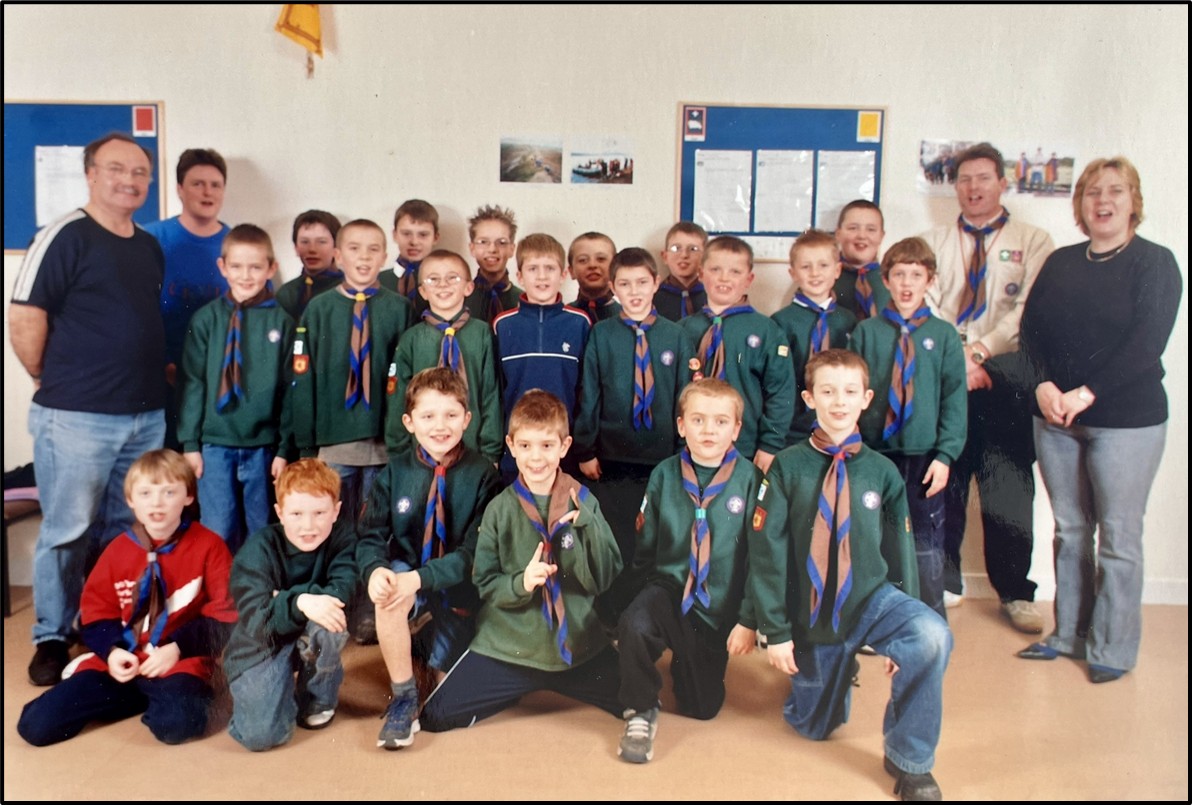
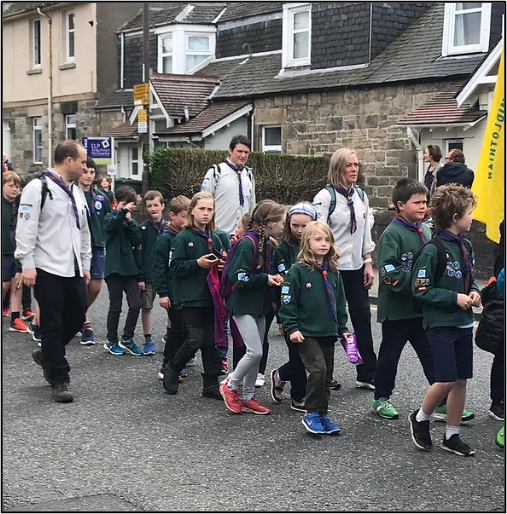
Following the changes, the Cub Scout uniform consisted of a dark green crew-neck sweatshirt, a Group scarf (necker) and an identifying Six woggle. They could also adopt optional items such as navy-blue shorts, a grey fleece, a navy-blue outer jacket, and a navy-blue baseball cap. For activity wear, Cub Scouts could choose navy-blue activity trousers and a dark green polo shirt.
The revised Scout uniform comprised a teal green long-sleeved shirt or blouse, navy blue activity trousers or a smart navy-blue skirt, a Group scarf and woggle, and the leather Scout belt and buckle. Groups could also choose to include optional items such as navy-blue shorts, a grey fleece, a navy-blue outer jacket, and a navy-blue baseball cap. For activity wear, Scouts could opt for a teal green polo shirt and a navy-blue sweatshirt.
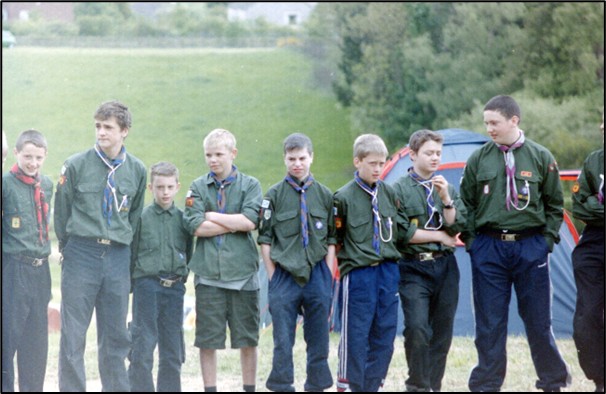
“Scouts was a shirt, an actual shirt that you had to iron and you had like you could fold it up, it was a good bit of kit, I think, you know, a sturdy shirt, you put all your badges on it and wore like a woggle, I think it was called, and you had to wrap up the brown and blue tie as well. I remember that, yeah. Yeah, it was a decent uniform.”
Anthony Ozkan (Cub & Scout 2000s)
Explorer Scouts who replaced Venture Scouts the previous year) comprised a beige long- or short-sleeved shirt or blouse, an Explorer Scout Unit scarf and woggle (or a Group scarf if specified in the Partnership Agreement), navy-blue activity trousers or a smart navy-blue skirt, and the Scout, Explorer, or Young Leader belt and buckle once achieved.
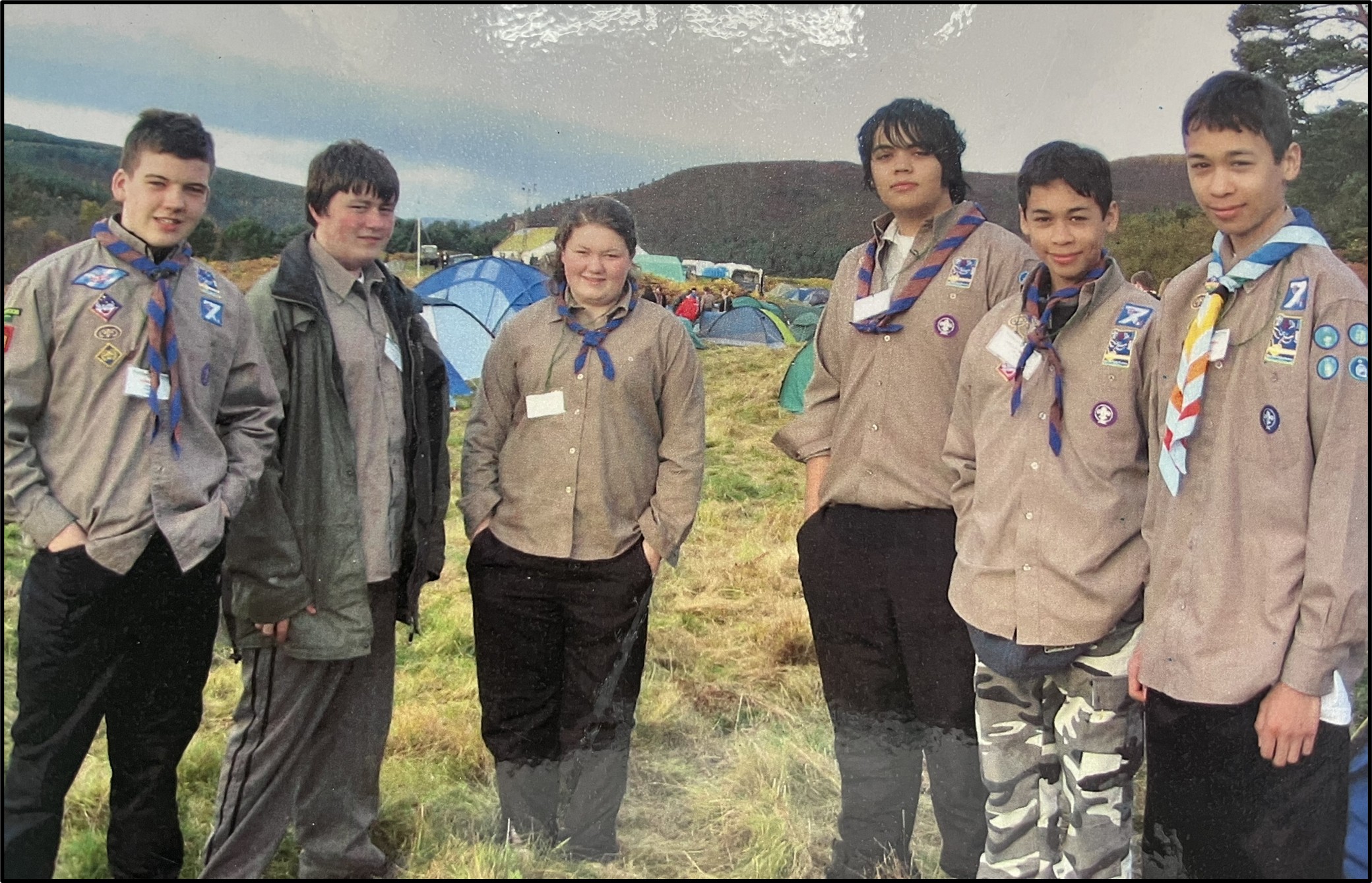
The Scout Network and Leaders uniform consisted of a stone-coloured long- or short-sleeved shirt or blouse, worn with the appropriate Group, Explorer Scout Unit, Scout Network, universal, Gilwell, or Scout Active Support scarf and woggle, or a blue tie for formal occasions.
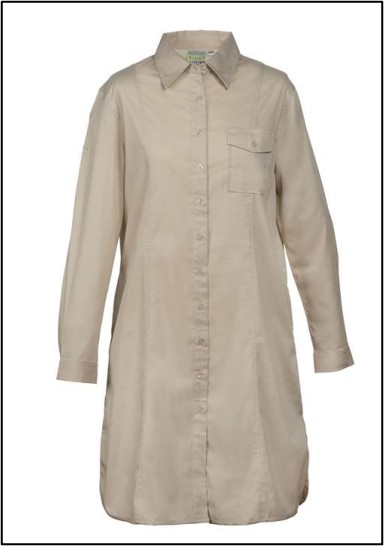
In 2014, to ensure the official uniform met the needs of all its members, an alternative version of the female adult uniform was developed for those who dress modestly for religious or cultural reasons. The shirt was created in consultation and partnership with female Muslim members, ensuring it was both practical and inclusive.
The Squirrels section, a new early years programme for children aged four to six, was officially launched by the UK Scout Association in September 2021 and marked the first time in 35 years that Scouting had introduced a new age range.
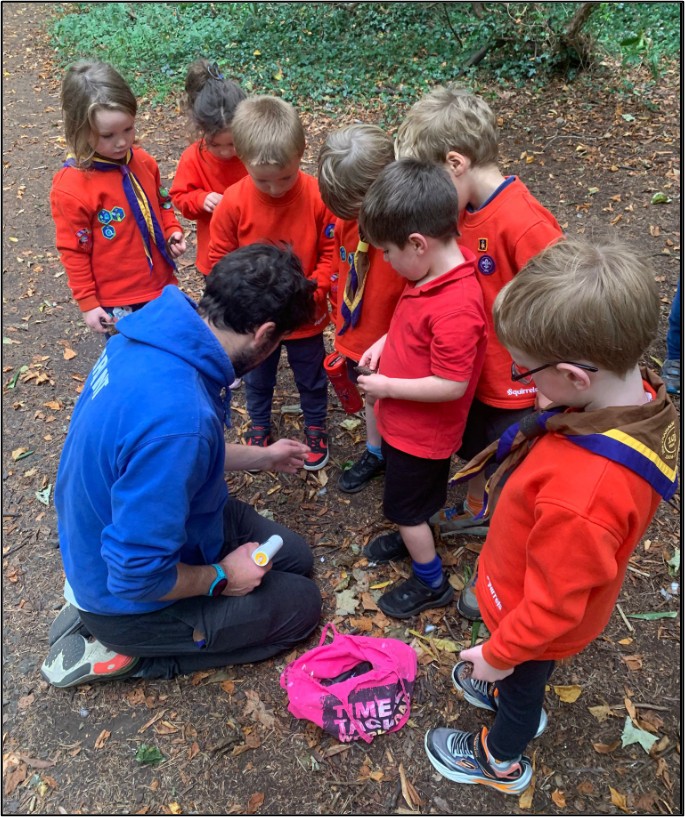
The Squirrels' uniform consists of a red sweatshirt and a necker to represent your local group. They can also wear optional items such as hats, hoodies, navy blue trousers or shorts.