In 1939, war broke out and, like elsewhere in Britain, the 30th Midlothian Scout Troop experienced significant changes.
Scouting during the Second World War took on a markedly different character from pre-war times. During these years, Cubs, Scouts, Rovers & Leaders often played vital roles at home, undertaking numerous important tasks for the war effort, and many members also went on to serve their country directly, joining the armed forces both at home and overseas.
For the 30th Midlothian, this period saw several leaders called up for service, including Cubmasters Mr Amos and Mr Hay, and Assistant Scoutmasters Ferguson and Fisher, who joined the RAF and Royal Navy respectively.
The Group’s original Scoutmaster, D. M. Galloway, also contributed to the war effort by serving as Officiating Chaplain at RAF Kinloss in the northeast of Scotland.
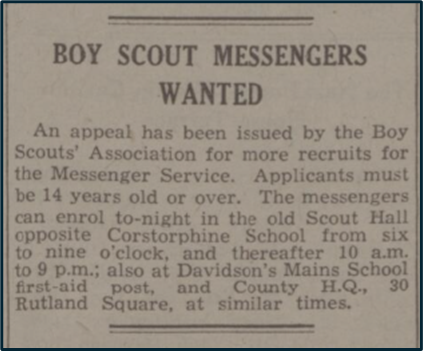
Edinburgh Evening News September 1939 © British Newspaper Archives
The Civil Defence Messenger Service requisitioned the Scout Headquarters on Main Street, a key component of the Air Raid Precautions (A.R.P.). They frequently enlisted volunteer Boy Scouts, aged between 14 and 18, to serve as messengers or runners.
These Scouts would carry verbal or written messages from air raid wardens and deliver them promptly to sector posts or control centres.
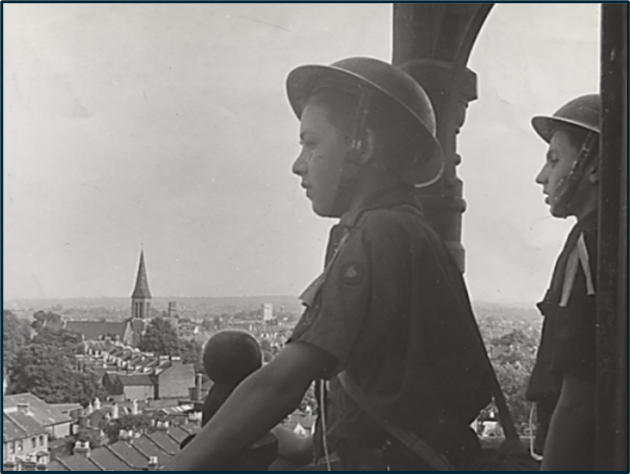
Scouts during WW2 © The Scout (UK) Heritage Collection
Although many Scouters and Rovers had been called up to serve in the War, the Group evenings continued to run with the Scoutmaster remarking that the Scouting spirit has persuaded their everyday activity & games during these difficult times.
The Edinburgh Evening News would place an appeal in September 1939, issued by the Boy Scouts Association, looking for more recruits for the service within the locality.
Those boys who signed up to this Civil Defence Messenger Service in Davidson’s Mains (known as Ward 23, Group A) were under the leadership of Mr J.R. Nesbitt, assisted by Gordon Watt, with both men members of the 30th Midlothian Scout Troop
For the Scouts of the 30th Midlothian, contributions during the Second World War extended well beyond their duties in the Civil Defence Messenger Service. Several older boys volunteered for a fifteen-day Timber Camp in Tweedsmuir, where they helped fell and prepare wood for the war effort.
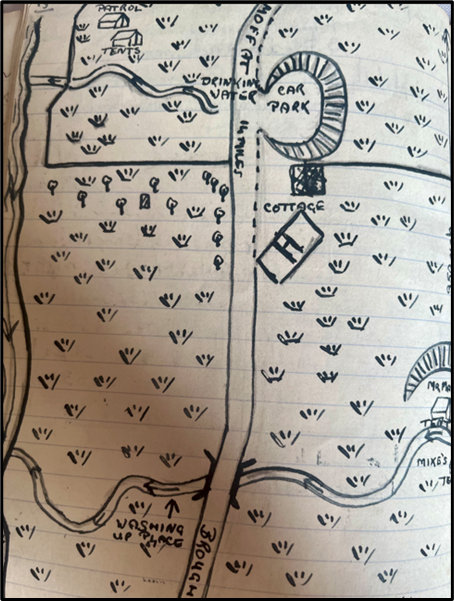
Hand-drawn map of Tweedsmuir Timber Camp 1941 © 30th Craigalmond Archives
Their involvement demonstrated the Scouts’ strong sense of duty and their willingness to support both their community and their country during this challenging period.
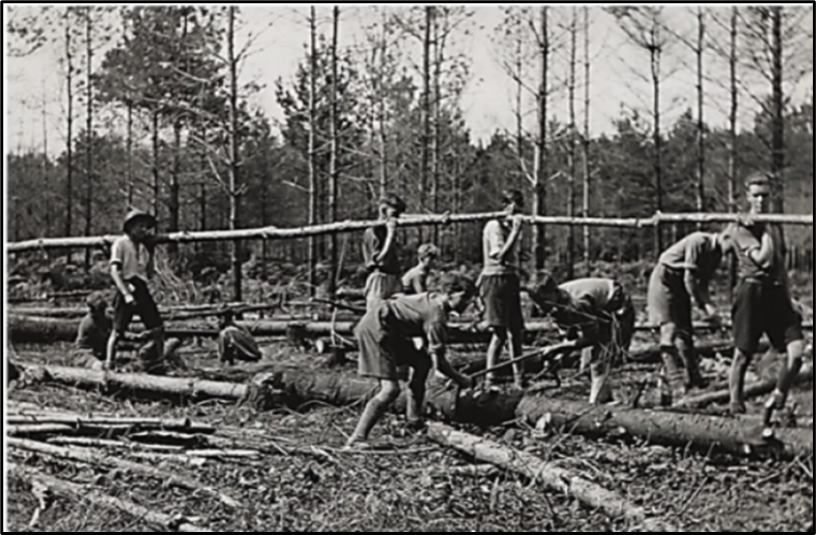
Scouts volunteering to fell timber during WW2 © The Scout (UK) Heritage Collection
Scoutmaster Fisher would reflect on the Troop activities during the War in his Troop Report:
With regard to badges & other tests, several of these have been gained, and I do think that with badges such as the Ambulance and Firemen, to mention only two, at their disposal, the boys are learning something of which will doubtless prove useful before the country is at peace once more. In gaining badges such as these, the boys are fitting themselves out to be able to assist the general public should the occasion ever arrive…During last winter, the Scout Movement offered its services to the public in connection with the erection of Morrison Indoor Shelters and several of these were erected by the Troop in and around the district…Many members of the Troop who have not yet reached the age to join the Forces are doing their bit in serving their country in the Cadets & A.T.C besides remaining loyal to the Troop.
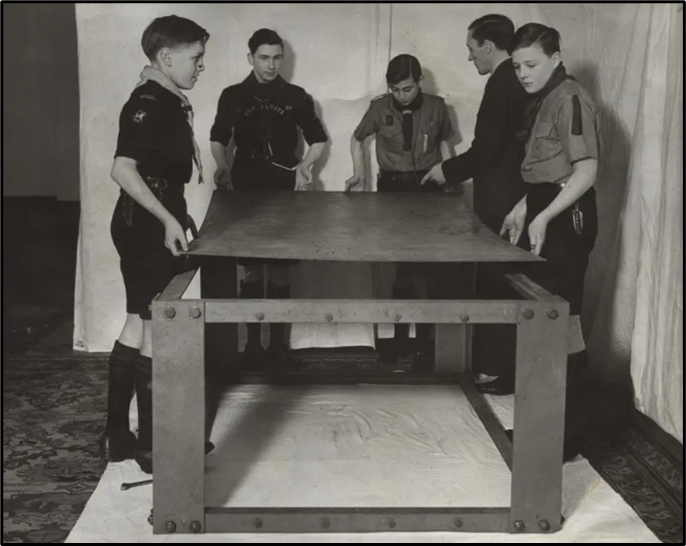
Scouts helping to erect indoor Morrison Shelters as part of the war effort © Scouts Heritage Association
In 1944, during a social evening and dance held in the Davidson’s Mains Church Hall by volunteers of the Civil Defence Messenger Service, a presentation was made on behalf of the messengers to their Ward Leader. It was remarked that the high standard of efficiency attained by their Group was largely due to the energy, zeal and fine leadership of Mr Nesbit.
He went on to state that he would be very sorry when the final “stand down” order came for the Messenger Service but had every confidence that the destiny of our land could be safely left in the hands of the youth.
Since the summer of 1942, the 30th Midlothian Group Committee, made up of parents and friends of the Troop, had ceased proceedings of their Annual General Meetings; however, with the War ending in 1945, these would resume in July of that year.
The Scoutmaster’s Report recorded that, despite the disruption caused by the conflict, the Troop continued to operate, even as many leaders and members of the Rover Crew departed in response to the call of H.M. Forces. It also detailed the Scouts’ activities during this period, including their annual Good Turn Party, where it was written:
It has been the custom of the Troop to invite some of the less fortunate boys from the Canongate Parish of Edinburgh to join us in an evening of games at Christmas Time. This “Good Turn Party”, as we call it, is run entirely by the boys and is surely a good example of the carrying out of the 4th Scout Law, which says “a Scout is a friend to all and a brother to every other Scout, no matter what country, class, or creed the other may belong.
The Troop had continued to take part each year in District Scouting competitions and sporting events, and in 1944, they achieved runner-up position for the Cardross Flag - a trophy they had not won for several years.
They also played an active role in Davidson’s Mains’ annual Gala Day, helping to erect tents and providing a Guard of Honour for the members of the Gala Court, made up of children from the local school.
Each year, the Troop attended Armistice Day services at Davidson’s Mains Parish Church to honour those who served and sacrificed. Additionally, they joined in a Thanksgiving Service at Cramond Kirk, commemorating the end of hostilities in Europe. This community service was held in partnership with the Cramond Scouts and the Davidson’s Mains Girl Guides.
By this time, Scoutmaster, Mr Fisher, had taken charge of the Troop, and although the 30th Midlothian Boy Scouts did their best to carry on throughout the war years, he noted in his annual report the significant toll the conflict had taken on the Group and its members.
While it is a grand thing to know that the Troop has served the King and County well during the past 6 years of war, it is tragic to know that, from my own personal record, 10 former members of this Troop have been killed in action and will not be with us when we hold our reunion when peace at last returns and all our men return home. I personally have been associated either as a brother Scout or as the S.M. of all these men, and I have lost many dear friends. I shall read the 10 names, and then I would ask the Committee to stand in silence for one minute in remembrance of the fallen and also of the friends whom they have left at home.
They are:
F/Lt: W.G.C. Cogman. R.A.F.
Sub/Lt. C.L.S. Hogg. R.N.
Pte. C. Jenkinson. Army
W.O./A.G. G.S. Sinclair. R.A.F.
Flt/Sgt. Alex Grieve. R.A.F.
Lt. D. Drysdale. R.A.M.C.
P/O G. Thomson. R.A.F.
Capt. J. Hardie. 4/5th Gurkha Rifles
Capt. G. Dickie. Army
Sgt J. Walker 1st Airborne Division
However, it was not until the following year that the full impact of the Second World War on the Troop became evident, when Scoutmaster Fisher delivered his report.
Finally, I would like to mention that the 30th has, besides a good scouting record, a good
service and well over 100 members here served or are serving in the forces. Again, we were unfortunate; 16 failed to return. So, it is with their example and devotion in view that we set out another year of scouting.
The war years had a significant effect on the British Scouting Movement, leading to shortages of leaders and a widespread need for rebuilding and fundraising - challenges that were also experienced by the 30th Midlothian Troop.
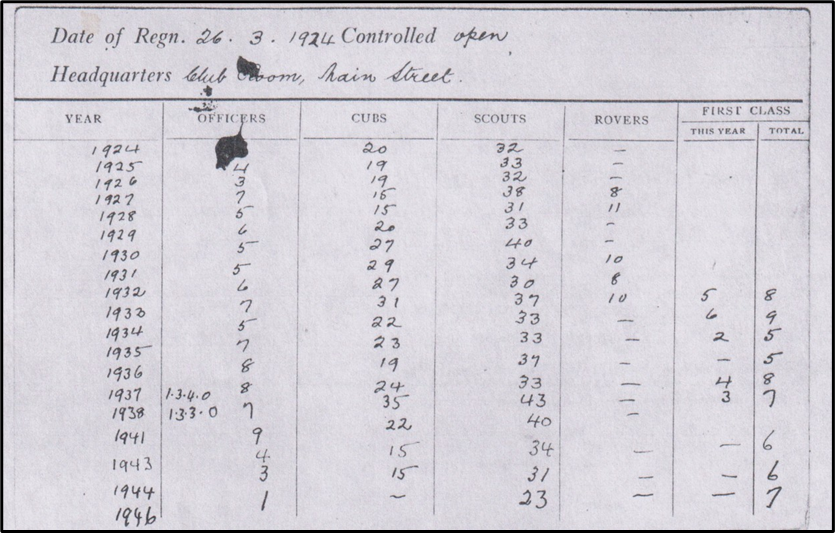
30th Group Census, showing a decline in member numbers following the end of World War II. Image courtesy of Alan Willoughby (SESS Archives)
The Scout Hall had fallen into disrepair, prompting the Group Committee to launch a fundraising campaign to secure the money needed for essential repairs and redecoration.
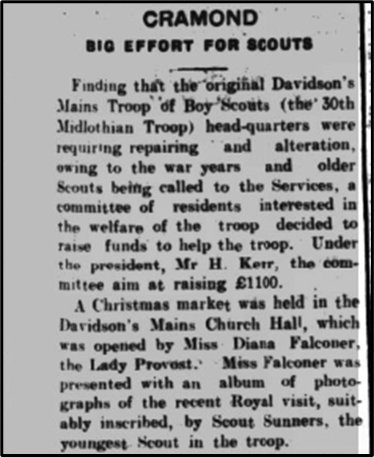
Midlothian Advertiser 21 December 1945 © British Newspaper Archives
In December 1945, the Troop hosted the first in a series of Christmas Markets in the Davidson’s Mains Parish Church Hall, an event opened by Miss Diana Falconer, the Lady Provost.
The following years saw continued fundraising through county dances, Christmas markets, jumble sales, whist drives, and concerts, and as a result, the Troop’s finances improved significantly, enabling important upgrades to the Scout Hall, including essential repairs to the roof.
Troop funds would also allow for the financing of Christmas Parties for the Cubs and Scouts, as well as covering the expenses of two of their Scouts to attend the Sixth World Scout Jamboree – the Jamboree Mondial de la Paix, held in the Forest of Moisson in France, situated approximately 50 miles from Paris.

Logo of the Jambouree Mondial de la Paix © Jambouree 1947
Just two years after the end of World War II, 25,000 Scouts from around the world gathered in France for the Jamboree of Peace, a powerful symbol of resilience, international unity, and hope for a future built on goodwill despite the scars left by conflict.
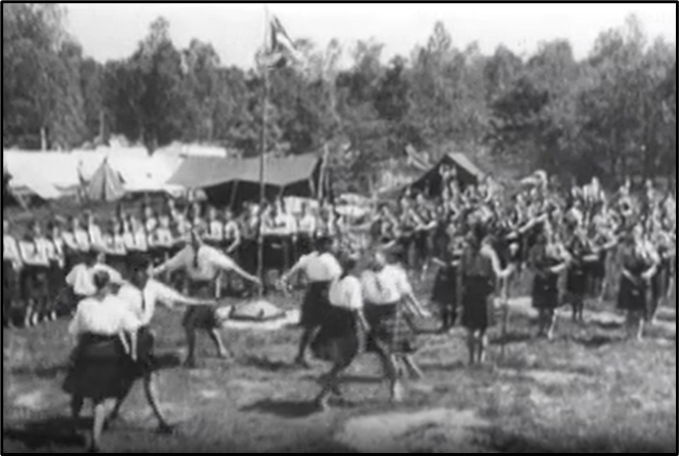
Scottish Scouts at the 6th World Scout Jamboree in France. Image Courtesy of British Pathe