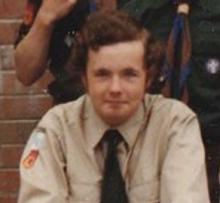
0.00 - The Respondent was introduced and thanked for attending the interview.
He was asked when he was born and where he grew up, to which he stated that he was born at the Simpson’s Memorial Hospital in Edinburgh in 1959 and had always lived in Edinburgh.
0.33 - The conversation then turns to how the Respondent was involved with the 30th Craigalmond Scout Group and his years there.
“There was a troop at Holy Cross just along the road in Davidson’s Mains, but we only had two patrols, and the leader left, so we amalgamated with the 30th so we were at the 78th and two patrols came along and amalgamated with the 30th Inverleith, as we were called, and that was in 1972. So I was almost 13 at the time in 1972.”
1.11 - The Interviewer asks if he can recall when the 78th Troop started, to which the Respondent stated that he thought it may have started in the mid to late sixties by a gentleman from the Church called Bruce Cameron, who the Respondent believe went on to become the Bishop of Aberdeen in later years, so moved away from the area in relation to this and so the Troop folded.
The Interviewer goes on to ask if there had previously been any competition between the two groups.
“No, we were much smaller along there. The 30th was always quite a bit, quite a bit bigger, no, I don’t recall a competitive element at all.”
02.16 - The Respondent is then asked if all the Scouts from the 78th moved to the 30th.
“Yes, when you say all the Scouts, there was about twelve of us, and there were two patrols worth, and we came along, and one patrol became the Ravens, as they were, and the other became the Ospreys.” Interviewer: Okay, so you didn't amalgamate the two patrols. You became your own patrol within the 30th ? Respondent: I believe the Ravens was a complete patrol, and I think, as I recall, the Ospreys were almost complete. But I had to join a different patrol, because my brother was the patrol leader of the Ravens, and I wasn't allowed to be in the same patrol. Interviewer: I haven't heard that before. Respondent: So I became a Falcon, and I met some very good friends in the Falcons.
Interviewer: So very much bird- themed names of the patrols at that point?
Respondent: There were eight of them. If you want the names, I can remember them. When you go round the hall in clockwise order, it is the Curlews, the Falcons, the Peewits, the Owls, the Ospreys, I think, the Ravens, the Woodpigeons…oh and the Gannets, I had missed out the Gannets. I think that’s eight.”
03.46 - The Respondent is asked what he recalls about being a Scout and if he enjoyed the experience.
“Yes, I loved it. I mean, initially, I felt a little bit out of place because I'd been sort of almost removed from the patrols I knew, and put in a different patrol. But my patrol leader then was a chap called Alan Donaldson, and he took me under his wing and he made me feel very comfortable. Cause he would be 15, 16, and I was sort of 12, 13 and quite a bit younger, but I was very, very comfortable, and yes, I very quickly took to the Troop, and I loved my time as a Scout here.”
04.29 - The interview moves on to the activities the Respondent did as a Scout.
“Gosh, every Friday night would be Troop night, of course. We had games and badge activities in the hall, and we would often go up to D’Mains Park for wide games and things, and we would be round and about the local area a lot. We had things like night hikes, which were always very exciting. We were on the hills, we were on the Pentlands a lot. Scouts introduced me to the outdoors, for which I'm eternally grateful, and camps, of course, which were great. Our leader at the time was Ken Thompson. He was very much a hero of mine when I was a Scout – I’m sure you’ve heard a lot about Ken already!”
04.33 - The Respondent talks more about the Scout Leader, Ken Thompson.
“Ken was only… I was maybe 12, but he was only ten years older, at 22. He just graduated, I think, but he seemed like a much older person to me at 22 years old. But he was terrific.”
05.45 - The Interviewer then asked if he would usually come to Scouts with friends from school.
“No, it was a church-based organisation - the other one that I went to it was Holy Cross, just on the junction there. I did have good friends there, and one of my friends is actually going to be interviewed later, Robert Armour. We were at the same school as well, but otherwise, it was mostly a church-based group.”
06.17 - The Interviewer explained that throughout the interviews, there had been some discrepancies about how much the Church was involved with the Troop and asked the Respondent about this.
“Well, sorry, that was the old one, but, yes, that was very linked to the Church. The 30th wasn't quite so linked, we were linked slightly to the Church along the road – Davidson’s Mains Church.”
06.42 - The Respondent is asked if it took place in the old hall beside St Margaret’s Church when he attended Scouts.
“Uh, no, sorry, the one I came from? Interviewer: Uh-huh Respondent: No, in fact, it burned down, unfortunately. It was on the grounds of Holy Cross, just on the junction of Quality Street and Main Street, it was in the grounds there. Later on, the hall burnt down so it doesn't exist anymore, but it was just really almost a shed, I think, at the side of the Church.”
07.11 - The Interviewer explained that the original Scout Hall of the 30th was beside St Margaret’s Church in Davidson’s Mains and asked if he knew of any connection the Troop had to that Church.
“I'm not quite sure. I was only ever in the old Hall, maybe one or twice, for some investiture ceremonies as people came up to the 30th. My recollection was that it was maybe a couple of old cottages knocked together at the time, I think that’s correct. A couple of the folk coming in later this afternoon were based there, so they will know. I think it was almost quite a ramshackle couple of old cottages, quite exciting to go into, but I don’t remember too much about it.”
08.11 - The Respondent was asked what he remembers about doing badges or going to any camps.
“Yes, oh yes, indeed. The first camp I went on was a summer camp, we went up to Dunkeld, near the Loch of Lowes, just above Dunkeld. That was tremendously exciting for a young kid, because we, at the time, we travelled in the back of furniture vans, if you believe it. You've probably heard these stories already, but..
Interviewer: Not a furniture van; I’ve had a coal truck.
Respondent: Right, right. This was definitely a removal van - T&S, I think they're still in business – “T&S moved the best.” So it would back up the lane, we would… all the kits would be piled on there, the tents, the pioneering poles and then all the Scout’s kit would then be lobed on top of that, so that half the van was full of kit and then the Scouts would all get on and we would lie on top of the kit, except the patrol leaders, they were allowed to hang over the tailgate. That was the pride of place. They would hang over the tailgate as we went up the road [laughs] I think health and safety would have a fit these days; it doesn't happen anymore. But yes, travelling up in the back of a furniture van to the camp was tremendously exciting.”
09.30 - The Interviewer asked what camps he had gone to.
“So that was the week-long summer camp. It was about I think, ten days at the time, and we were in our patrols. There would be about five patrols there, I think, and we did all sorts of things. There were hikes, there’d be some swimming in the loch, and all sorts of competitions and of course, campfires. Every time I smell… wood smoke these days, it just takes me straight back to the Scout camps. Yes, campfires and learning the songs and things Yes, tremendously exciting for the first time.”
10.15 - The Interviewer asks about his experiences as a Scout at Camp.
“It was quite relaxed, but there was a definite programme to each day. There would be inspection in the morning, rations would be handed out, and the meals would be at specific times of the day. The Scouters kept an eye on us, I think. I think it was pretty well organised, I don’t think we wandered too much on the hills on our own [laughs]”
11.04 - The Respondent is then asked if he received his Queen's Scout Award or any other badge as a Scout, to which he said he didn’t and wasn’t much of a badge collector. He did recall a collaboration with Heriot-Watt University to receive one particular badge.
“I do remember at the time, it was quite an innovative thing, they had a collaboration with Heriot-Watt University to do the Map Makers Badge and then the Map Maker’s Instructor Badge. So I actually got the Map Maker Instructor Badge in the second year, and we were using exciting things like tape recorders and things like that [laughs], which were quite novel in the 70s, and we were allowed to use university equipment for the training, so I do remember those badges quite clearly.”
11.50 - The Respondent was asked if he remembered any other collaboration, which he said he didn’t. He received some documentation, however, from Alison Thomson regarding this collaboration that he would pass on to the project.
12.15 - The conversation then moves to other Scout Troops within the area, and he is asked if they interacted much with the 30th when he was a Scout.
“It was mostly the 23rd - Blackhall; they were our main competitors in the district, I think. Each year, there would be a District Flag Competition for patrols from around the district. There used to be about ten troops in the district, I think. So it would be one or two patrols from each Troop, and if the 23rd didn’t win, then we would win usually. Interviewer: So was it a direct competition between the two? Respondent: Well, yes, but there were others involved as well, we didn’t always win between us. The 23rd were quite strong – they used to win quite a lot.”
13.07 - The Respondent is asked how he became involved as a Scout Leader at the 30th
“Right, so yes, that would be in 1977, so I’d left Scouts as a 16-year-old in 1975. And then became a Venture Scout here, which I think had recently been starting up, the Venture Scouts here, that was from 16 to 20. And then when I was about 18, in 1977, Ken Thompson invited me and Robert Armour, who’s coming in later, to come to Summer Camp that year, which was held in the Borders. So that was 1977, it was a very hot year, if you remember the summer of ’77, it was a very warm year and I think some of the trees on our campsite became on fire that year. So that was ’77 when I was 18.”
14.25 - The Interviewer asked if he remembered what a routine evening was like as a Scout Leader.
“The leadership team was almost a patrol in its own right. There would be about 8 or 9 of us lined up at the end of the hall here, and that was terrific fun, it really was. So we would appear before seven o'clock, things started at seven. There would be a duty patrol [that] would be looking after the evening, and we would have a flag break at seven, with the duty patrol leader would break the flag, and then there would be inspection and then a variety of games and badge activities after that – pioneering, knotting and first aid, all those sorts of things. At the end of the evening was probably the most fun for the leaders, because the older boys would stay on and there would be very competitive games of football between the leaders and the older boys [laughs] And then the leaders would disappear to the Old Inn after that [laughs]. So it was terrific fun.”
15.43 - He is then asked if he remembers much about the ceremonies that took place in Scouts when he was a leader.
“I remember coming up quite clearly, yes. That was quite a serious thing, really. The Troop would all be on one side of the hall. There would be a rope put across the hall, and the Cubs, being invested or the people joining the Troop, would stand on the other side of the rope.
They would recite the Promise, the Scout Promise and would be invited to step across the rope and be greeted by, at the time, by Ken Thompson and the other leaders, and it was quite a solemn thing.”
16.30 - The Respondent is asked whether the 30th, when he was a leader, had two Scout Troops?
“Not at that time, no. The Troop grew through the ‘70s, and I can’t quite remember when the split took place, but there were nights where we might have sixty or seventy Scouts in the hall bus plus eight or nine leaders, and it was becoming too unwieldy, too large. So the split must have been about 1980, I think, I can’t quite remember, but I'm sure I could find the date somewhere. Interviewer: I can’t imagine sixty in that hall! Respondent: There was no space to stand, and it was lined up completely around the hall. So, yes, so then it became a Monday night and a Friday night.”
17.21 - The Interviewer asked how they managed to play games when they were so busy.
“Yes, it was difficult. It was quite robustious at times, yes, but it did work, yes, it didn't seem to hold things back.”
17.42 - The Respondent is then asked about working with his fellow leaders.
“I mean, we would have meetings to decide the programme, and then each person would have a specific task for the evening. But generally, the Scout Leader would run the evening and people would be delegated to run a badge activity or a game or something like that, so it was spread around.”
18.14 - The conversation moves on to the kind of badges the Troop worked on.
“The badge work was split into three; there was the Scout Standard, the Advanced Scout Standard and the Chief Scout's Award. Within each thing, there were various different activities, awards, and tests to pass. Interviewer: So, did you split the groups up by age at that point then, so that they were working through each stage? Respondent: Yes, indeed. Yes, so there'll be a group doing Scout Standard work, and within that, there may be people doing map work or knotting work or first aid, and then they’d be an Advanced Scout Standard Group and then the Chief Scouts Award as well, yes. Interviewer: So, were you allocated a group each evening so that there was a leader helping each section? Respondent: Yes, typically, yes, you would have a bit of training to look after each evening, yes.”
19.16 - The Respondent was asked if he could share a memorable outdoor adventure or trip as a Scout Leader.
“Some of the most memorable trips were when we would go away for weekends to bothies in the Borders. There was a series of Border bothies around the hills, typically for the older boys, and you would spend the days on the hills and then the evenings cooking and relaxing at night; that was great fun, and I went to quite a few of those. Interviewer: Were those weekend camps? Respondent: That would be a weekend trip, and there were weekend camps as well. The first one I went to was at Stobo in the Borders, and that was terrific. Around about the Tweed Valley there used to be quite a lot of campsites.”
20.10 - The Respondent was asked if such trips and camps brought the Scout Leaders closer together.
“Yes, I mean running the camps was as much fun for the leaders, possibly more than the Scouts, I think [laughs]
Interviewer: Do you think that’s why, because you are obviously here today with other leaders, is that why you’re quite a close group do you think?
Respondent: I think so, yes, the group that we’re here with today, we've known each other for the best part of 50 years. It just seemed like yesterday when we met each other last. I think that stems from Ken Thompson, he was a super leader of people, he really was. He was a teacher to trade, and I think his teaching skills were great at forming groups of people.”
21.05 - The conversation moved back to Scout nights, and the Respondent was asked about games played and if he had a favourite or which ones were popular with the group.
“I guess British Bulldog springs to mind straight away [laughs] Yes, a lot of physical activity involved in that, and rushing around in the hall. What else? We used to play a game called Crab Football, where it would be squirming around on the floor with a football [laughs]. That was quite popular, and that was an inter-patrol competition, so that became quite competitive.”
21.44 - The Interviewer asked if the Scout group had ever been involved in community or volunteer projects.
“Yes, we did do a Bob-a-Job at the time, quite a bit, I do recall that I also recall, from the Chief Scout’s Award, there was quite an element of service and that and quite a few of us were involved to help at the Western General at the time and we’d help the Portering Department there. That was very interesting. Interviewer: How was that organised? Respondent: I'm not really sure how it was organised, but we would just turn up at Western General, I would park my bike outside and go in, and the Portering Department was expecting us, and we would just help out with some of their work. Not convinced how useful we were, but it was interesting at the time [laughs]”
22.45 - The Respondent is asked to talk more about what Bob-a-Job entailed.
“We would get things to do, like car washing and window washing, things like that, grass cutting. So we would… I think we would have to do it in uniform, so we would turn up to people who knew who we were. Yes, they would offer us something for doing various jobs around the houses. Interviewer: Did Scouts do that as individuals or groups or was it up to them? Respondent: You could do it as an individual or in a small group, I think, as I recall. I'm not really sure when it stopped, but it's been quite a long time, I think, since Bob-a-Job, but yes, it was good fun and it did raise funds as well.
Interviewer: Did the Scouts enjoy it?
Respondent: Yes, I think so. I certainly did as a Scout. Yes.
Interviewer: In terms of fundraising, was that quite a profitable enterprise, was it one of the main fundraising things you did?
Respondent: I think so, there was possibly a charitable element as well. I'm not sure if we kept it all for our group or if part of it was charitable.”
24.11 - The Interviewer asked what types of things the Scout Group fundraised for, to which he responded that the Troop was always active in fundraising, with most of the money going to maintain the Scout Hall, as that would cost quite a bit.
24.30 - The Respondent is asked what he recalls of Gala Day and Remembrance Parades.
“Yes, yes, we would have an annual Church service certainly, where all the Troops in the district would assemble and parade with flags and that would move around the district to various churches. We did do something in the Gala each year, I think. We would be parading down Main Street and up to D’Mains Park, can't quite remember what we did when we got there [laughs] I think Jim Campbell has already shown you some pictures of the bridge we built one year, that was quite spectacular, but I don’t think we did anything like that every year [laughs]
Interviewer: Okay, so it wasn't an annual thing that was up in particular… so that had been part of badge work, then?
Respondent: Not really, no, just taking part in the Community, really, as part of the Gala.”
23.35 - The Interviewer brought the conversation back to camps and asked the Respondent if he could talk more about them.
“I wasn’t at very many camps as a Scout; I was at more as a leader, but we had the one at Dunkeld, which I’ve mentioned. As a leader, I was at Hounam in the Borders at Rutherford on the Tweed, and we went to Locheranhead a couple of times, which was a fabulous campsite right at the end of the Loch. Favourite activities, I think. I think all the canoeing activities were great, we used to have a couple of old canoes, which I think are long gone, but we did a lot of canoeing. Hiking, of course, and orienteering was one of my favourite things as a Scout, certainly.
Interviewer: Do you recall if you were in tents or an accommodation?
Respondent: If we went on a winter camp or a spring camp, we would be indoors often, but in the summer, it was always under canvas; that was very much part of it. Interviewer: In terms of activities, is that very much leader-led, or did you allow the Scouts to pick some of the activities that were being held at camp? Respondent: The programming would be done by the leaders, certainly. There would be quite a structured series of events; the planning meetings were always good fun as well, working out what to do.
25.46 - Interviewer: And was it weather-dependent sometimes?
Respondent: We would typically have wet weather activities for that planned, yes, yes. If it was a very wet day, the Scouts would be given things they could do in the tents, writing poems and things like that [laughs]
Interviewer: So, writing tasks? And they would present that to the group later?
Respondent: Yes indeed.”
27.42 - The Interviewer discusses that many of the Camp Log Books from the sixties that have been transcribed seem to miss out on the activities that were done during wet weather. The majority of the conversation seems to be about food. She then asked the Respondent if he recalled any of the kinds of food eaten at camp.
“Yes, I mean, there was certainly a menu each day, and there was a Rations Tent, so every day, the Scouts would be delegated to go up to the Rations Tent and would be given out the rations for the day and sometimes a menu, you’d have a menu, even. The food, I mean, was fairly basic, things like corn, beef hash, things like that. But yes, quite a lot of Scout Troops, I think, cooked communally in one large tent, but we always did patrol cooking, so every patrol would cook for itself, and a leader would be delegated to eat with each patrol, just to make sure they're eating okay. Interviewer: Was that over a fire, or was that in a kitchen? Respondent: It was typically over fire, yes. There were metal frames, and sometimes there were firepits on the ground and also we would cook on metal frames with the fire elevated above ground level. Yes, always over fire, yes.
Interviewer: It was mainly edible?
Respondent: Mainly edible, yes, yes [laughs]”
29.24 - The Interviewer asked if he had attended any international camps or jamborees, to which the Respondent said he didn’t.
So, she then asked if there were any moments during his time with the 30th that he felt a sense of accomplishment engaging the young people.
“It's a big question. I'd have to… I'd have to think hard about that. I'm not really sure how to answer that one, sorry. But I did get a lot of, a lot of personal pleasure out of doing it, and I think the Scouts enjoyed what we as a leadership team gave them, I’m pretty sure they did. Interviewer: So, as a leader, it did impact your skill set and personal growth? Respondent: I think so, yes. I think so.
Interviewer: So, you mentioned your love of the outdoors. Do you think that's directly due to Scouting?
Respondent: Yes, it did. Well, Scouting actually gave me a love of the outdoors.
I started climbing Munros at that point and that became quite a passion with me, and yes, the outdoors became a large part of my adult life. I do owe that to Scouts, I’m sure. Interviewer: And skills, you know, like your orienteering and knots and things like that, do you think that’s been because of it? Respondent: I got a love of map reading from Scouts for sure, yes. I hope I managed to pass some of that on as well. I used to love teaching map work.”
30.51 - The Respondent is asked for his views on current Scouting and whether he would recommend Scouting to others.
“I must admit, I’ve been away for such a long time. I would certainly recommend it, I’m sure, but I don’t know much about… I mean, things have changed, I know, and there are Beavers, and is it Squirrels? Interviewer: Squirrels have just started, yeah Respondent: So, it's changed in its age profile quite a bit, but I would definitely recommend it, yes.”
31.20 - The Interviewer asks if he has any other thoughts or memories of the 30th that he would like to share.
“Just really that it was an integral part of my early life, and … yeah, it’s a period of life that I have some of the clearest memories, that hasn’t been apparent just now [laughs], but I have some of the clearest memories of my early life, and I owe that to Scouts. And it's given me a lot of friends and a lot of friendship groups and things as well. So I owe it a lot.”
31.54 - The Respondent was thanked for doing the interview.