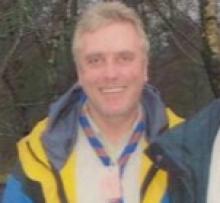
0.00 - The Interviewer introduced the project, asked the Respondent to confirm his details for the record, and then asked where he was born and where he grew up.
“I was born in Glasgow. I grew up, I was a scout in Glasgow 24th, in Bearsden, in the 1960s.”
0.40 - The Interviewer then asked about moving to Edinburgh.
“I went to University in Aberdeen and then worked overseas for 12 years, and I came back with a young family and wife to Edinburgh in 1992. Interviewer: Okay. Respondent: We settled in Edinburgh.”
1.00 - The Interviewer asked the Respondent how he became involved with the 30th Craigalmond Scout Group
“Well, my three sons were in the scout group, or about to enter the scout group, and a plea went out from the Committee; they had a vacancy for a Group Secretary. So, in 1998, I joined the group as Group Secretary. I was in that post for 2 years.
Interviewer: Okay, and is that the same time as your boys started in the group as well?
Respondent: Yes, my eldest son was at Cubs, and my younger twin sons were just entering the Beavers.
Interviewer: Okay.
Yeah, and you say they put out a plea, was that just word of mouth over there, signage somewhere, or also a bit more through emails? Respondent: I think it was probably a note that was sent around to parents.
Interviewer: Okay
Respondent: A take-home note from the group, and I saw that, and I thought, well this is a way I can contribute. Interviewer: So that you're part of the Committee, initially. Respondent: I started off as Group Secretary.”
2.18 - The Interviewer asks about his time in that role
“I was there for 2 years.
Interviewer: And did you feel that you were impactful and included in the scout group?
Respondent: Well, funnily enough, yes, I mean, it was a very active Committee - Norman Hinkley was Chair, Paul Furbank was Treasurer, and we had other active members. And the uniformed leaders were Committee members, that's how I first interacted with the sections. And we met pretty routinely … was it once a month, or six weeks? There was a lot of business, some of the main events were: The Scout post, D'Mains Gala these things were all organized through the Committee.
Interviewer: Okay
Respondent: So the Committee was an active part of the group and then the sections did their leadership of the scouting side of it. But, the Committee was pretty integral to what was going on”
3.23 - The Interviewer enquires about setting the agenda for the meetings.
“Well, Norman did that. It was a routine structure to the…. and it would consider upcoming events, planning for events, hearing back from sections. What kind of supports they were asking for, issues arising, like changes of leadership and so on.”
3. 51 - The Interviewer enquires about the leadership turnover and the accomplishments of the committee
“There was, in fact, I stepped up into Cubs because of the turnaround of leaders. But, I mean, one of the major accomplishments of the Committee when I was there for 2 years was the hall refurbishment. That was secured lottery funds to bring the hall up to the standard that you see today. I know you've, beautifully, kept it properly, in good order but it was so dilapidated in the late 90s that, it was virtually condemned.”
4.39 - The Interviewer asked for some elaboration of the refurbishment.
“Well, health and safety-wise, there were lots of sharp edges. It was old floorboards which, if you skidded on them, you would get skelfs, you know. There were protruding nail heads and things, so the whole thing was very rough and ready. OK for maybe having a knock-around, but not really suitable for continued use. So we had it assessed and it was poorly heated, it was an uncomfortable place to be in - it was just like a shed and also it was quite hazardous in terms of jutting corners and the boards.
So options were looked into - we relocated to other halls. other church halls and applied to the National lottery for the Millennium Fund and were successful to secure funding, and that enables the works to progress. We had different options - some were more elaborate than others, but this is the perfect option, because it was basically making the most of what was already there without trying to be too ambitious. The key thing was a brand new floor, good heating, good preparation of all the surfaces. Better use of the storage, the stores and it brought it up to a suitable standard for use, and then we moved back into the hall.”
6.46 - There was a brief discussion about some specifics of the refurbishment before the conversation moved on to how the hall fell into disrepair.
“It was just wear and tear, we look back nowadays and think, well, this is the required standard for youth activities. But in the earlier days of scouting, there wasn't quite the same thought put into it. It was a knockabout type of activity that scouts were involved in, and it just had run its time. Sort of, it wasn't exactly dilapidated, but it was substandard, and it needed more than just a lick of paint, it needed proper investment.”
8.03 - The conversation moves on to ask how the Committee went about getting funding for the hall refurbishment.
“Well, it was a group activity within, within the Committee, led by the Chairman and Treasurer. My role was to administer the application, so I oversaw the actual filling in of the forms and the submission of the forms, but it wasn't my responsibility either to oversee or to accept the lottery funding; it was a Committee responsibility under the chair. But, you know, I was very pleased to be so actively involved; it was, was one of the major, I feel, it's one of the major achievements of my time in scouting, and I was still only on the Committee.”
9.23 - A brief discussion about the amount of funding, where the Respondent wasn’t positive, but thought it might be for £40,000. The conversation then continues about the work done in the Scout Hall.
“It was a complete refurbishment done around the time of the millennium - there was a lot of community hall activity going on, so this was refurbished, not as a Scout hall, but as a community hall. And part of the justification from the Lottery Commission was that it had to be opened up to community use. Interviewer: Right. Respondent: And it was, and we said, it was open to use by other organisations, and there were a number of organisations that used it, I don't know if they continue to because you now have a very full program, but some days of the week, it was possible to have other activities going on.”
10.27 - The Interviewer asked about the length of time the refurbishment work took and where the Group’s Scouting activities were held during that period.
“I was in the Cubs by that time when the work was underway and it took the best part of the year. We went to, two of the church’s church halls, in Davidson's Mains, which was a stop gap measure, it kept us going - wasn't my ideal, but it worked out okay.”
11.11 - There is a discussion about the number of nights the Beavers, Cubs and Scouts had within the Group before moving on to ask about the open celebrations
“There probably was a kind of reception - snacks and drinks, and with the parents, and showing the activities of each of the sections. So, yeah, so I do recall that event. It was after the hall opened, so yes.”
12.23 - The conversation briefly continued regarding when the hall reopening took place, which he believed was around late 2000 or early 2001. They then moved on to discuss the Respondent’s appointment as a Cub leader.
“Yeah, the Cub leader stepped down in 2000 and left the gap in that section. I had… it was quite a crisis for the group - there was no other Cub leader around, no one was willing to take it on.”
Interviewer: So there weren’t any other volunteers at that time?
Respondent: It was very weak, I mean, it was very, very difficult to recruit and engage. So anyway, on the Committee, we were sitting in the Committee discussing this with the then Akela, the Cub leader, there was no solution, and I gave it a bit of thought, and I came back to the group and said, Well, look, I'd like to step up and move into the Cub Section.”
13.30 - The Interviewer asks if there was any pressure for him to step up as the section might close.
“No, by this time, I was really quite keen to actually step up and get more involved.”
13.41 - The Interviewer asks about the Respondents’ children in the group.
“My youngest ones were coming up into Cubs, and my eldest was in Cubs.”
13.50 - The Respondent was asked how his children felt about him becoming a Cub Leader
“Well, they might have felt it was a bit strange, but they accepted it. I mean, they knew what the situation was, and we got on fine.”
14.05 - The conversation moves on to talk about leaders at this time.
“They were constantly calling for leaders for them, but not a lot of success and once I was in the Cubs, of course, I campaigned to bring in more leaders. Interviewer: And how did you do that? Respondent: Well, through communication to the parent body, that we needed parent helpers and uniformed leaders. But the big success was at Cub Camp, where parent helpers came along to help, and I recruited four leaders at that camp.
Interviewer: Oh, wow, okay.
Respondent: I caught them at a good... you know, good weather, they were enjoying it [laughs] I managed to persuade them to step up. So, we suddenly had a good number of leaders.”
00.00 - Part 2 starts due to an interruption. It resumes following a change of location. The question of recruitment at the Cub Camp was raised again.
“Well, the camp was organised by Cubs district. They were very, very active under, then Diane Ross was the Commissioner of Cubs, and it was Bonally, in 2001 and we had parent helpers out at the camp, so they were involved with things like catering, general kind of help duties, I was the uniformed leader, and there was a series of activities organised by the District so we were participating as, as the group. And given that we spent a few days together, with the parent helpers, inevitably, the issue of uniform leadership, I was the only Cub Leader, and it was a difficult position to be in, just the sole leader, and we had a very big Cub section. Interviewer: How many Cubs did you have at that time? We had 6 patrols, and it should have been 6 by 6, so it should have been 36 maximum, but we were, we were over that, we were spilling over that, so it was a big Cub group, Cub Section. So anyway, I put it to them, towards the end of the camp, I said look, we're recruiting leaders, we had a chat about it and then three or four of them agreed and said Yeah, we'll join up. Interviewer: Can I ask you, could you recall any names? Respondent: Well, the most active one was Nicky Vohra; he remained with Cubs, Scouts and Explorers, with me. And the others stayed, for not very long, well, the key one was Nicky Vohra, his son was in Cubs and Scouts, so others came and went, but he's the key one.”
02.57 - The discussion moves on to the skills required for Leaders, other than willingness and turning up.
“Of course that are that are requirements that uniformed leaders had to go through - Health and Safety, Child Protection and all of that, which is quite a big commitment, as well as the training for scouting so that's was something it doesn't appeal to everyone but you know, Nicky was up for it, and he went through all that.”
03.43 - The Interviewer then asked about what was involved in his role as a Cub Leader at that time and what a typical Cub meeting evening looked like.
“Well, it was a busy time for me, because I had to put together a programme for each evening, which of course starts with Flag Break. I generally tried to tire them out, that was easier in summer than in the winter, with kind of an active game, and then skills badge, badge work, then it would conclude with another game of some sort and then there will be Flag Down to the close the evening.”
04.31 - The Interviewer asks if there was any help from the other leaders regarding planning.
“It was almost like a second job, a) I was inexperienced, so I didn't have a body of knowledge to, sort of, look back on, I had to work it out for myself, but some evenings were simpler than others, especially on sort of warm summer evenings, you could get out and do a wide game or something, but in the hall, of course, it had to be structured. Cubs have a short attention span, easily bored and have to be kept occupied, so it was quite a lot of planning work to give them new and interesting things to do. Now, what I did do with them at an early stage was to say, what do you want from your Cub experience? So we had a discussion about what the possibilities were, and I described the badge and award structure, and they said, ‘Yes, that's what we want to do. We want to do badges and awards.’ Good for them, because I think, that's the whole point of scouting, it's not a babysitting service, as far as I'm concerned, so that gave it structure and purpose and so of course the award structure is very progressive, badges contributing to awards, and they ended up with sort of sleeve of badges and awards, which is looked down upon by some groups. You know, they think, ‘Oh well, we're not impressed with all these badges’, but actually they loved it, they loved getting badges and the ceremonial accomplishments of it. And it did have a purpose behind it, because there was the Chief Scouts Awards – Silver, Gold, Platinum that this all contributed to, so that's what also gave a structure to the evenings, like there could be outdoor activities based around a particular badge, which is more meaningful than just games and things.”
07.15 - The Respondent was asked about the guidelines he had as a leader and whether help for planning was available.
“Yes, the District was very supportive - huge credit to Diane Ross. So they did the heavy lifting in terms of things like camps and events like the Gang Show. In terms of badges, yes, I had to look through, I think we had some folders of the different badges and awards, and then I’d try, and sort of discuss among the Cubs what the possibilities were for accomplishing certain things and which ones they wanted to do. Some of which they could do on their own initiative, some of which required more sort of active scouting involvement.
Interviewer: Was there time set aside each week for badgework?
Respondent: So generally, Flag Break, game, badge work, game and that would be the kind of general structure.”
08.24 - The Respondent was asked how the badge work was structured.
“Pretty much in their patrols, so they would all be doing. for the most part, doing the same badges at the same time. So, if they were doing map reading, they would all be doing map reading, and such like.”
09.03 - The Interviewer then turned the conversation to uniforms, asking how strictly leaders enforced uniform standards and discipline more generally.
“Well, I tried to keep them smart, proud of wearing a smart uniform, but you know it's youngsters, so it was pretty decent but not too strict. Yes, they wore uniforms, full uniforms for Flag Break and Flag Down and then sort of more casual for games and activities.”
9.51 - The Respondent was then asked about how Cubs chose the badges they worked towards and whether there were any particular preferences.
“Always very keen on getting out and about, outdoor activities, which I think is, you know, a real strength of scouting, so they were all very keen on camping, any kind of outdoor activity. Interviewer: Can you take us through some of the camps or outdoor activities that you can recall? Respondent: Well, the Pirate Camp at Bonally was one example; there was a series of camps at Bonally and other places – Fordell Firs.
And they would have a set of programmed activities that they would do for two or three days. They camped in all seasons, so sometimes it would snow if it was winter. Interviewer: In tents? Respondent: In tents, yes, in Storm Haven tents in those days. So yeah, in all weathers, all conditions Interviewer: Did they enjoy it? Respondent: Loved it.”
11.13 - The Interviewer asked whether any parents had ever complained about their child attending camps in cold weather. The Respondent said that this largely depended on parents’ expectations, referring to the “Brass Monkey” camp, which was intentionally held during colder seasons. He explained that, despite the challenging weather conditions, the Cubs would erect Storm Haven tents, which could be difficult to put up without experience. However, once erected, the Cubs were able to make them warm and comfortable, as well as keep them tidy and well aired, thereby learning valuable practical skills. He was then asked about food at Cub camps and whether the Cubs cooked for themselves while they were there. He explained that it was varied depending on the nature of the camp. Often, it was backwoods cooking, and on more formal camps, it was mainly parents who were involved in the cooking. The Respondent was then asked what his aims were as a leader in supporting the Cubs.
“Well, given that we had a badge and award structure, my aim was to reach the top award.
Interviewer: To get everyone to that level?
Respondent: Yeah, and we did so in Cubs, it was the Chief Scout Silver Award, so that was the target to aim for, and everything else was kind of - you worked back from there and what needs to be done to accomplish that.”
13.18 - The Respondent was asked whether he remained in contact with people he had been involved with during his time in the Group. He said that he remains primarily in contact with the current Group Section Leader, Dylan Lynch, who had been a Cub, Scout, and Explorer Scout before becoming a leader. He explained that Dylan was close with his sons during that period and that this relationship has continued to the present day. He also stated that he remains in contact with the Vohras. The conversation then returned to Cub evenings, and he was asked what games he recalled playing with the Cubs.
“Well, I used to love it in summer, where it was possible to go out with really very little structure to the programme. So after Flag Up, we could just go out to the park, play a wide game. I used to make them run around a lot, get them tired out because they have a lot of energy and to dissipate some of that energy made it a lot easier to manage the rest of the programme. So the easiest times were summer, and sometimes I could get away with really very little in the way of the programme because we could just focus on games. So it wasn’t all just routine badgework, there’s a lot of fun and games about it too – scout games. Interviewer: What was your favourite activity to do with the young people? Respondent: I did enjoy wide games, seeing them run about and enjoy themselves, but I got a lot of satisfaction out of the awards too. That made me feel there was a purpose to all of this; they were accomplishing something. It was kind of a life skills development.”
15.43 - The Interviewer asked whether most of the Cubs came from the local primary school and whether they tended to join in existing friendship groups, or whether children from other schools in the area also joined and, if so, whether they found it difficult to integrate. The Respondent explained that young people joined from both state and private schools. He went on to say that children usually joined at a younger age, as it was easier to access Scouting at that time, unlike today, when it is much more popular. Over the course of the year, there was typically some drop-off in numbers, which created opportunities for others to join. The conversation then moved on to discuss the Cubs’ involvement in events within the local community.
“There was no Bob-a-Job, that was something I was involved in in my youth and fantastic, but that preceded. But I mean the two main formal group activities was the Davidson’s Mains Gala and the Scout Post – great fun. Also in terms of the award structure, there was things like conservation, and I have a bit of a conservation background, so I was quite keen on that, and they did a lot of activities such as clearing invasive non native species on Corstorphine Hill, clearing litter from Cramond Foreshore, Cramond Island. So they were very active in conservation, and the great thing about conservation is it gets you out and about, and you can team up with the local Ranger and get an evening organised by the Ranger to do activities. So that again kind of reinforces the outdoor exploration, expedition, and having a working purpose behind it. That was an important core activity during all three sections, really, but the Cubs were very active in conservation activities.”
18.52 - The Interviewer then asks what he remembers about the Davidson’s Mains Gala and how the Cubs were involved.
“Well, we met up, the uniformed sections, in Davidson’s Mains Main Street and walked to Lauriston Castle, and the Gala took place there. We weren’t directly involved in the Gala as such, but there would be a Scout Group tent – generally it was a tea tent, they did teas, which were very popular, they sometimes did other activities like football – scoring goals, coconut shy, things like that, but the main activity was the tea tent. That was mainly the Scouts that did that activity rather than the Cubs. Once the Cubs got to the field, they were free just to enjoy the Gala.”
20.10 - The Respondent was asked how he worked alongside the other Section Leaders. He explained that there was not a great deal of contact with the Scout Troop at that time in terms of supporting the Cub Section and felt that most of the support came from the District, and noted that this had changed over the years, with the Group now being much more supportive internally. He added, however, that this had not been an issue at the time. The conversation then moved on to Scout Post, and he was asked to describe what this involved.
“It was huge, I think it required an awful lot of organisation, which was a bit of a black art. Again Norman Hinkley and Paul Furbank knew it and understood it and it took place over a period of about 3 weeks and the main elements of it were – you were given a huge amount of post with the scout’s label on it so people would post their Christmas cards instead of a stamp with the Scout Post label on it and the Post Office would batch them up into districts, as if that’s their first sort, and they would send them to the relevant scout group. So we would have this huge amount of post that needed a first sort, so the entire hall had tables out and groups of people allocated to different neighbourhoods, and it was alphabetical in some way, and the first sort was basically to take all of this unsorted mail, which was for our neighbourhood, and sort it approximately into streets, was it? I think – so alphabetical streets. And then if there were any post that fell outside of this district, that was accidentally brought to us, that would have to go back to the Post Office to be redistributed. I think we continued to get more of this mail in, so a lot of activity over the first week, receiving incoming mail and getting it batched up into this first sort. And then I think the second sort was to put them into numerical order – well, the alphabetical had to be sorted into the different streets, and each street had to be put into numerical order so that…
Interviewer: You could do them logically?
Respondent: Yep, but of course, street names don’t necessarily mean that the streets are close together geographically; they can be – if you’re in Silverknowes, then they are quite close together, but just because you have a street beginning with ‘D’ doesn’t mean you are near another one.
Once you got them sorted into the street and chronologically, then they have to be batched into geographically coherent areas, and that is another step in the sort process.
Then you end up with batches of post and the Scout post itself took place over several days in which the individuals from the section were allocated different neighbourhoods and they would go out and post it, and have an adult supervisor with them, and they would do the post, some of which was more troublesome than others in terms of getting access to the post.
But that went on for several days up until Christmas Eve when all the post was sent out. So great fun, hard work, very intense because every day the batches had to be put into order for the following round of activity. Fantastic fun!
The Respondent was asked who was involved in sorting the Scout Post. He explained that everyone in the Group was encouraged to help and that the scheme relied largely on people’s goodwill to operate. He felt that it worked very well and was enjoyable to take part in, including for the Scouts who delivered the cards. He described it as quite an adventure for many of them, as it took them to new areas within their local community to deliver the post. When asked whether Scout Post operated only locally within Edinburgh, he said that he believed it was a UK-wide scheme. In response to whether it was a successful fundraiser for the Group, he stated that it was one of the key fundraising activities, alongside supermarket bag-packing events. The conversation continued briefly on this topic before moving on to discuss how fundraising income was used within the Group. The Interviewer then asks if he had ever attended any Scout Jamborees or International Camps.
“Yes, well, notably 2007 was the World Scouts Centenary. District put on a District Camp for all sections at Dalmeny, and I was in Scouts at this stage as a Scout Leader. There was a World Centenary Jamboree down in Essex – I led a Flag Party down to that, so those were the two big ones.
There was also a Ceremonial Sunrise on Arthur’s Seat, which was fantastic because it was good weather – very, very clear, and had to get up onto Arthur’s Seat at about five o’clock in the morning for sunrise, which was fabulous. It wasn’t a cold time of year, but it was pretty frosty out there.
So the World Centenary was the big event.
Interviewer: How was it working with the other Scout Groups? Did you do a lot of intermingling?
Respondent: Very much, especially Cramond. When I was a Cub and a Scout Leader, Cramond were very supportive. I got to know the Cramond group because, bizarrely enough, I became Assistant District Commissioner to Diane Ross and through her Committee, I got to know the other groups in her District, and they would talk about things they were going to do and all the things I was going to do were organised by District, but they had a stronger leadership team than we did and they were talking about other things.
So I had a chat with them, and they said ‘yeah, come and join in’ so we did a lot of things again, where Cramond [did] summer camps off their own backs, and they were very active, they had international camps themselves with other groups like Sweden, for example, and they let us join in their camps. So yes, we supplied all our own equipment, but they organised the transportation, the programme. My involvement was as a leader, so I was actively involved in the leadership of the camp, but it gave us a whole range of camping activities that we wouldn’t otherwise have had.”
33.08 - The Respondent was then asked why he decided to become involved at a District level within Scouting. He explained that, while he was a Scout Leader, he had been asked to step in when a vacancy arose on the District Committee, which he accepted, and he went on to hold this role for approximately a year. He added that, despite his best efforts, he did not have sufficient time to commit fully to the position. The conversation then moved on to discuss his move to become a Scout Leader in 2003 and the reasons for this transition.
“Well, again, funnily enough, it arose through a vacancy. I had recruited Cub Leaders, and the Scout leadership fell empty, and coincidentally, it was at the time when a cohort of Cubs was ready to progress, so they would have had no Scout group. I suggested I’ll go up and become a Scout Leader. I had leaders - Cub Leaders who could keep things going for Cubs, so I took a leader up with me, and we established the Scout Group, and coincidentally and fortuitously, this was the year that the new programme came in.
And that was a complete review of Scouting – the award structure, the badge structure – much more structured, more progressive, more logical. So I had seen the previous activity books for Scouting and couldn’t make hear or tail of them, it was just like random stuff but the new programme was clear in terms of how the awards structure was organised going up to Chief Scout Gold Award and that made it a really good opportunity to start afresh in Scouts with a new section and a new award structure.
The Cubs were the Cubs who were already keen on awards and badges and stuff, so it made a kind of logical progression for them to extend this, and of course, in Scouts, it's more adventurous, there are more things for them to do, and I was in Scouts for four years while we progressed.”
37.05 - The Interviewer asked how the existing Scouts responded to these changes. The Respondent explained that there were very few Scouts remaining at that time, as the majority had already moved on. Of those who did remain, he found their experience to be very helpful in supporting the new intake of Scouts; however, they stayed only for a short period before progressing on to the Venture Scouts.
The Respondent was then asked about his experience as a Scout Leader.
“Yeah, we organised our own activities, events and expeditions. We still did a lot of things with Cramond – Cramond Scouts – so that was a huge enabler for us, to do things that we didn’t have the ability to do by ourselves.
Interviewer: Could you give me an example of that? What kind of things would have been challenging if you weren’t working with another group?
Respondent: Well, like the summer camps to Loch Rannoch, Loch Venachar, there would be overnight expeditions, like up into the Lomond Hills.
They were very, very active and strong, and they also had a Sea Scout section so when we went to camp, they’d be sailing activities.
Interviewer: Ah, okay.
Respondent: And they were just so much better organised.”
39.32 - The conversation continued briefly about the Cramond Group, and he was asked whether they worked alongside any other Scout Troops. He said that they did not during the period in which he was active.
The Interviewer noted that the Respondent had served four years as a Cub Leader and four years as a Scout Leader and asked whether his involvement at District level occurred during this time. He explained that he held the role of Assistant District Commissioner while he was a Scout Leader, but that this was a relatively short appointment due to the demands of his other roles.
The discussion then moved on to the introduction of the Explorer Scout section.
“The new programme came in in 2003, then there was a transition while Venture Scouts remained, and in 2007, the new section, Explorer Scouts came into being for the first time ever to replace Venture Scouts, and there was no one to lead an Explorer Unit, so the Scouts were ready for that level but there was nothing there.
So once again I had Scout Leaders who could look after the Scout section and I suggested ‘well we’ve never done this before but how about we establish an Explorer Unit?’ That’s what we did and that was the most brilliant part of Scouting because then we were into the Duke of Edinburgh Award activities and by that stage, they were quite seasoned Scouts and much more adventurous as Explorer Scouts.”
42.58 - The Interviewer asked whether the Scouts were keen to continue. The Respondent reiterated that, although some Scouts left, there was a core group who moved up into the Explorer section. He explained that the unit was not large, numbering around 15 members, and was made up mostly of individuals from the former Scout Troop, although some joined from outside this group.
The Interviewer then asked whether any girls were able to join the unit
“Right from the start, yes, so girls were in right through my whole time. Scouts was very progressive in terms of…I think it came in under the Equality Act…but yes, they were right at the very start of the equality of introducing girls. Yes, we had girls throughout.”
44.35 - The Respondent was then asked about his experience of the introduction of girls into Scouting.
“I thought girls were brilliant in Scouting, they were keen, they were focused, they were very good at it. I think it's great to have a mix; there were no issues whatsoever – it worked really well, and I always found the girls were a huge part of the activities that we did.
Interviewer: Did that change the leadership structure, as it seemed like it was largely male-dominated?
Respondent: I would have loved to have had a female leader; I never had any. There were female leaders during my leadership, but I never had a female – I did try, but it was all male leaders in my time.”
45.53 - The Interviewer asked where the Explorer Unit was based, to which he explained that it was located in Davidson’s Mains. He noted that not all Scout Groups had their own Explorer Unit, and that this likely attracted young people who had not previously been part of the 30th Group to join.
Unlike many other Explorer Units, whose activities were organised at a District level, this unit arranged its own programme. As a result, there was a significant influx of new support and energy and the structured progression of the Duke of Edinburgh’s Award - Bronze, Silver, and Gold - alongside the Chief Scout’s Platinum Award and the Queen’s Scout Award, formed key ambitions for the unit’s members.
When asked whether any members achieved these awards during his time, he stated that three individuals gained the Queen’s Scout Award. He then went on to discuss this in more detail.
“I was very, very proud because we had come through all of the major awards, reached the highest one, which is unusual anywhere in Edinburgh, but to have three within D’Mains was…I don’t recall in recent knowledge of having accomplished Queen’s Scouts - so it’s a big thing.
Interviewer: Can I ask is there anything about those three individuals that stands out to you to persevere to that level?
Respondent: One was Dylan [laughs], and he was the kind of driving force, you know, to being one of them, which was a big help to me because he had a natural enthusiasm, a can-do attitude. I could say things like ‘how about doing this’, and Dylan would say ‘yeah, come on, let’s go! Yes’ and they might be hesitant, and he’d be like ‘no, we’re going to do this!’ So it was brilliant, he was a big motivator for his friends in the group.”
48.46 - The Respondent talks more about the various award structures within Explorers, and that many worked on their Duke of Edinburgh and attended various expeditions. The Interviewer remarks on the amount of organisation required in running the activities to which the Respondent agrees, saying that he would have benefitted from more interaction with parents at this time and wished he had been able to get a parent body together in assisting with some of the planned activities as it’s a lot for young people to manage the record keeping and organisation required in achieving some of the awards.
The Interviewer then asked the Respondent about what he felt was his own personal achievement within the 30th.
“I get a lot of satisfaction out of that progressive award structure, and they got all of the awards – the Duke of Edinburgh – Bronze, Silver, Gold, Explorer Belt, Zodiac – you know Zodiac?
Interviewer: Yes. Again, a lot of work.
Respondent: Camping in all months of the year in different conditions, different situations, and Queen’s Scout is an outstanding achievement, I think. The three that got their Queen’s Scout Award – they went on into Network and became Young Leaders, and Dylan progressed further and actually became a leader.”
52.24 - The conversation continues briefly, then the Respondent talks about a memory he had about the opening of the Scottish Parliament.
“There’s a funny moment in the opening of the Scottish Parliament. We went to the Old Town – the Royal Mile to watch the procession, and of course the Queen and Duke of Edinburgh were attending the opening of the Scottish Parliament, and there was military – all sections on duty there, and when the Royal Car passed, it first went down the soldiers, airmen, navy who’d come up to escort them.
We were on High Street and realised the Royal Car was going to come back up the High Street. So, the crowds there were all taking… you know wanting to snap photographs, and I had a quick word with our Scouts, who were in uniform, and said, ‘look instead of taking photographs, how about we come up with a salute?’ So they said ‘right, fine’, so we all got lined up, and I called…you know, gave them the timing – ‘right here they come’.
So when they came, I said ‘right – salute!’ we saluted and the Royal Car was passing right in front of us and we were saluting and Prince Philip saw us and he tapped the Queen and she looked at us and they were delighted, they were so cheerful and they were waving to us, that we had thought to do that for them. So that was a kind of treasured moment.”
55.38 - The Interviewer asks if there is anything else he would like to share.
“There have been big moments – Scouts Centenary was fabulous. I think the Group, although I was only in it for 15 years, is a huge, huge part of my life, and I’m very pleased and proud to have been involved. I know you're going from strength to strength, so wish you every success.
56.10 - The Interviewer concluded by thanking him for sharing his memories and stories and for giving his time to take part in the Project.