0.00 - The Respondent was introduced and thanked for attending the interview.
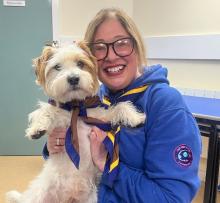
She explained that she was accompanied by her dog, Stanley - a long-haired Jack Russell who also serves as the Cub Mascot.
She added that the Cubs refer to her by her nickname, Tiz.
She was asked when and where she was born. She stated that she was born in Liverpool, where she lived until the age of five. Her family then moved to Scotland, and she lived in St Andrews until leaving for university in Dundee, where she studied Law. After completing her studies, she moved to Edinburgh for work and has lived there ever since.
She was then asked how she became involved with the 30th Craigalmond Scout Group. She explained that around eight to ten years earlier, her sister - whose children had been members of the Group—had suggested that she would be a good fit for the 30th Craigalmond Scout Executive Committee, which was looking for new members. She joined the Committee for a period and felt the work was quite similar to her professional role. She also joined the Adult Support Unit (ASU) to take on a more hands-on position, helping at coffee mornings and other events.
After about a year, she felt she might enjoy a more involved role with the young people, and after discussions with the Group Scout Leader, Dylan Lynch, who explained there was a shortage of volunteers, she was encouraged to sign up as a Leader in the Cubs where she remained for several years before becoming the Section Leader of the Thursday ‘Ledi’ Cubs, taking over after the previous long-serving leader, who she described as ‘excellent’, stepped down last year.
She was asked if, before joining the Group, she had any previous Scouting experience.
“No. I was a Girl Guide for less than a year when I was very young, and I didn't enjoy that. That was all sorts of sewing badges and nothing like the Cubs at all. And now I'm not, you know, I don't want to speak badly of the Girl Guides because I'm sure it's now greatly advanced, but we're talking, you know, 40 years ago. So no, I hadn't had any experience with the Cubs or the Scouts other than just when I learned about them through my big sister, but I have obviously had experience with children.
Interviewer: So, did you learn on the job or find a lot of resources that were useful to you?
Respondent: Yeah, I mean, I'm a lawyer, and I specialised in child law, so I knew a lot about child development and, you know, children because that's what I've done for the last 30 years. So, I kind of mean all about that kind of stuff, safeguarding child development like that. With regards to actually sort of being a Cub Scout leader, I, yeah, I just literally learned to, as I went along on the job and just learned from other leaders that had been there longer than I had been and, and just picked up things from them. And you just learn more the more you do it.”
5.38 - The Respondent was asked if she could describe a typical Cub evening that she would be involved in running. She begins by stating that at present the pack is running nearly at maximum capacity with 28 Cubs, and a more ideal number is around 20.
“A typical Cub night is not just turning up and doing it, and I think a lot of parents and Cubs and other people don't appreciate that, because a Cub night takes a hell of a lot of planning, and if you're in charge of that particular night… we take it in turn to leaders to be in charge of different nights so that we can allocate the work accordingly so, it's not just the same leader planning for every week, that would just be too much because as you know, we're volunteers, we're not paid.
So, a Cub night, before we turn up, then obviously we have to look at the risk assessment and the plan for the night, and that's has taken a lot of planning by myself or another Cub leader. And that literally says from what time to what time you do what and when and who takes charge of what, and it also has the risk assessment, which is, you know, essential now, to make sure that identify any potential risks, and to have answers as to how to deal with them if the risks become a reality.
So, before you've even really unlocked the door, you've done quite a lot of work. Often it will also involve buying things for the night, and you know, the Cubs love cooking, for example, so you'll be away making sure there's enough gas in the camp stores, you'll be making sure that you've got the ingredients that are necessary, the pens if they're doing crafting and sports equipment, all that sort of thing - so, a lot, a lot of preparation.
And then the actual night, if the preparation has been done properly, the night should be, and usually is, relatively easy to manage and follow because you've got this fabulous plan in front of you and you know exactly what you're doing when you're doing it. And you try to stick to the time; the times are all down. You try to stick to that. If you don’t - you improvise, but it's just great having that plan there. This is what happens. This is what happens. This is what happens.
So, a Cub night will always start with the flat break, which will get the Cubs, you know, in a horseshoe circle shape, and then one of the Sixers will break the flag, we'll have a Cub promise and then we will launch into whatever we're going to be doing that night, and then at the end, obviously, we finish the night and with the flag and dismissal.”
8.44 - The conversation goes on to talk about traditional routines in Cubs.
“I think they've been going for years; at the moment, they work very well. We also have Inspection at the beginning of the night, which I think works well. There was a bit of debate about whether we should bother with Inspection in this day and age, you know, because it consists of a tidy, well-ironed necker, good behaviour and clean hands and nails.
So, I know there have been some discussions in recent years as to whether or not that should be kept. I personally wanted it kept. I advocate for that because I think it instils some discipline in the Cubs.
And also the Sixer, who is the person in charge of their particular group in the Cubs, because they're all split up into groups of six. So, the Sixer is the person in charge of their particular, say, Green 6, and it's the Sixer’s responsibility to prepare their pack for inspections so they will help the younger Cubs fix their necker, for example, although they say, ‘Could you go and wash your hands.’
So, to me the scoring doesn't really matter and if a Cubs got filthy fingernails it doesn't really bother me at all - the point of it for me is that the Sixer, the leader, the Cub, the little Cub in charge is the one that is learning life skills in my view to coordinate teamwork, to be in charge of a group to help them. Pass, you know, the task that's set for them. So, I think it's just as a really good life skill to learn going forward.”
10.38 - The Interviewer asks whether the Cubs who go on to become Sixers and Seconders take ownership of their leadership roles. She explains that they definitely do, although some take it more seriously than others. Some embrace the responsibility fully, while a few less so, with each bringing their own individual personality to the role. She then goes on to discuss how the shyer Cubs tend to respond when given these leadership opportunities.
“When they become Sixers - that means that they're the eldest in that group of six as well - they become far less shy, you know, they can change from when they started two years previously when they were the youngest in that group of six – two, two and a half years later when they're in charge of that group of six. It's amazing how much they flourish and change and gain confidence – which is great.”
11.26 - She is asked whether many of the Cubs move on to Scouts when they reach the appropriate age. She feels that, overall, most of them do. Those who don’t usually have another activity that takes priority, football being a common favourite.
The conversation then continues the theme of Scout traditions and ceremonies. When asked if they have any others, she explains that they also hold a moving-up ceremony, which she goes on to describe.
“We have a ‘moving up’ ceremony. So, it's very simple, and the Cubs line up in twos, and they make an archway, so there's a big line of them making an archway and then the cub who’s moving up will start from the top of the tunnel - it makes like a tunnel - and they run through it, and then at the end, the ideal thing is we have then a Scout leader, rather than a Cub leader, waiting for them at the end, and they shake their hand and say ‘Welcome to scouts’. So that's their way of signifying we’re moving on up now from Cubs to Scouts.
And I believe the same thing happens - so if you're a Beaver, very often I'm asked, like last Thursday, could you come in a wee bit early, Tiz, so that you can welcome the Beavers to Cubs. So, there were two lovely Beavers that ran under the tunnel and up, and then I shook their hand at the end to say ‘Welcome to Cubs’. So that's a nice wee ceremony, I think.”
13.37 - The Interviewer comments that this ceremony seems to have been going on for many years throughout the Group’s history. The conversation then moves on to Investitures.
“And obviously, we have the Investitures - when Cubs after usually a term - they decide they want to stay, and I've never known a Cub not want to, so that's lovely. If they want to, then stay; they become invested.
So, two of the older Cubs will have the flags - hold them, cross them over, it's hard to explain and just verbally, but they will stand with the two flags, and then the Cub will make the Cub sign and say a Cub promise, which we now….I don't know whether we have one promise years ago, I suspect we did… now we've got all sorts of promises, which is quite nice.
They all amount to the same thing, but it depends clearly on what religion, if any, that particular Cub is, and it's nice because you can ask the parents or the carers beforehand, you know, what promise would they like to take - you know, a Christian one or a Buddhist one or whatever. So that's really nice. I'd be interested to know, I suspect that that wasn't the case years ago when we first started off, you know, and so that's probably an example of how things have changed for the better.”
15.00 - The Interviewer asks whether she feels the current Cub pack is quite diverse. She agrees that it is, noting that while there are more boys than girls, the Cubs range in age from 8 to ten and a half and come from a variety of religious and ethnic backgrounds, she feels that the group works very well together.
When asked if this diversity is reflected in the activities they do, she explains that it is, and the Cubs often learn about different cultures and religions through themed evenings based on celebrations such as Diwali, St Patrick’s Day and Chinese New Year.
She goes on to say that both the Cubs and the leaders gain a great deal from the sessions and mentions a recent Astronomy Night where they invited an astronomer to visit - something she previously knew nothing about - and she felt she learned just as much as the Cubs. She says this is one of the reasons she loves being a Cub Leader.
The conversation then moves on to the role of badges within Cubs, and she continues by discussing the badge programme.
“I’ve been told that the 30th Craigalmond are brilliant at their badges, and so I'm very proud of that because I've heard anecdotally that other areas aren't quite as into their badges, but we are. And we when we design a programme, so, we had a planning meeting last week, for example, to plan our summer terms programme, because now it's the Easter holidays, we make sure that when we plan, we plan what badges can be achieved and what they need to get those badges.
And also with Cubs, at the end, the highest award that Cub can receive is the Cub Silver Award, and in order to be awarded that Cub Silver Award they have to have already achieved a number of other badges.
So, we always try to make sure that when a Cub leaves Cubs and moves up to Scouts, hopefully, or even if they don't move up when they leave Cubs, when they are old enough – we are constantly working towards making sure that they their Silver Award and nine times out of ten they do, which is a really good thing, because its that Silver Award – if they move to Scouts - they can keep that badge on their uniform, whereas the all the other badges they can take them off - my understanding is that they can put them on a blanket or whatever, but they then have to work towards new badges in Scouts, but the Silver Badge is the one that can stay on their uniforms. So, it's a biggie in my book.”
19.50 - The Interviewer asks if there is a presentation made of this award, to which the Respondent says yes and goes on to explain what happens.
“We would have the ‘moving up ceremony’ as I've described to you, but we would also be in our horseshoe shape, and we would call that person's name out and shake their hand and hand them a certificate and the Silver Badge. So, we make a big thing about it because it is, it's taken them two, two and a half years to obtain. So, it's a really, it's a, it is an important award.”
20.22 - The Interviewer asks if she feels the young people have a real sense of pride when receiving this award, to which the Respondent replies ‘definitely’. She goes on to talk about badges and pride.
“My experience in the last three years…they feel very proud when they receive their Sixer or their Seconder stripes. So, it's going back to what I said to you earlier, but when you hand out the stripes and they are, they're a bit like they're yellow and red stripes - it's a bit like you're in the army, you know, and if you've got one of them on your jumper, you know, you're something you've earned that you've been there for a long time. So, they really love getting their Sixer or their Seconder stripes, which means they're second in charge. So, they love that.”
21.06 - The discussion then turns to badges, and the Respondent is asked whether the Cubs have any input into the badges they work towards. She replies that she would like to say they do, but in practice, this is limited.
The Pack follows a two-year rolling programme, which sets out the badges to be covered in advance, and while there is some scope to adapt the programme when opportunities arise, keeping to the structure helps ensure that Cubs can work towards achieving their Silver Award by the time they move on.
She explains that, because most Cubs stay for the full two years, the programme also prevents activities and badge work from being duplicated.
However, leaders do involve the Cubs in planning by sitting them down at the start of each term to ask what they would like to do. Their suggestions often include games or fun outings, such as cinema trips or trampolining, and the leaders do their best to incorporate these into the term’s programme.
The Interviewer then turns the conversation to activities that take place in the community, and did the Respondent have a favourite memory of this.
“I have loads, I mean I remember when we…it made me laugh… we went to plant pumpkin seeds at Lauriston Farm, which is a local farm… very close, I think that you would class it as being in Davidson’s Mains. And Dylan, the chief Cub Leader decided that we should all plant some pumpkin seeds - and that was the Cubs, the Beavers, the Cubs, the Scouts who were all going to plant in the seeds so that we could have lots of pumpkins to then carve in November for our Halloween Coffee Morning because we've done it the year before and our chief Scout leader had gone off and bought loads of pumpkins and they were very expensive.
So, we thought, oh, this is great, so we can learn about cultivating pumpkins, picking pumpkins and everything, and we had the most gorgeous night, for it was a sunny day like today, it was absolutely beautiful, and they absolutely loved it. And we planted the seeds, put all the snail pellets down and made a brilliant job of it, and it was a really, really good night, just lovely. I think the weather made it as well and so that was fun.
The downside of it, however, was that I think we've got about three pumpkins out the whole [laughs]
So, they didn't really work, which was a shame. It was great fun, great fun doing it at. At another time, just quickly again was I had organised a treasure hunt over on Cramond Island, which was ace fun because it was great fun. Just you know, I had to go over early and I was digging the sand, and putting the treasure, you know, underneath in the beach and big arrow marks, and it was just great fun. They loved it. They were digging up for the treasure, digging in all these wrong places, and then eventually they found the treasure. So that was really nice.
And they were able to learn about Cramond Island as well, because that’s got a history which not many people actually appreciate or realise. They go over there and back, but they don't realise it's got a history, so they learn about that as well. I mean, that's what I think is good about our nights out, aren't just really nights out. We really try to at the same time, teach them something, you know.
So, we went to South Queensferry to the lifeboats for example, and they loved that, on the lifeboat, not in the water, but off the water. But then they learn about, you know, what the RLNI was all about and all that kind of thing. So that was great. But no, our adventures out and about are always great fun.”
25.57 - The Respondent goes on to say that the Cubs are always very well-behaved when they are out as a group or when visitors come to the Scout Hall - often even more so than on regular meeting nights.
The Interviewer comments that the Cubs seem to be very active within their community and asks whether they also take part in more traditional community events, such as the Memorial Service. She confirms that they do and goes on to speak a little about their involvement in this and the annual Gala.
“The Memorial is brilliant - every year for the last few years we've made different types of poppies for the Memorial, and we've marched in the Memorial and again this is an example of when they’re also very well behaved and very respectful and that's when I have a wee tear in my eye because I think, oh, this is lovely. And they appreciate why they've got to be quiet and respect what's going on and why it's going on and why we're remembering fallen.
So yes, we do that every year, and we also have the Gala march, which is much more upbeat. We walked last year, and we decided, or somebody decided it wasn't me, but it was a great idea, to have big bags of sweets and throw them out to the crowd as we were walking down all.
Oh! and the Cubs absolutely adored it because they'd see their friends and their relations, you know, on the lining, the sides of the pavement down the Main St in Davidson Mains and throwing sweeties and getting them to catch it was all it was oh! They just loved it”
28.00 - The Respondent goes on to describe another community activity the Cubs regularly take part in: litter picking to help keep the local area tidy. She shared that during their most recent litter pick in Davidson’s Mains Park, it appeared another group had been there just before them, as there was hardly any litter left to collect.
They are scheduled to do another litter pick in the upcoming summer term, but she plans to choose a different location this time to make sure their efforts are useful.
She also mentions another community activity, which is bag packing at the local Tesco, which helps raise funds for the group.
The Interviewer then asks whether, in relation to Davidson’s Mains Park, the Cubs attend the annual sausage sizzle held there.
She confirms that they do and goes on to talk more about this event and then about JOTT.
“We have a sausage sizzle at the end of the summer, and we basically - it's with everyone, so we've got Squirrels, Beavers, Cubs and Scouts and possibly Explorers, I'm not sure about that, you'd have to check up on that one. Because we're kind of at different times for the food, for the sausages, you can imagine it's a lot to organise and cater for, yes.
So, that's absolutely lovely, and we normally get great weather for that, and we're going to the park, and we play games, and then we can have the ‘moving up’ ceremony as well, because quite a lot of people will move up then.
And the big tunnels, and we eat sausages and then that's us for the summer. So, we love that. And we've also got that Jamboree on the trail – JOTT – that’s another thing, we did. We did that a couple of years ago. I don't know why, I don't know whether we did it last year, I'm not sure, but we did it a couple of years ago, and that was lovely. We started off… trying to remember where we started off, but we walked all the way down to sort of Silverknowes Beach area that runs on to Cramond Beach, and we played lots of games down there after we'd done the walk down to there. So that was absolutely lovely.”
30.20 - The Interviewer then asks whether she feels the Cub pack has a strong connection with the wider 30th Craigalmond Scout Group.
She replies that although the connection could be stronger, the Cubs definitely feel part of the wider Group when they attend the Group camps.
She believes these camps are very important, as they allow the Cubs to mix with the other Cub pack and also with the Scouts. She adds that this is also true during the JOTT.
The conversation then moves on to Cub camps, and she is asked to talk about the types of camps she has been involved in organising.
“I mean, I always thought, you know, I wouldn't be into camps, to be honest, because I'm not a great outdoorsy person. I'm more arts and crafts and music and drama, etc., that kind of thing. But as it's transpired, I've absolutely adored the camps and they again, take a lot of preparation, as you know, I've been involved in camps where it's just the Cubs but usually every year we have at least one group camp and that's everyone and I have been to those and they have been just great fun - very, very tiring, but just amazing, amazing fun.
Takes a lot of organisation, catering, especially the equipment, getting equipment there and back. There’s a lot goes on behind the scenes that I don't think necessarily everyone appreciates or parents appreciate as well. Because it's very easy just to drop your kids off and collect them and then have them tired and sleep well on the Sunday night.
But the amount of planning, strategic planning that goes into it is, is immense and hats off to those that have their overnight permits, because I don't have mine yet, and, and those that actually… the volunteers as well that volunteer with the catering and everything, it's just, it's an amazing joint effort and it couldn't work if people didn't work in the teams that we work in and so it's just - they're brilliant. They're a brilliant way of bringing everyone together. And I love camps.
One that sticks out for me, my favourite was - it wasn't a camp as such because we weren't erecting tents - but we had with… this was joined with another…
We had to have a certain number of Cubs attend and we didn't have enough Cubs that could attend, so we opened it up to another Cub group in Edinburgh I can't remember which one it was., but they were great, and so therefore it was a good way as well of our Cubs meeting another. Division in Edinburgh, so that was fabulous.
So anyway, drum roll.
It was just one night, but it was at Dynamic Earth in Edinburgh, and it was the best. I think partly because the team at Dynamic Earth were so great as well, so they did a lot of the planning. Normally, we have to do the planning but they had already, you know, written the risk assessment, done planning, told us do you want this or that for your tea. So, it was great. We didn’t need to work as hard as we usually do, because the wonderful staff at Dynamic Earth did it for us.
Also, when we got there the things that were at Dynamic Earth, you know, like a giant iceberg, they were literally, they're all like stroking and touching this giant iceberg. We got to experience like an earthquake where the floor was actually moving and we went to this planetarium, and it was like we were really like in space and seeing the stars, and then we slept under the stars and it was nice and warm. You know, nice toilet, not like sometimes when we end up in outdoor camps. So, it was just to me that camp, if you could call that a camp, it was an overnight experience was absolutely amazing, really, really good. In fact, I've still got I think [shows uniform sleeve] here we are, my badge on my arm
Interviewer [reads badge] Slept under the stars at Dynamic Earth.”
35.48 - The Respondent explains that one of the important things about badges is that they serve as mementoes of a camp, activity or outing.
When asked whether most Cubs attend camps, she says that around 75% do, with those who don’t usually having other activities that clash.
She adds that once a Cub attends their first camp, they generally continue to take part, which shows how much they enjoy the experience.
She then mentions the upcoming Centenary Camp, to be held in May at Lauriston Castle. Because the site is in Davidson’s Mains, no travel will be required, and they plan to visit Cramond Island as part of the weekend. She was amazed by the level of interest from Scouts, Cubs, Beavers and Squirrels, and is excited about the event.
She is then asked whether Cub camp is typically a young person’s first time away from home.
She explains that this isn’t always the case, as many come up from Beavers and will already have had at least one night away and for those attending for the first time, leaders liaise closely with parents and keep a particularly close eye on the children to ensure they aren’t feeling homesick.
The Interviewer then asks whether she has any memorable experiences from traditional outdoor camps. She says that none stand out in particular, but notes that she has attended two Group camps - one at Fordell Firs and one at Bonaly. She then goes on to describe an incident from one of these camps.
“They were both ever so good. I suppose the first one stuck in my mind because we had what was called, dare I say, and you might want to cut this out [laughs] but we have what was called…we called it something and I'm trying to remember the name of it - we gave it a nickname because what happened was, we went to sleep, I shared a tent with another leader, and we fell asleep, and then we had someone come up and say, oh, I've had a little accident - so that's OK, so that's fine and sorted that out because that happens, and then we sorted that out, but then it was a bit like dominoes because then we had once one had done that, the next one did it and the next one. So, we ended up four.
So, we were kept awake all night, but it was all fine, and it was all, you know, it was all good fun.
We are used to that; they were younger Cubs, I think some of them were even Beavers, and you know, we always take spare sleeping bags and things like that. So that was quite fun for the leaders. We're not really fun, but you know, it tired us out because we were up all night, but that's just the things we have to do at situations like that, it was quite funny; we look back and laugh.”
39.50 - The conversation then moves on to the subject of games and the types of activities the Cubs enjoy most. She describes some of their favourites, noting that the ones most frequently requested are Dodgeball and a game called Helicopters.
The Interviewer then asks her to explain how Helicopters is played.
“Helicopters. I feel very sorry for the leader, who is the helicopter because the leader, I have never done this, but we have a couple of leaders that volunteer, so I'm very happy for them to volunteer, and they stand in the middle and the Cubs all line up in a circle around the Cub leader and the Cub leader has a big long tug-of-war rope.
And basically, this is why I don't envy the leader, because the leader then in the middle spins round with the rope. So, the ropes going right round a bit like the hand of a of a clock. And the Cubs have to jump over it and if the rope catches them on their ankle, then they're out.
So, it goes on and on and on until there are two Cubs left, and then that one Cub is the winner and for some reason they absolutely adore it.”
41.30 - The Respondent briefly talks about Dodgeball before the conversation shifts focus to her own experiences.
The Interviewer asks whether Scouting has had an impact on her life and whether she has experienced any personal growth through her role as a Cub Leader.
“Yes, it’s very time-consuming, I won’t lie about that, but it’s definitely worth it. I have met a lot of people as well that I wouldn’t ordinarily meet. I actually live down in Cramond, so it's a 15-minute walk up to Davidson’s Mains, and Cramond has its own Cub Group, well, Scout Group, but I chose to join here because I wanted to know this community, because I'm already sort of part of the community down in Cramond.
So, for me, it's just been great meeting, especially the parents and the interaction with the parents, and just even for me, what I love is I'll go around Tesco, for example, up in Davidson’s Mains, and then I can't get around it without someone going ‘Hi Tiz’
And it's just lovely. Do you know what makes my day. It really does. Or I'll be driving along Davidson’s Mains High Street with Stanley, my wee dog and then all you'll see is, you know, a wee lad waving away at me and I'm like, oh, there's Tyler or whoever it is giving me a wave, and it just lifts my spirits. I really, really love it and I'll it's just so nice when you get the thanks as well.
Sometimes at the end of term you'll get a wee card from a parent or a wee chocolate orange or whatever just to say thanks for what you've done, and it makes it all worthwhile, it really does. And the children themselves make me laugh so much, you know, just learning things from them and who's in and who's out. You know, Taylor Swift at the moment, all the girls are Swifties and it's just lovely, it keeps me young. So, I really, really like it. I love it.”
44.24 - She is then asked what she feels her biggest challenges are as a Cub Leader. She explains that managing a group of twenty 8 year olds while still ensuring they have a good time can be difficult.
For her, the key is finding the right balance between being firm enough that they listen, respect the leaders and each other, but not so strict that it feels like school or takes the fun out of the sessions.
She wants the Cubs to look forward to attending while still maintaining good discipline, which she admits can sometimes be challenging.
The Respondent is then asked whether she would recommend Scouting to other adults.
“I absolutely would, but it depends. I think there's a difference between being a Scout leader or Cub leader and the… I can't remember like the Section Cub Leader… I think I'm a Section Cub Leader. So basically, I'm in charge of the Thursday Night, and there’s other leaders, but because I’m the section leader, I have to make sure all the badges are done, and everything is sorted and dah dah dah. Now that I wouldn’t recommend to everyone because you need a lot of time, you need a lot of organisational skills and you also need to be very firm with the Cubs, and not all leaders can be really firm. I mean they are lovely but there not all firm and can get someone to stop something because they are just too kind and soft.
So, I would say to them they are brilliant, I would recommend. everyone become a leader, but not necessarily a Section Leader because it takes certain skills and I'm not saying I have them because I'm learning them all the time but, it does take a bit more time, bit more commitment to be a Section leader than an actual leader, but as far as becoming a leader, absolutely…unless you don't like children, I would say become a leader.”
47.12 - The Interviewer finally asks if the Respondent has any final thoughts or memories she would like to share about her time with the 30th Craigalmond Scout Group.
“I just loved it all, really, and my little mascot Stanley is loved by all; he comes on the JOTT with us. I just really enjoy even the journeys to camp, they stick in my mind when we're all on a minibus heading up to camp with them all middle, full of excitement. I just love it.”
47.58 - The Respondent is asked whether Stanley goes to camp, and she explains that at the moment, he doesn’t, as he’s not quite disciplined enough and she needs to keep her full attention on the Cubs. However, she adds that he may be allowed to go when he’s a bit older.
She is then thanked for sharing her memories and stories, and for giving her time to the Project.