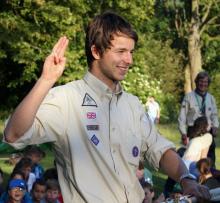
0.00 - The Respondent is introduced and thanked for attending the Interview. He is asked where he was born and where he grew up.
“I was born in Edinburgh and grew up in Davidson’s Mains.”
0.38 - The Respondent is asked how he was involved with the 30th Craigalmond Scout Group and his years there.
“I started Davidson’s Main’s Scout Group in 2006 as a Beaver; I then went into Cubs, then Scouts and then was an Explorer with one of the local units, and I was then a Young Leader here from 2014 to 2018, and I’ve stayed actively involved in the Group ever since.”
1.04 - The Interviewer then asked what the Respondent remembered about a typical night when he was a Scout.
“Mike Ponton was the main Scout Leader, along with Dylan Lynch and Steve Barton – they were our three key leaders. We did lots of different activities, we did games, we did knots, lot of pioneering, lot of first aid. We did a lot of camping…as a Scout, we went to Lochgoilhead for a week over the Easter holidays, where we partnered with another Scout Group from Fife, and went there for a whole week, and we did kayaking, canoeing, mountain biking, all the mountain ranges. We did the survival badge, where we went off to the woods and built shelters and cooked all our food over fires and stuff like that. We did the Pentland Challenge and the JOTT Ness Challenge at annual camps where we used to go to this camp run by Scouts Scotland and you would have a team that would go off hiking for the day and then they’d get lots of points and then in the evening, you’d have different Scouts go off on a night hike and a lot of different challenges on your hike.”
02.21 - The Interviewer goes on to ask what the Pentland Challenge involved.
“One of the years we did it, we did the evening hike, which was our main one, where you were in groups of four or five people and every kilometre, every two kilometres, you had to get to a checkpoint and at every checkpoint, there was a different challenge. So, you could have a first aid situation, where someone was screaming the place down that they’ve got a car crash, or name six Munros or name different map coordinates or something like that.”
02.53 - The Respondent is then asked if he has a favourite memory from camps.
“I remember my first Cub camp was in 2008, where we were sleeping in the Stonehavens – the traditional patrol tents, remember that was our first camp. We did abseiling and archery, and you know I remember being woken up with someone throwing a football in my face and all that kind of stuff [laughs] and the inflatables…yeah, that was really good, there are just good memories as a Cub.
We did a week-long camp at Canty Bay when I was a Scout, so a bunch of Scouts and a bunch of Cubs went for a whole week at Canty Bay in 2013, and we did power boating round North Berwick Rock…Bass Rock…went round Bass Rock, did a lot of swimming, did a lot of hiking, did a lot of swimming in the sea – it was just a very lovely camp.”
04.11 - The Interviewer then asked, since the Respondent was a Beaver, Cub, and Scout, what he thought were the most significant differences between each section.
“Different challenges isn’t there, so you know Beavers is all about just fun, you’re getting your first glimpse of adventure and being able to go to the woods and build dens, and it's totally brand new, being six years old and being able to roast marshmallows on a fire is absolutely incredible, and you get so excited about it.
At Cubs, that natural level of progression of okay, maybe this time you're building the fire and then Scouts again, similar, you know, you may be using traditional methods to light fires, then moving onto Explorers, you're then probably more taught to teach people and learn those development skills and teaching people from the other sections.”
05.05 - The Interviewer asks if the Respondent remembers any traditions or ceremonies during his time as a Scout.
“Yeah, and everyone always gets it wrong [laughs], we all have different ways to do it. So, Beavers, the start song “1, 2, 3, who are we? We are the Beavers, can’t you see?” That was always the start, and I remember being at Beavers when they introduced the closing song, which was “3,2,1 our time has done and we have had lots of fun fun fun” I remember when we first got that and I remember we all got these pieces of paper and we had to try to learn the lines and none of us could read cause we were six, seven years old trying to learn the lines of this song, but its now very much stuck and they still do it. Cubs, yeah, we did inspections at Cubs, a little but not many, not as much as I think they do now or what they used to do back in the day. Other things like Gala Parades and Remembrance Services, and all that kind of stuff, they are all part of our traditions.”
06.06 - The Interview talks about Scout uniforms, and the Respondent explains that they were all similar to those that Beavers, Cubs and Scouts wear today, but that he hated wearing the uniform.
06.21 - The conversation goes on to discuss any leaders who had influenced the Respondent during his time at Scouts.
“Beavers, we had Lisa Coburn. She was the main leader, I believe, and she was my mum’s pal as well. We had Janet Patterson as my Cub leader with Janette Stone. May and Tracy Sanderson – I think they were all involved in some manner. In Scouts, we had Dylan, Mike, Steve, and we had Owen for a while; he was there and Peter Malone.”
07.00 - The Interviewer then asked if the Respondent had ever been a Patrol leader and what he remembered about that role.
“I was a Patrol Leader. When I was in the Troop, it was quite a small Troop. When I first moved up in Primary 7, when we all went into 1st year, loads of people quit, there was a massive drop and me and maybe two people stayed in so I was promoted to Patrol leader very early so I think I was twelve years old as a Patrol leader and I took that role very seriously and knew we had to be the best patrol. I remember getting a piece of tape and taping it to the floor and like ‘that’s where our Patrol stand’ and Dylan going ‘yup that’s very good Fraser, yeah I like that, I like that.’ That was always fun. Couldn’t remember who was in my patrol, to be fair, I was in the Stags, I was in the Stag Patrol. We did some patrol challenges; we did some Patrol Camps and stuff like that.”
7.57 - As a Patrol Leader, could you choose what badges you wanted to do?
“We did, and I was really passionate about getting the Chief Scout Gold Award and the leaders at the time, they very much wanted you to earn it instead of it just being part of the programme, so they were like okay if you want to get your Chief Scout Gold Award you need to do things outside of Scouting. So, I remember most weeks coming up to Dylan with a list of things I’d done the weekend before and being like ‘look, here’s what I’ve done, please give me the badge’.”
08.22 - The Interviewer asks if he got the Chief Scout Gold Award in the end?
“Yes, I got the Chief Scout Gold Award, and I got my Queen’s Scout in 2017.”
08.30 - The Respondent was asked about his Queen's Scout Award.
“The Queen’s Scout is the highest award in the Scouts you can get, so it’s now changed to the King’s Scout, now the Queen has passed away. So, when you achieve it, it is the Gold Duke of Edinburgh at the moment and then also six different challenges. So, I went on a Challenge Camp to Denmark in 2017 with the Connect Explorer Unit. We did a massive Himalayan Balsam environmental project where we had 3000 people up Corstorphine Hill trying to clear Himalayan Balsam.
Interviewer: I did that
Respondent: Every young person in the district was involved cause we just drummed up support and lots of different things… When you get that award, you go down to Windsor - so you get a certificate from the Queen, it was signed by the Queen, and you go down to Windsor, and you meet Bear Grylls and members of the Royal Family, and it's really cool.”
09.25 - The Interviewer returns to the topic of badges and asks the Respondent if there were any badges he was particularly keen to get while he was a Scout.
“I wanted to get as many nights away as possible; that’s what I wanted to get as a young person. Interviewer: What was your record? Respondent: By the time I left, I was on 175 nights away, and that was because when I was a Young Leader, me and Fiona Priestley, we decided that we would run camps every month for Scouts. So I was 14, 15, 16, 17, and we ran every single month a camp for the Scout Troop and it was brilliant, it was a really great way for me as a young person to develop leadership skills and organising skills also great for the young people to get on loads more camps but also great for me to tick my nights away and I believe as of today its over 365 nights away and I still have a spreadsheet keeping track [laughs]”
10.20 - The Respondent is then asked about his time camping as a Beaver and Cub.
“So, Beavers, we weren’t allowed to do camps at the time; it was not allowed, but we used to go to the camp for the day, so we did like a Saturday at the camp. My first one was at Bonaly in 2006. We met with the Cubs and Scouts at their camp, and I remember having a campfire, and I remember climbing the hills at Bonaly, and you know, making mudslides and sliding down the hill, that was always good. The 100-year camp, so in 2007 it was a hundred years of Scouting, they had this massive regional camp at Dalmeny Estate, which is just along the road, and I remember going along and seeing all the Scout camping and all the inflatables and stuff like that.”
11.10 - The Interviewer then asks if, since the Respondent is still involved in the Group, Beavers can now attend camps.
“Yeah, Beavers go on camps. I was part of the first Beaver Camp in 2014. We did a Beaver sleepover in the Hall; it was our first one. Then we did one the following year as well, where we did like a spy-themed camp – think it was a pirate-themed one the first year, then spy-themed the second…Yeah, they go regularly camping and sleeping in tents.”
11.37 - The Respondent is asked about the friendships he made at Scouts and if he still stays in contact with people.
“Through D’Mains? Yes, I made some great friends at Scouts. I see a few semi-regularly. I probably made more of my friends during Explorers, my 14-17 year old time in Scouting and then when I was 19 years old, I went and worked at the International Scout Centre and made loads of friends from all over the world.
Interviewer: Whereabouts is that?
Respondent: Kandersteg in Switzerland, so I went and worked there, which was very lucky.”
12.12 - The Respondent is asked if he remembers any games he played at Scouts and if he had a favourite.
“As a Young Leader and a Leader, I always loved to do different games, so I hate running the same game every week. I like different games because we have such a great bank of games that we can run and deliver. When I was a Scout, I always loved the Poison Game, which is when the chair was in the middle and you had to pull people in and drag them into the chair – that was probably my favourite one. As a Cub, we played Bomb the Bottle and stuff like that, which you always got the excitement, the stress of throwing this beanbag at the bottle, and you’re gonna miss because my coordination is never that good, so they were always fun. And yeah, it's also good to bring new games in as a Young Leader – you can get games from all round other Scout groups and bring them to the nights.”
13.15 - The conversation then discusses the Community Projects the Respondent was involved in. He talks about when he was a Cub, he was involved in building a greenhouse at Davidson’s Mains Primary School.
“I remember going round collecting loads of 2-litre bottles from all my neighbours, and they were all stored in Janette Stone’s garage – it was just filled with 2-litre bottles. And then we went to the school one Saturday and we pretty much cut the bottles, not in half but in two thirds, cut the bottles then put them together on a bamboo stick and then we’d screw them onto this frame and then we made this greenhouse for the primary school - and actually only until recently it was still there, so it’s only just gone.”
14.14 - The Respondent talks a little more about Community projects such as Balsam bashing and removing Salmonberry (another invasive plant) from Corstorphine Hill.
14.46 - He was then asked what his favourite type of accommodation was while on camps.
“As a Scout, we used to only sleep in tents or indoors. I would say, as an Explorer, I would always say hammocks are the best for camping.”
15.13 - The conversation then moves on to talk about Scout Jamborees.
“So, when I was 17, I went to the Danish Jamboree - Davidson’s Mains Scout Group supported me and a few others to go to that as an Explorer.
Interviewer: Is that in Denmark?
Respondent: Yeah, yeah, Danish Jamboree, so we did home hospitality, so we stayed with a Danish family for four days, and we lived with them and literally lived life with a Danish family and then we all went off to the Danish Jamboree, where we had 40,000 Scouts from all around the world all camping together – that was awesome. In 2018, we went to Ireland – the Irish Jamboree, which was 5000 Scouts – myself and Paul Steen and Graeme McGlashen we ran that camp for the D’Main Scouts. We had twenty of them that went to the Irish Jamboree, and that was fantastic. My key memory, which is probably not the best memory to have, was that we nearly missed our flight on the way home, and we had twenty Scouts running through the airport trying to get on the Ryan Air flight that was due to take off ago. That camp was brilliant for lots of activities and lots of different games.”
16.45 - The Respondent is asked what his most memorable experience at Scouts has been.
“I would say definitely the Young Leaders scheme at Davidson’s Mains Scouts – I was really lucky because D’Mains allowed me to develop my leadership skills at 14, 15,16 – it has definitely made me who I am today, those skills I look back on – I wouldn’t have had those if it wasn’t for Davidson’s Mains Scouts, for them allowing me to grow and supporting me to grow, doing those things. So, I would say that kind of memory of just that leadership of developing me as a person and that community and support that it gave me at Davidson’s Mains was amazing, and that’s why I’m still involved in D’Mains to this day. As a young person, as a Scout, I’d definitely say Lochgoilhead, we went there for a week, and it was kind of our first time being with another Scout group and camping with that Troop, and just doing lots of activities with them – it was really nice.”
17.46 - The Interviewer asks about his thoughts on the current Scouting movement.
“I think it’s keeping up with the times. I think it’s a really good organisation of looking ahead and going ‘where is the youth movement going which is amazing, you know it was perfectly suited to kids in the sixties, perfectly suited to kids in the seventies, I think it struggled through the eighties and nineties I believe and then it kind of has come back now, where you know our Scout Troop has got two Beavers, two Cubs, two Scouts. You know back when I was there, we were struggling to have a Beaver colony, struggling to have a Cub pack, struggling to have a Scout Troop, you know, struggling for leaders, you know we’re connected to the largest Explorer unit in Scotland, second largest in the U.K. So, Scouting in this Community is so big and so huge, which is incredible. I would say ‘no phones’ [laughs], but I think every leader would now say ‘no phones’ – I think that’s going to be our biggest challenge – how we get young people off the screens, you know, we’ve got the TikTok generation, you're probably a TikToker
Interviewer: Yeah.
Respondent: Who’s struggled with that thirty-second focus, and as a leader now talking, I would say that’s our biggest struggle is the attention span. You could be doing one of the best activities, but two seconds later, they are on their phone and off the activity. So I think that’s what’s going to be a struggle, and I think how people communicate and engage and socialise is definitely changing. You see that when I go to Beavers, or Cubs or Scouts, or definitely Scouts – you see how they socialise very differently as to how I used to socialise at Scouts and Explorers too.”
19.28 - The Interviewer asked what these differences in socialising are.
“I think people struggle with the kind of natural connection that they have because they have this phone barrier a lot of the time. But also, the positive on that is that you’ve got an amazing network around the world where you can contact people. I’m on multiple different WhatsApps with people I met through International Scouting, and you know you’ve got all these people’s phone numbers and you can call them up and go ‘hey, I’m gonna be in Canada next week, are you free?’ I regularly have people stay with me from all over the world, because they are just visiting Edinburgh for a couple of days and they stay at mine or stay at the Scout Hall or whatever – it’s a really lovely thing we’ve got.”
20.04 - The Respondent asks if he has any other thoughts or memories he wants to share.
“I remember a camp, it was probably my second Scout camp, we went to the Craigs which is in Midlothian, and I remember
showing up and I remember Mike stalling and blowing the clutch of the minibus, so we were absolutely stuck, right at the start of
the camp. So we’re driving this minibus, it was absolutely stinking that kind of tarry smell, and we arrived at the camp and we’re like pitching our tents and people are pitching their tents and the leaders had forgotten groundsheets for the tents, so we had no
groundsheets, I think it was also the muddiest campsite I have, to this day, ever been on in my life, and I’ve camped a lot, and there was just mud absolutely everywhere, it got everywhere it was absolutely miserable.
But the only positive was that the park was really good and had amazing ziplines on it, and we never went back until recently,
cause both Dylan and I both went ‘No, no we’re not going to the Craigs, it's too muddy, it's horrendous.’ [laughs] That was
definitely an amazing memory. What other things can I remember from being a Scout here… I remember when we first set up the second Beaver Colony. I remember the first night of that was incredible, it was lovely to have twenty new young people coming in and their first time at Beavers and a lot of those kids, now, embarrassingly now, are all turning 18 and moving on. I see them all off at Explorers and it’s like ‘I remember your first day at Beavers’ [laughs] and it makes me feel slightly old but it’s an incredible compliment to the movement and we were the first lot to set up a second Beaver Colony, they were the next lot to set up a second Cub pack and then the next lot to set up a second Scout Troop, so yeah, it’s absolutely incredible.”
22.00 - The Respondent was then informed that the Interview had ended and thanked for his time and for sharing his memories with the project.