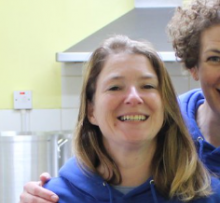
0.00 - The Interviewer welcomed the Respondent to the project and asked about her early life.
She explained that she began her schooling at Davidson’s Mains Primary in Primary 2, continuing there before moving on to the Royal High School, where she completed her secondary education.
After leaving the area for a time, she returned in her 30s and has lived locally ever since. She recalled being involved in the Brownies and Guides as a child but noted that she had little awareness of the Scout Troop while growing up. When her son was in primary school, he expressed an interest in joining the 30th Craigalmond Beavers.
They attended an information evening and learned that the Group needed adult volunteers.
She decided to sign up for an administrative role, while her son joined the Beavers. This was around 2014. She was then asked whether there was a particular role within the Group that she felt she might like to take on.
“I was definitely less of a hands-on kind of person, I was not sure I would make a great leader, so I though if I do some of the admin work then I can do it after I finish work or before work or that kind of thing So I thought – well what I can do, I work on computers, I can do something with computers, so the kind of admin thing seemed more appealing than trying to put a tent up [laughs].“
2.31 - The Respondent was then asked to explain her role as a Cub section admin
“There was a system called O.S.M. I think that’s just recently changed to something else, but you basically had to email out to the parents every week to tell them what was coming up that week, where to meet, what to bring, if the pick-up or drop-off was different from normal if there was special events happening, that kind of thing. So, I took it quite seriously because if I don’t send out this email – nobody’s going to know where there meant to be or what there meant to be doing. So yeah, I did take that quite seriously, normally on Saturday morning I’d be like – right I need to get this done before I go out anywhere or do anything else.”
3.13 - The Respondent was asked whether she had received any training for her role. She explained that she was trained on the system and would meet with the Cub leaders during their term planning sessions to gain an understanding of the activities and events taking place. She noted that the role was not particularly onerous, as the planning meetings were held only once a term and the email communications were usually on a weekly basis. She carried out this role for around a year to 18 months. During that time, she also began volunteering as a parent helper, attending camps with her son and assisting the leaders whenever an extra pair of hands was needed at evening meetings. Shortly afterwards, the Active Support Unit (A.S.U.) was established around 2017, which she joined. She was then asked to speak more about what the A.S.U. involved.
“I think it was Fraser [Dunmore] that initially set it up, but it might have been an idea that sort of came from the wider Scout community, and I thought it sounded quite cool, you know, Active Support Unit sounded great! And it was just really, you know, at the time doing the admin thing like I said was maybe just an hour on a Saturday morning so I kind of thought I’ve got other times I could be getting involved, you know, weekends, camps that kind of thing, so I put my name down. So, I do remember a couple of camps, maybe, where I stayed over, maybe a couple of camps where I went along on the catering side of things. Interviewer: Do you know how many people signed up? Was it a large pool or just a few of you? Respondent: I’m kind of thinking at the time maybe 16 rings a bell – it's bigger now, there’s more people in there now, but yeah, having the flexibility to be able to not have to over-commit but to turn up when you were available was good, yeah, I liked that idea.”
5.51 - She was then asked about her first duty as part of the A.S.U., which she thought may have been a Cub camp, which her son also attended, as she remembered wearing her A.S.U. hoodie. During the camp, she was involved in running activities and supporting the Cubs as they moved between them. She also recalled making hot chocolate and cooking sausages in the evenings and remarked that it was enjoyable to reminisce about those experiences. She explained that one of the things that drew her to volunteering in this role was the way it encouraged her son to attend Cub camps. It gave him the space to take part independently while also knowing she was nearby if needed. She also felt that the role allowed her to extend her community involvement, moving beyond the background nature of the admin role. Being part of the A.S.U. gave her the chance to meet more people, spend more time with the young members, and feel more connected to the community. She went on to explain that her role was not limited to helping at camps, as she had also attended a couple of jamborees. She was then asked what she remembered about her first jamboree experience.
“I think we’d been down to Silverknowes Beach more than once. I think we met up after the Spring Fair at Davidson’s Mains Primary School, and then we would all walk on mass down to Silverknowes Beach. And I can’t remember now…maybe we had some games when we got there, something like that I think, maybe some juice and crisps, that kind of thing… But I always thought it was quite a sight seeing the whole Troop, you know, marching down the street, and we’d get quite a lot of attention from passers by.”
8.01 - The Interviewer then asked whether she felt more involved in the activities and events run by the Scout Group. She responded that she did, and she recalled attending the Scout Group Ceilidh, where she helped by taking tickets at the door.
She also supported at camps that her son did not attend, simply getting involved wherever help was needed, and remembered assisting at the annual Sausage Sizzle.
When asked if the A.S.U. had participated in the Gala Day, she could not recall much involvement with that event. She was then asked whether she would recommend joining the A.S.U. to others or if she felt she was expected to do too much.
“No, no, I liked the flexibility. I mean, I think I’ve never been that practical or a hands-on type of person, you know, putting up a tent or camping overnight, I’m not a massive fan of that, but I thought, there’s other leaders who’ll do that sort of thing, and they’re happy to do those things, A.S.U. you can just kind of support in other ways.
Interviewer: So would you recommend it?
Respondent: Yes! Oh yeah, for that reason you can do as much or as little as you want, you get to know people, you build a sense of community, you build friendships, so you know, yeah.”
9.43 - The Interviewer asked whether she had maintained friendships within the A.S.U. She replied that she had, explaining that it was a good way to connect with people she might not otherwise see often, as the group largely consisted of fellow school parents and the parents of her son’s friends.
She felt there was a strong sense of community within Scouting and was then asked if she had taken on any further roles within the Group. She explained that she had, including running sessions for young people on Internet Safety and Awareness, as well as on Money Skills, both of which she delivered with support from her employer.
She also recalled helping on Cub nights when there was a shortage of leaders and in addition, she became involved with the Fundraising Committee, a role she went on to describe further.
“So, we’ve done things like Movie Nights, the Christmas lights with home-baking, Spring Coffee Mornings, Bag Packs, applying for grants, lots of things like that.”
11.38 - The Interviewer asked if the Fundraising Committee was separate from the Scout Group Committee to which she said it was a subcommittee and went on to explain a little more about this.
“It’s a small group of about 5 of us and some people have come and gone over the years that I’ve been involved with it. Some things we know are successful, so the Spring Coffee Morning, we’ll do that every year but the Movie Night I think was something I’d come up with just in terms of, we’ve got a hall, how can we do something that will entertain the children but actually gives the parents a bit of free babysitting?
So, we did a couple of Movie Nights, so that’s always been quite good fun, cleaning up the popcorn and the drinks at the end of the night [laughs].
Interviewer: So that was in the Scout Hall here on a non-Scout night?
Respondent: Yeah, it was the weekend night. I think we did two sittings the first time, I can’t remember exactly, we might have done that, but the young people could come with their blankets or cuddly toys or pillows and just make themselves comfy on the mats. They got popcorn, they got juice, and it was all just very exciting. They had a big screen, projector, sound system, so it was always good fun – chaotic but good fun. Interviewer: Was it open to non-Scout children? Respondent: No, just Scouts.”
13.06 - The conversation then turned to her involvement with the Fundraising Committee. She was asked whether she was given the freedom to come up with ideas, to which she replied that she was. She described some of the fundraising initiatives, including the Smarties tube collections, where each child was given a tube of Smarties and once eaten, asked to fill the tube with coins before returning it. She also mentioned that some companies, including her own, offered match funding of up to £500 - meaning that any initiative raising £500 or less could be doubled through a company donation.
The Interviewer observed that, although the Respondent may not have initially felt she had the skills for a hands-on voluntary role, she had in fact made a significant contribution through her abilities, which had a very positive impact on the Group.
When asked if she still held the fundraising role, she confirmed that she did and added that she had also recently signed up to help at the Centenary Camp being held at Lauriston Castle. She noted that through the various Scouting WhatsApp groups, it was easy to get involved as much or as little as one wished.
Although she had recently moved slightly outside of Davidson’s Mains, she admitted that she would miss the Scouting community, which had become such an important part of her life over the years. She also felt that being involved in fundraising was a way of doing something meaningful for a good cause, supporting young people to take part in activities they enjoy, so she had chosen to continue in the role as well as volunteering with some activities and camps.
She was then asked if she felt that being a member of the Scout Group has a positive impact on her life.
“Yeah, I think I’d like to think so. I think when I first joined and thought I’ll just do the admin behind the scenes; I’d never have pictured that a few years later that I’d be at a camp or I’d be delivering a badge session to the young people, you know all these things. I think I’ve benefited, and I can bring things from my work that will help the Scouts, but I think I can take things from the Scouts that help my work, so if I’m standing in front of a group of 30 children and try and keep them disciplined, I can probably do anything at work! So yeah, I think it’s kind of worked both ways.”
16.35 - She then explained that, as the Group was in a strong financial position, they wanted to give something back to the wider community. Instead of holding their usual Spring Coffee Morning, they decided to bring together all the voluntary organisations in the area, creating an event where the community could learn more about the different groups and even get involved if they wished.
She noted that everyone they had spoken to about the idea was very enthusiastic. The plan was for the event to be held at Davidson’s Mains Parish Church, with tables set up for the various organisations and space for presentations, allowing each group to share what they do. The Interviewer pointed out how meaningful this was, given that the very first Scout meeting had taken place at the Church more than a hundred years ago.
The conversation then turned to the theme of community, and the Respondent was asked whether she felt the 30th Craigalmond Group had a strong community presence.
“Yeah, definitely because I think you’ve mentioned the Gala, I know there’s been time we’ve had coffee mornings and if we’ve got homebaking left over – we’ve taken it to the local old folks’ home. We do the Remembrance Parade – you know a lot of kids will be from the local schools, so they all know each other, and I guess even though I kind of grew up here and moved away – I did come back, so I guess you hope these young people might come back and remember the community that was here when they grew up.”
18.47 - She was then asked, based on both her own volunteering experience and her son’s involvement, whether she felt Scouting remained relevant for young people today.
She replied that she did. Whenever she helped at evening meetings, events, or camps, she could see how much fun the young people were having but also recognised the value of the life skills they were learning.
She highlighted examples such as first aid and the recently introduced Money Skills badge, which prepared children for adult life in a fun and engaging way. She added that there were many activities the young people would likely never experience if not for Scouting. When asked whether she felt the Scouts were keeping up with today’s changing youth culture and the challenges it brings, she said yes.
She believed Scouting successfully balanced modern developments with traditional values and activities, giving young people opportunities to step away from technology, build friendships, and enjoy being social.
She also felt that the young people themselves would ensure Scouting continued to stay up to date.
Finally, the Respondent was asked, reflecting on her time with the Group and the various roles she had taken on, what she felt had been the most important to her.
“So, I think the online safety, when I did that a few years ago, because it was one thing that I could get the materials from my work but I think I approached the leaders at the time and said, this is something I could do, and did do it over three different sessions for each of the groups, or something along those lines. And that always feels like a bit of modernisation, maybe, maybe?
I remember one of my favourite occasions was the jamboree, as we met inside [?] and walked back along the River Almond, and it was such a lovely day, I think it was May, and the sun was shining, everyone was happy, picnics, and it was such a nice experience. You know, sometimes you end up at the back, making sure everyone’s in front of you, and you might not have much interaction, but you might find one child that’s kind of left behind, and you need to guide them along, and you’ll have a chat to them and that kind of thing. And I think as my son’s grown up, he’s now 15, it's nice to still be able to spend time with younger people because I don’t get that any other way these days, so yeah, I enjoy that.”
22.33 - The Interviewer then asked the Respondent whether she would recommend volunteering with the Scouts to people who feel they don’t have skills to offer. She replied that she would.
She explained that much of volunteering in Scouting is about learning together, getting stuck in, and doing your best, values that reflect true community spirit. She acknowledged that there is always a bit of chaos, but noted that the young people rarely notice, and the events nearly always end with everyone having had a lot of fun.
She believes that even if someone thinks they have nothing to offer, they should come along anyway, as there is always an opportunity to contribute, and they will learn as they go. In her view, most people get far more out of the experience than they initially expect. She added that she never imagined she would still be part of the Group after so many years, especially as she no longer lives in the area, but she is glad to remain involved in such a strong and supportive community.
The Interviewer concluded by thanking her for sharing her memories and stories, and for giving her time to take part in the Project.