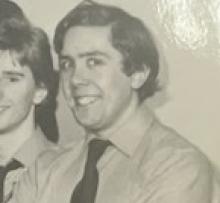
0.00 - The Interviewer welcomed the Respondent to the project and began by asking where he was born and raised, to which he replied that he was born in Edinburgh.
He was then asked how he became involved with the 30th Craigalmond Scout Group. He explained that he, along with Dave Briggs and his older brother Stephen, had previously been Scouts in a Troop based at Holy Cross Church, beside Davidson’s Mains Park.
“They had a small Scout Hut, which has been demolished, and I think two patrols in that and it merged probably after six to nine months of me being there with the 30th Inverleith, so we all kind of trooped across and came here, which by time had, I don’t know, six to eight patrols.”
1.34 - He went on to explain that by this time, the 30th had moved from their Scout Hall on Main Street to their current premises on Quality Street Lane. The Interviewer asked what it was like to join an already established Group.
“You went with friends, and as I say, we had started at the other church, and this was a separate group, and when we came across, we just came across as two extra patrols into that group, and yeah, you just accept it.”
2.25 - The Interviewer asked if he remembered the name of his patrol, and he thought it had been the Kestrels.
When asked whether he had friends in that patrol, he explained that although he had lost touch with many of them, he could still recall a few names. He noted that many members of the Group had attended the Royal High School, while others, like him, went to Stewart’s Melville College. Most, he said, were from nearby areas such as Davidsons Mains and Barnton.
He briefly attended a Cub Pack in Cramond but didn't stay long, although he wasn’t sure why.
The Interviewer then asked what kinds of activities he remembered doing as a Scout.
“I mean this hall has changed. It’s a lot cleaner and, you know, more pristine because everything bounced off the wall. The walls, as remember them, were brick, and you had the heaters and the lockers around the edge. And you have a lot of ball games or British Bulldogs or things like that running up and down. So, it’s a good deal of wear and tear on this one. First Scout Camp was on Cramond Island, and that was fairly disastrous. We sailed out from Cramond before, this would be before joining, I suspect, so we sailed out and set up the camp on the island and tried to avoid the rats. I suppose it was the first camp, and I tried to tidy the tent, wasn’t a good idea - put all the clothes at one end of the tent - it looked very neat – nobody found their clothes in the morning, they got all mixed up. I’d spent quite a lot of time with a candle trying to read in the evening, candle got its wax on everything and it's quite difficult to get out of parkas and such, so it was – yeah, but good fun [laughs]
Interviewer: How old would you have been?
Respondent: 9 or 10, something like that.”
5.30 - They spoke a little more about this before he explained that he and the other patrol members who had transferred from the previous Group quickly settled in with the 30th.
After completing his time as a Scout, he later returned for a short period as a leader before starting university.
The Interviewer then steered the conversation back to his Scouting days and asked what he remembered of a typical Scout evening.
“I'm assuming now it started about 7 o’clock, I may be wrong. But you know, in the summer you might be outdoors and doing things, so we might be talking about going up to the quarry on Corstorphine Woods and doing abseiling or something like that. Or you might have games that you had in the park at different points in time, most of them were inside because it was through winter.
And what did we have? I suppose I remember the games more than the educational bit. Although looking back now, you learn a great deal on orienteering, map reading, doing things in a practical sense, which has been, I think, really useful in later years.”
7.36 - The Respondent went on to recall that, as a Scouter (Scout Leader), he sometimes found it challenging to come up with new and varied activities for the Group each week. The activities that stood out most clearly in his memory were night hikes, expeditions, and camps, which he remembered more vividly than other events, such as Bob-a-Job.
He was then asked whether he remembered much about the Scout uniform, to which he replied that he did. He described it as a green uniform with a brown and purple necker. He then produced his Scouter uniform and explained the standard Scout Leader trousers and belt, noting that the belt also functioned as a bottle opener.
He was subsequently asked what had motivated him to return to the Group as a Scouter.
“I pretty well stayed on, I suppose I was a Venture Scout, then was asked would I stick around and provide extra.
Interviewer: What made you say yes to that?
Respondent: It's just kind of an evolution, you knew everybody and there no good reason to say no.”
10.19 - There was further discussion about Venture Scouts within the 30th Group, who remained involved to support the younger sections as Scouters. He recalled the frustration of trying to encourage people to assist with activities, although he himself continued to be involved, particularly with camps and driving the minibus. However, as the demands of University increased, he eventually had to step back from his role. He served as a Scout Leader for approximately two to three years.
The Interviewer then asked about how Scout evenings were planned by the leadership team.
“That's a good question. not one I can actually picture now. But yeah, trying to come up with new things and the preparation for it and not just go back into a routine that kind of makes it seem same old as was something but then thinking up something new each week was, I thought, a challenge. So I took my hat off to all the people who had done it beforehand and made it enjoyable fun.”
13.17 - The Respondent was then asked if the Scouts had any participation in the planned activities or games.
“Well, there are certain things they almost used to want to go for, like, you know, certainly when I was younger, people would always be wanting things like British Bulldogs at the end of the night, and which would involve running down into each other, straight down the hall, and it was quite physical. But in general, no, I think they left it to be provided by whatever was, was organised.”
13.56 - The Interviewer brings the conversation back to the difficulty leaders faced trying to find volunteers to help with bigger activities and asked what he thought the reasons for this could be.
“I mean, that's interesting, I think it changed over time at the expectation of what is there.
And you can kind of see it in the evolution of the picture, I think, of Scout camping more spartan or basic and then as you moved into the 80s it becomes more sophisticated expectations and competition, from people as such and sometimes it gets frustrating that you thought, are we dealing with middle class kids and parents who want it all kind of laid on - more regulation and all the rest of it, but are less willing to go out and do things and take part and volunteer and all the rest of it.
I knew that was the frustration that was just building up, partly because you felt it was a kind of relentless job of sounds very negative, but just you know, at times there's a frustration that you, you know, you're having to do all the work to get people out there, rather than they're enthusiastically wanting to say right, let's go and do something or that which I mean, I can remember usually we've got a lift from David's parents coming down, but you know, we walk from Barnton to events here or walk back quite happily, and latterly you got an expectation that, you know, you didn't have to do that, and it's probably true for us as well. I just don't think about you when you're on the other side.”
16.15 - The Interviewer changes the conversation to discipline and asks the Respondent how strict the Scouter were when he was a leader about uniforms.
“Well, everybody was expected to turn up in uniform when I was a Scout or when I was a Leader. Yeah, the Scout Shop sold the uniform up near the King’s [Theatre] That was it. That's where you got the uniform. The badges of course came separately.
Interviewer: I take it you did a sort of inspection each evening, and how strict was that? And did you notice a difference from when you were a Scout to when you were a Leader?
Respondent: I don't remember them being desperately strict. It was more about fun than anything, but there was an expectation of uniform, and which has probably loosened over the years, partly because of the expense. That becomes a barrier to people; now you don't have that, but at that point, it's the same in school and everything else; it was more restricting. Although you look at some of the pictures of the hairstyles and the size of the shoes and all the rest of it.”
17.39 - The Interviewer then turns the conversation to the changes in attitudes of the parents and young people towards Scouting over the years.
“I'm sure there is less, whether it's respect or discipline or whatever. Although maybe everybody, you know, it's natural, and people have always pushed the limits on whatever, and you don't just see it. But yes, I really can’t say that I noted a colossal difference in the way people, in their attitude or whatever. I suspect it comes down to leadership skills, and if somebody inspires you and leads, you're happy enough to follow. You can get people who push back and say, ‘I'm not doing this’ or ‘I'm not doing that’ or ‘You can't do this for me’. ‘You can't tell me that. And I remember that at camp, you know, we went to camp and somebody in your patrol - they say ‘I don't do washing up at home - I'm not going to be washing up here.’ And you're kind of sitting there saying, ‘you're not going to get much food either.’ But in general, part of the scouting is to teach you to fit in and work as a team.”
19.14 - The Interviewer asked how leaders dealt with Scouts who challenged or pushed back within the Group. He explained that such issues were initially managed within the patrols, but if that approach was unsuccessful, a leader would intervene. He recalled that, during camps, some Scouts occasionally struggled or failed to contribute fully, which could be frustrating as it often created unnecessary tension. In these situations, the challenge was to find an effective way to encourage the young person to become more engaged.
He believed this behaviour was sometimes due to the Scout being unhappy and, in some cases, simply wanting to go home.
Overall, however, he felt that most Scouts were keen to participate, contribute to what needed to be done, and enjoy themselves.
He was then asked whether many Scouts completed their Scouting journey.
“Yeah. Most people continued through because your friends are there and you're doing interesting things, and quite a lot went on to Venture Scouts, inevitably, it's a smaller group.”
22.13 - The Respondent was asked what camps he recalled
“I didn't do camps in my first probably three years, so I missed out on some of the ones where we all got a lorry and went off. I was certainly at Lochearnhead, which I think was 1980. We were at Stank Farm, which is just outside Calendar, so named because it's a bog with an awful lot of midges. Where else do we go? Hunam, which is down right almost at the start of the Pennines down near Yetholm in the Borders. Abbey St Bathans, which is over the hills from Gifford, again heading south.
Interviewer: And do you remember much about the accommodation, was it tents?
Respondent: Yes, tents. Yes, all of us were in tents; each patrol had a tent.
Interviewer: What about cooking and activities? How was that divided?
Respondent: We did our cooking, usually as a patrol. So quite often, I think, Ken and Alison [Thomson] would prepare the menus and the rations that we were all going to deal with, and then we had to do that as a patrol and usually feed one of the Scouters, lucky them [laughs].”
25.32 - The Interviewer asked how leaders were selected to have patrols cook dinner for them at camp. The Respondent explained that this usually rotated, although not every patrol would cook for a leader, as there were typically more patrols than Scouters. He was then asked whether he could recall any activities or rituals that took place during camps.
“Certainly, you know the night hikes and the various things that you did, that involved... there was one up at Loch Venacher, and we trekked up a good 20 miles over the hills to Rob Roy’s Grave, and such. You saw some really interesting places, and I think learnt a lot about yourself in doing these things. Building competitions,building rope bridges and aerial runways, these sorts of things that come to mind. The more mundane things about camp, I struggle to remember.
Interviewer: But the sort of bridge building and things like that, were They [in] patrols, or was that as a whole group?
Respondent: Probably as a whole group. Some of the things [in patrols] where you’re building something over a stream, or it will be a competition to do things. Of course, different games – wide games, tug of war, whatever, these things.
Interviewer: And were the patrols quite competitive?
Respondent: Well, yes, you’re all trying to...and that goes for the inspections, it goes for the games, it goes for a whole variety of things.
Interviewer: And was it a points system you worked for, or was it each activity awarded?
Respondent: It was fifty years ago, and I can’t remember who won either [laughs]”
26.23 - The conversation continued with a discussion of a similar points-based competition between patrols for activities held during regular Scout meetings. He was then asked whether he could recall taking part in any Gala or Remembrance parades as a leader. While he did not remember these clearly, he did recall attending the Gang Show, although he was never a participant. He then went on to talk about Bob-a-Job Week.
“An annual chore with a whole variety of different... Some people who took the complete loan of you and some people who were, I suppose, extremely tolerant and keen to participate in making it a charitable exercise in earning things. You had a wee book that you had to fill in on various things and all that. And then I can remember various charitable fundraising things that we did, where, and it may have been Bob-a-Job, or it may be something else, that you had to go round the houses and try and raise some funds for things by doing things.
Interviewer: Do you remember any of the things that you would do? Either Bob-a-Job or other fundraising?
Respondent: I remember the gardening usually, you know, a shilling for an hour’s gardening and such, but yeah, I mean, people would get you to do things, whether it's sweeping or whatever it was, but generally fairly basic physical activity.
Interviewer: Was it people you knew, or were you literally knocking on doors?
Respondent: You would go to your neighbours, but sometimes, where we were, we went slightly further afield, and you know you'd go to streets within - I don't know, half a mile or so, and no, it wasn't people you necessarily knew, just tried it, because otherwise you’d all tramp around in the same groups.
Interviewer: And you did that individually?
Respondent: On your own.
Interviewer: You didn’t meet up with David.
Respondent: No, no, nope, you did it a way you don’t do it today and probably couldn’t do it today.”
29.32 - The Interviewer asks if he can remember any other community activities or events, to which he recalled jumble sales and talks a little about this.
“You had queues of people outside there [points to Scout Hall] waiting and trays of tables that were layered with stuff which you’d collected, cause you’d go round the street collecting stuff with a hand cart in the weeks before, and you ended up with an awful lot of junk at the end.
Interviewer: So what kind of things were you collecting, was it clothes or games or anything?
Respondent: Anything.”
30.38 - The conversation continued with a discussion about the jumble sale, where he explained that the Scouts were likely involved in setting up and helping to sell the goods. When asked what the money raised was used for, he believed it went directly to support the Scout Group - perhaps to purchase tents or other equipment. He could not recall whether funds were ever raised for local charities. He was then asked whether he felt a sense of accomplishment in his role as a leader guiding young people.
“I think actually of specific moments, other than actually it's creating something, which the kids enjoyed and which you enjoy. And I got a lot out of it, and you probably wanted to put some of that back. Specific things and achievements... I suspect it was more...either organising a camp or achieving something by saying ‘We're going to do these hills, these mountains.’ you know, because you got some real interesting challenges and trips. I remember one time we went off by train to climb the Cobbler at Arrochar, and they held the train for us in Glasgow, and off we went up the hill. As I look at it now, I'm sitting there saying, we took the train from here to Glasgow, the train to Arrochar, we then walked from the station, and it's a couple of miles before you get to the foot of the mountain, and then we walked up the mountain and walked back down and got the train home. That which is, you know, not something I'd have done if the Scouts hadn't pushed me, and I hope other people feel that some of the things that we did laterally just extended their horizons.”
33.32 - The Respondent then talks about his own personal growth and skill set because of being in the Scouts.
“It made you far more self-sufficient and capable, although you probably didn’t realise it at the time.”
33.45 - The conversation continued as he spoke about how his love of map reading, compass work, and orienteering had developed through his time in Scouts.
When asked for his views on the current Scouting movement, he reflected that young people today appear to be more independently minded, whereas Scouts in the 1960s and 1970s were generally more willing to accept direction.
He said that he would encourage young people to join the Scouts and was then invited to share any final thoughts or memories. He spoke about keeping in touch with several former Scouts and occasionally meeting people who still remembered him as a Scout Leader. He expressed the hope that he had made a positive impact on their lives during their time with the 30th.
The Respondent was then thanked for sharing his memories and reflections on his years with the Troop.